


Ma Ying-jeou’s (馬英九) “6-3-3” campaign promise to revive the economy must haunt him. Or should we say, it would have haunted “Ma the incompetent” if he were a president who felt responsible for the truth, accuracy and sincerity of what he says.
Unfortunately, many Taiwanese don’t have that opinion of the president. Even the foreign media are starting to catch on to the two-faced facade that he and his PR team have built in the past decade. But that is not the point here; it seems that Ma has acquired a new moniker among Taiwanese: “Ma the fawner.”
“Ma the incompetent” is a well deserved title given his lackluster record as mayor of Taipei as well as the many boondoggles that happened under his watch. But why are people beginning to call him “Ma the fawner”?
This is not a recent occurrence. There were hints when he was mayor of Taipei, but it has intensified since he became president. As a result, a debate is developing. Has Ma become a fawner because he is desperate to bring the economy at least close to the level it was under former president Chen Shui-bian (陳水扁) and before it tanked under his administration? Does Ma feel that the People’s Republic of China (PRC) is his only hope? Or has he always been a fawner because he ultimately believes the “one China” myth that both the PRC and the Republic of China (ROC) have jointly been trying to foist on the Taiwanese and that he needs the PRC’s help on this?
Ma claims he was elected on the promise to improve the economy; that is true, for that was the point of his exaggerated 6-3-3 promise (an annual GDP of 6 percent, per capita income of US$30,000 and an unemployment rate of below 3 percent). However, it is not true, as Ma claims, that he was elected because he promised to improve the economy through increased contact with and dependence on the PRC. That second part has been tacked on by his staff and is used as an excuse to explain his fawning ways.
Ma has countered criticism by claiming that cross-strait ties have improved. But have they? To be sure, China has been quiet, but it has no reason to speak out as Ma jumps at its slightest suggestion. If a potential problem appears on the horizon, all China has to do is hint that its feelings are hurt and Ma rolls over and plays dead.
A visit by exiled Uighur leader Rebiya Kadeer? No way; she is a terrorist in Beijing’s eyes. Should there be a national day parade? An excuse is found to cancel that. Should the nation’s flag be shown at international events held in Taiwan? Not if the PRC is there. Should the human rights of Taiwanese nationals be suppressed to avoid offending a visiting low-ranking PRC official? Why not?
However, what is more surprising is the fact that it is not just green voters that are suspicious of Ma; the true supporters of the ROC — not just its profiteers — feel he is betraying them as well. With a long history of fighting Communist control, they wonder why Ma almost appears ashamed to stand up for the ROC before the PRC. For although at times Ma will invoke the outmoded Constitution of the ROC in the strangest of circumstances, when the PRC is involved it seems Ma has never heard of it.
If Ma had a reputation for competence, there would be a potential reason to give him some benefit of the doubt in his dealings with China, but Ma’s past performance and his proclivity to never accept responsibility are his own condemnation. More and more people wonder what secret deals are being worked out in the proposed economic cooperation framework agreement with China.
All this gives rise to the question that is increasingly on the minds of many: Why is Ma being such a fawner?
Jerome Keating is a writer based in Taipei.
Minister of Labor Hung Sun-han (洪申翰) on April 9 said that the first group of Indian workers could arrive as early as this year as part of a memorandum of understanding (MOU) between the Taipei Economic and Cultural Center in India and the India Taipei Association. Signed in February 2024, the MOU stipulates that Taipei would decide the number of migrant workers and which industries would employ them, while New Delhi would manage recruitment and training. Employment would be governed by the laws of both countries. Months after its signing, the two sides agreed that 1,000 migrant workers from India would
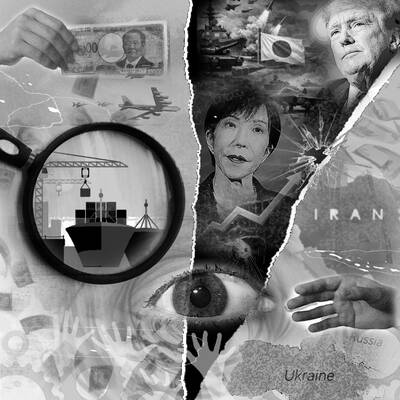
Japan’s imminent easing of arms export rules has sparked strong interest from Warsaw to Manila, Reuters reporting found, as US President Donald Trump wavers on security commitments to allies, and the wars in Iran and Ukraine strain US weapons supplies. Japanese Prime Minister Sanae Takaichi’s ruling party approved the changes this week as she tries to invigorate the pacifist country’s military industrial base. Her government would formally adopt the new rules as soon as this month, three Japanese government officials told Reuters. Despite largely isolating itself from global arms markets since World War II, Japan spends enough on its own
On March 31, the South Korean Ministry of Foreign Affairs released declassified diplomatic records from 1995 that drew wide domestic media attention. One revelation stood out: North Korea had once raised the possibility of diplomatic relations with Taiwan. In a meeting with visiting Chinese officials in May 1995, as then-Chinese president Jiang Zemin (江澤民) prepared for a visit to South Korea, North Korean officials objected to Beijing’s growing ties with Seoul and raised Taiwan directly. According to the newly released records, North Korean officials asked why Pyongyang should refrain from developing relations with Taiwan while China and South Korea were expanding high-level
When 17,000 troops from the US, the Philippines, Australia, Japan, Canada, France and New Zealand spread across the Philippine archipelago for the Balikatan military exercise, running from tomorrow through May 8, the official language would be about interoperability, readiness and regional peace. However, the strategic subtext is becoming harder to ignore: The exercises are increasingly about the military geography around Taiwan. Balikatan has always carried political weight. This year, however, the exercise looks different in ways that matter not only to Manila and Washington, but also to Taipei. What began in 2023 as a shift toward a more serious deterrence posture


 RSS
RSS