


In his article “Good education, made in Taiwan” (July 9, page 8), Bill Costello suggests ways that the US could learn from Taiwan’s educational system. Costello raised some excellent points, but I would caution against the suggestion that Taiwan serve as a model for education in the US.
Costello notes that Taiwanese students do well in math and science, but what about other crucial subjects?
Taiwanese students do well where rote learning is involved, but their independent thought and critical thinking skills leave much to be desired.
Ask a child to add numbers or repeat information and you’ll be amazed at their performance. But ask that same child to form an opinion or draw a conclusion about something and you’re likely to be met with a blank stare.
Students are taught to regurgitate information and are not encouraged to ask questions or apply logic to deduce things for themselves. Tests do not challenge their capacity for creative thinking, but rather check what they have memorized.
Costello suggests the US serve more nutritious lunches, keep students more active and use hands-on interdisciplinary learning. These are all great suggestions, but he also says the US should adopt the practice in Taiwan of requiring public school students to wear uniforms.
Making students don uniforms fits in with the simple input-output instruction employed at Taiwanese schools. Although Costello doesn’t mention it, each student is assigned a number. Students don’t have their names stitched onto their uniforms but their numbers.
This has the effect of discouraging individuality and independent thought. If this is our goal, school uniforms are a superb idea. But if that’s not what we’re shooting for, it is difficult to imagine what benefit uniforms could possibly bring.
Costello writes: “Studies show that school uniforms raise academic performance, while lowering violence, theft and the negative effects of peer pressure.”
I’m skeptical of this claim. What studies is he referring to and what methodology did they employ? How did they eliminate the countless variables that affect academic performance?
The suggestion that putting your son or daughter in a uniform increases his or her chances of performing well at school is ridiculous.
Likewise, we should not think students’ misbehavior is the result of allowing them to choose their own attire.
As for peer pressure, this is part and parcel of the experience of growing and learning, and prepares children for the “real world.”
Costello suggests Taiwanese students are taught more personal responsibility than their US counterparts, citing as evidence the daily cleaning ritual at schools. The question is whether they practice “personal responsibility” outside that ritual.
Students in my new classes have tended to be so messy that I had to clean up the classroom after every lesson. But my students were not incurable. I instilled a sense of responsibility in them not through a cleaning “ritual,” but by asking mess students questions such as how they would feel if the student who used their desk before them had left used tissues in it.
I explained the importance of respecting our shared space and each other. I discussed how our actions affect others, challenged students to think of examples and demonstrated the practicality of applying the golden rule in their daily lives.
When you speak to children as equals, allow them to express themselves, foster their curiosity, promote critical thinking and seek their opinions, the results are truly rewarding.
The effects of doing the opposite are less than desirable.
I agree with Costello that US schools need improvement and Taiwanese schools perform better in some respects. However, Taiwan’s educational system is in dire need of attention before we start touting it as a model for others.
Jeremy R. Hammond has taught English as a second language in Taiwan for seven years.

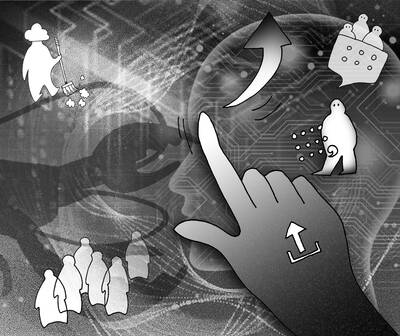
Weeks into the craze, nobody quite knows what to make of the OpenClaw mania sweeping China, marked by viral photos of retirees lining up for installation events and users gathering in red claw hats. The queues and cosplay inspired by the “raising a lobster” trend make for irresistible China clickbait. However, the West is fixating on the least important part of the story. As a consumer craze, OpenClaw — the AI agent designed to do tasks on a user’s behalf — would likely burn out. Without some developer background, it is too glitchy and technically awkward for true mainstream adoption,
On Monday, the day before Chinese Nationalist Party (KMT) Chairwoman Cheng Li-wun (鄭麗文) departed on her visit to China, the party released a promotional video titled “Only with peace can we ‘lie flat’” to highlight its desire to have peace across the Taiwan Strait. However, its use of the expression “lie flat” (tang ping, 躺平) drew sarcastic comments, with critics saying it sounded as if the party was “bowing down” to the Chinese Communist Party (CCP). Amid the controversy over the opposition parties blocking proposed defense budgets, Cheng departed for China after receiving an invitation from the CCP, with a meeting with
Chinese Nationalist Party (KMT) Chairwoman Cheng Li-wun (鄭麗文) is leading a delegation to China through Sunday. She is expected to meet with Chinese President Xi Jinping (習近平) in Beijing tomorrow. That date coincides with the anniversary of the signing of the Taiwan Relations Act (TRA), which marked a cornerstone of Taiwan-US relations. Staging their meeting on this date makes it clear that the Chinese Communist Party (CCP) intends to challenge the US and demonstrate its “authority” over Taiwan. Since the US severed official diplomatic relations with Taiwan in 1979, it has relied on the TRA as a legal basis for all
A delegation of Chinese Nationalist Party (KMT) officials led by Chairwoman Cheng Li-wun (鄭麗文) is to travel to China tomorrow for a six-day visit to Jiangsu, Shanghai and Beijing, which might end with a meeting between Cheng and Chinese President Xi Jinping (習近平). The trip was announced by Xinhua news agency on Monday last week, which cited China’s Taiwan Affairs Office (TAO) Director Song Tao (宋濤) as saying that Cheng has repeatedly expressed willingness to visit China, and that the Chinese Communist Party (CCP) Central Committee and Xi have extended an invitation. Although some people have been speculating about a potential Xi-Cheng


 RSS
RSS