


Last month Richard Holbrooke, the US state department’s special representative, met students from Pakistan’s northwest tribal areas. They were enraged by drone attacks, which — according to David Kilcullen, counter-insurgency adviser to US General David Petraeus — have eliminated only about 14 terrorist leaders while killing 700 civilians. One young man told Holbrooke that he knew someone killed in a Predator drone strike.
“You killed 10 members of his family,” he said.
Another said that the strikes had unleashed a fresh wave of refugees.
“Are many of them Taliban?” Holbrooke asked.
“We are all Taliban,” he replied.
Describing this scene in Time, Joe Klein said he was shocked by the declaration, though he recognized it as one “of solidarity, not affiliation.” He was also bewildered by the “mixed loyalties and deep resentments [that] make Pakistan so difficult to handle.” One wishes Klein had paused to wonder if people anywhere else would wholeheartedly support a foreign power that “collaterally” murders 50 relatives and friends from the air for every militant killed.
Much has been made of Pakistan’s “denial” about the threat posed by the Taliban rather than India; correspondingly, western politicians and commentators have applauded the Pakistani military operation in Swat valley that has exposed 3 million people to what Human Rights Watch calls a humanitarian catastrophe. Relatively little attention has been given to the US’ more damaging evasion of the fact that most people in Pakistan, a “frontline” country in the war on terror, are unsympathetic if not actively hostile to it.
Political bitterness rather than racial or religious supremacism fuels this variant of anti-Americanism. Twice in three decades the US has enlisted military dictators in Pakistan to fight its battles — most damagingly in the cold war when, as US President Barack Obama conceded recently in Cairo, the US heedlessly deployed Muslims as proxies against Soviet communism. Many Pakistanis remember how the blowback from the CIA’s anti-Soviet jihad in Afghanistan (millions of Afghan refugees, a rampant Kalashnikov “culture” and the rise of Islamic fundamentalism) ravaged their country, years before it crashed into the US itself on Sept. 11, 2001. Pakistanis now accuse the US, again not unreasonably, for pursuing its failed war on terror in Afghanistan into Pakistan, reinvigorating the extremists it had helped to spawn.
Though beholden to US aid, Pakistan’s civilian-military elite has been naturally reluctant to fight too hard to redeem the blunders of an overweening and unreliable ally; covertly supporting extremist groups, elements in the army and intelligence have tried to maintain their room for maneuver in both Afghanistan and Kashmir. Occasionally, as in Swat and now again in Waziristan, intense US pressure yields a military assault. It can even attract a degree of public support, as most Pakistanis are appalled by the brutality of Talibanized Pashtuns.
But this does not amount to popular endorsement of drone attacks. Last month Indian-born US journalist Fareed Zakaria told Jon Stewart on the Daily Show that Pakistan was emerging from its state of denial since his Pakistani friends, who previously opposed the drone attacks, now tell him: “You know what? If that’s the only thing that will work, kill those guys.”
Some members of Pakistan’s tiny elite, where Zakaria’s native informants come from, may long to exterminate the brutes: They fear, often correctly, Islamic extremists as embodying the rage and frustration of the country’s underprivileged majority. But as the suffering of civilians in Swat becomes known, the highly qualified public support for military action will wane quickly.
Certainly, claims of success in Swat are premature. The Taliban may vanish in order to regroup as they did after their apparently decisive defeat in Afghanistan in 2001. Furthermore, the refugee crisis can only strengthen the Taliban. Their pied pipers of jihad, nursed on hatred in refugee camps, will easily recruit suicide-bombers among the freshly uprooted millions. Pakistan will suffer many more attacks of the kind we have seen in recent days.
But all is not lost. The idea that Pakistan, with its ethnically and politically diverse population of Punjabis, Sindhis and Balochs, is ready to surrender to fanatics led by Pashtuns is a paranoid fantasy — easily dispelled by the briefest scrutiny of structures of religious and political power, and indeed recent election results in any region of Pakistan.
As Pakistani author Mohsin Hamid recently pointed out, Pakistan’s apparently failed state is more than capable of dealing with violent extremists if it can sort out its mixed loyalties. Institutionally distrustful of the US, which recently turned India into its main Asian ally with an extravagant nuclear deal, Pakistan has continued to incite extremists against the US-backed, pro-India regime in Kabul and Indian interests in Kashmir. However, much of the strength of the duplicitous intelligence agency, the ISI, derives from its claim to protect what even moderate Pakistanis regard as their country’s legitimate interests in Afghanistan and Kashmir — national interests that, as Obama partly admitted in Cairo, the US’ overriding geopolitical priorities have often rendered illicit, driving them underground.
The US has the opportunity to shrink the ISI’s malign role and redeem its standing among Pakistanis by urging India and Pakistan to a comprehensive political solution in Kashmir and by explicitly acknowledging that Pakistan, which shares a long border and a large Pashtun population with Afghanistan, will never tolerate a hostile ruler in Kabul, especially if backed by India.
Abandoned by their US allies after the anti-Soviet jihad, some of Pakistan’s megalomaniac generals sought “strategic depth” in Afghanistan against India; even their sober successors are unlikely to affect indifference to their volatile neighbor. Having grudgingly admitted Iran’s influence in Iraq, the US will eventually have to trust Pakistan to control its proxies in Afghanistan — a crucial component of any “regional” solution. The US can reasonably expect responsible behavior from Islamabad only if — as with Iran — it treats Pakistan as a power with inalienable interests, rather than as a nuclear-armed “rogue” state. Obama could then expedite the inevitable task of drawing up a timetable for the withdrawal of combat troops from Afghanistan.
Deprived of their main antagonists, the Taliban are unlikely to collectively embrace Sufism. But ending the occupation of Afghanistan would dry up their main source of legitimacy and support and undermine their loose alliance with al-Qaeda. It is no accident that Afghan Pashtuns have not been implicated in any international terrorist conspiracies even as many of them fight NATO troops in Afghanistan. The Obama administration should consider the possibility that, as Graham Fuller, the CIA’s former station chief in Kabul puts it, few Pashtuns “will long maintain a radical and international jihadi perspective once the incitement of the US presence is gone.”
Obama came to power, however, promising to exert brawn in Afghanistan rather than Iraq. Even his harshest Republican critics, including former US vice president Dick Cheney, have applauded his recent military “surge.” Admiral Mike Mullen, the US joint chief of staff, admitted that intensified action in Afghanistan could push the Taliban deeper into Pakistan, further destabilizing the country. Whether Obama, who is probably aware of the dangers of turning the Taliban into Pakistan’s Khmer Rouge, can break out of his hard-line posture remains to be seen.
Pankaj Mishra is author of Temptations of the West: How to Be Modern in India, Pakistan, Afghanistan and Tibet.
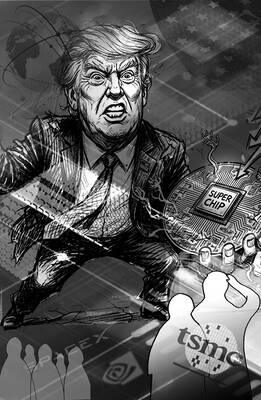
The White House’s decision to take a 9.9 percent stake in Intel Corp is looking like very shrewd business indeed. Since the government bought in at US$20.47 a share last August, the US chipmaker’s surging stock price has delivered the US a US$43 billion return. One of the reasons the investment has so far proved so sound is that the White House has made sure of it. According to The Wall Street Journal, Howard personally pushed deals on Intel’s behalf with some of the most lucrative clients imaginable. They include Nvidia Corp, the company at the heart of the AI
A single photograph can cut through a lot of noise, but it can also be used to misrepresent the truth. At the very least, it can concentrate the mind on something that requires further investigation. On Monday last week, Ma Ying-jeou Foundation CEO Tai Hsia-ling (戴遐齡) and former National Security Council secretary-general King Pu-tsung (金溥聰) held a news conference in which they showed a photograph of former foundation CEO Hsiao Hsu-tsen (蕭旭岑), now Chinese Nationalist Party (KMT) deputy chairman. In the image Hsiao is seated next to Xiamen Taiwan Businessmen Association chairman Han Ying-huan (韓螢煥). The two men were holding
I first met Professor Ray Jiing (井迎瑞) as a film and documentary student at Shih Hsin University’s (SHU) Department of Radio Television and Film in 1988. The following year, he went on to become the director of the Chinese Taipei Film Archive — forerunner of the Taiwan Film and Audiovisual Institute (TFAI). Over his eight-year tenure, Jiing rescued and restored over 200 classic Taiwanese films. In 1997, he established the Graduate Institute of Studies in Documentary and Film Archiving at Tainan National University of the Arts (TNNUA), and I joined the program in his third cohort of students. Beyond a
A recent report concerning a student who is suing his teacher posed the question in its headline: Does failing a student in two subjects constitute bullying? The college student in Chiayi County apparently sought NT$2 million (US$63,603) in state compensation, but a court dismissed the case. The first reaction of many might have been to ask: What has happened to students nowadays? Some say that teachers have lost their authority, while others say students are overindulged. Some even start reminiscing over the days when “whatever the teacher says goes.” However, the real issue might be overlooked if emotional reactions like that are the


 RSS
RSS