

Chiang Pin-kung ‘misquoted’
The front page story about SEF [Straits Exchange Foundation] Chairman Chiang Pin-kung (江丙坤) (“SEF head regretful over son’s PRC ties,” April 15) misquotes the statement that the SEF issued on Tuesday. Chairman Chiang and his family never abused his position to secure any business for themselves, so in his mind what he feels regretful is particular media reports based on fake information which could potentially do disadvantages to future cross-strait talks.
SHAW-CHANG MAA
Deputy Secretary-General,
Straits Exchange Foundation
Ending reef madness
The coral reefs and aquatic species of Kenting, Green and Orchid islands and others in Taiwan are a precious eco-system worth saving. The causes of coral destruction and marine species depletion over the past decade have been manifold. Overfishing, sustained high sea temperatures, irresponsible tourism and run-off pollution all contribute to dwindling fish populations and coral reef destruction.
It’s a crying shame that the Taiwan government doesn’t step up its efforts to enact and enforce more conservation legislation.
As Taiwan aspires to gain a greater market share of tourism in Asia this is especially crucial. As a dive master and local guide, I have witnessed firsthand the devastation of local reefs over the last decade.
Although the task at hand is enormous, a primary step in saving our island’s precious coral ecosystem is to promote education. We should let every aquatic enthusiast know that when swimming, diving or snorkeling that they should: “Take nothing but pictures and leave nothing but bubbles.”
It is essential that everyone realizes that coral reefs provide shelter for approximately one quarter of all marine life and that to date over 11 percent of coral reefs have already been totally wiped out. At the current rate of coral destruction, 40 percent of reefs worldwide will cease to exist by the end of next year.
The effects of reef destruction will spark a chain reaction that will affect local fisheries, increase unemployment and cause the extinction of many unique and wonderful marine creatures.
When splashing around and enjoying the many wonders of exploring the underwater world, remember these basic rules: Dive responsibly and maintain good buoyancy to stay off the coral. Coral reefs take years to form and only seconds to die.
Some corals may also be quite dangerous to come in to contact with.
Don’t take or buy coral souvenirs, ensuring that people don’t profit from the intentional destruction of reefs.
When lazing around the beach, take time to make sure you don’t leave anything behind that could wash into the ocean. Waves and surf pummeling litter against coral can kill these delicate organisms.
Sign up to coral reef conservation Web sites and newsletters to stay informed and lobby your local government representatives to promote laws that increase conservation efforts and protect our marine resources.
It’s not too late to reverse the trend of reef destruction in Taiwan. Everyone can do their part. Let’s save the reefs and marine organisms so that future generations can enjoy them.
PAUL OLIVER
Kaohsiung

Taiwan’s democracy and high-tech economy play a crucial role in global affairs and are central to the world’s embrace of a raft of next-generation technologies, including AI. It is underpinned by a security relationship with the United States that’s existed in several iterations since 1949 and the Chinese Nationalist Party’s (KMT) retreat from China. A central pillar of that security relationship is the American willingness to sell arms to Taiwan. Indeed, since 1979 it has been embedded in US law, with the Taiwan Relations Act (TRA) charging the US with helping to improve the island’s ability to deter an attack from
Academia Historica director Chen Tsui-lien (陳翠蓮), speaking at the handover ceremony for her new role on Monday, said that when she accepted the position, she knew that her peaceful life as a history professor was a thing of the past, and that from now on she would have to “wear a helmet.” A specialist in Taiwan’s post-World War II history and the 228 Incident, she has been accused of being politically divisive. A phrase she used in her acceptance speech set headlines alight this week, putting her in the sights of editorials in blue-leaning media. She said opposition figures calling for
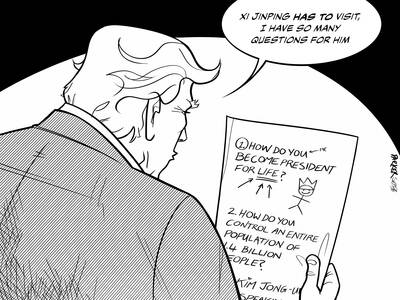
EDITORIAL CARTOON
When Panama severed diplomatic relations with Taiwan and recognized China in 2017, Beijing achieved one of its most important diplomatic victories in Central America. However, nearly a decade later, Panama is demonstrating that diplomatic recognition does not necessarily eliminate Taiwan from a country’s political system. Panama and Taiwan had diplomatic relations for more than 100 years and the goodwill between the countries was displayed last week when Panama’s National Assembly established an interparliamentary exchange group with the Legislative Yuan. Forty-five of the assembly’s 71 lawmakers joined the group, representing more than 60 percent of the legislature. Its members include National Assembly President Shirley


 RSS
RSS