


To paraphrase former British prime minister Winston Churchill, never have so many billions of dollars been pumped out by so many governments and central banks. The US government is pumping US$789 billion into its economy, Europe US$255 billion and China US$587 billion. The US Federal Reserve increased its stock of base money last year by 97 percent, the European Central Bank (ECB) by 37 percent. The Federal funds rate in the US is practically zero, and the ECB’s main refinancing rate, already at an all-time low of 2 percent, will likely fall further in the coming months.
The Fed has given ordinary banks direct access to its credit facilities, and the ECB no longer rations the supply of base money, instead providing as much liquidity as banks demand. Since last October, Western countries’ rescue packages for banks have reached about US$4.3 trillion.
Many now fear that these huge infusions of cash will make inflation inevitable. In Germany, which suffered from hyper-inflation in 1923, there is widespread fear that people will again lose their savings and need to start from scratch. Other countries share this concern, if to a lesser extent.
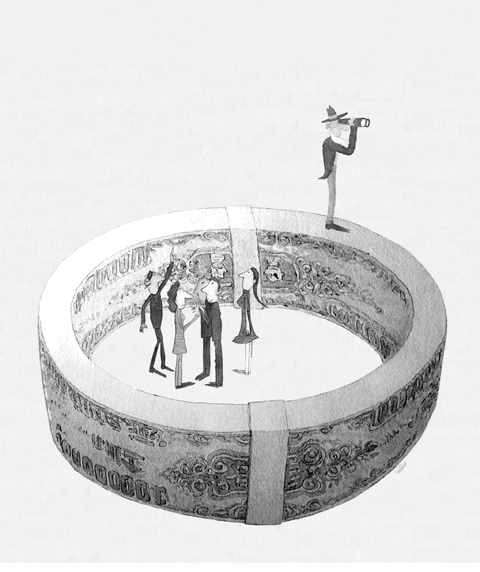
But these fears are not well founded. True, the stock of liquidity is rising rapidly. But it is rising because the private sector is hoarding money rather than spending it. By providing extra liquidity, central banks merely reduce the amount of money withdrawn from expenditure on goods and services, which mitigates, but does not reverse, the negative demand shock that hit the world economy.
This is a trivial but important point that follows from the theory of supply and demand. Think of the oil market, for example. It is impossible to infer solely from an increase in the volume of transactions how the price of oil will change. The price will fall if the increase resulted from growth in supply, and it will rise if the increase resulted from growth in demand.
With the increase in the aggregate stock of money balances, things are basically the same. If this increase resulted from an increase in supply, the value of money will go down, which means inflation. But if it resulted from an increase in demand, the value of money will increase, which means deflation. Obviously, the latter risk is more relevant in today’s conditions.
If the underlying price trend is added to this, it is easily understandable why inflation rates are currently coming down everywhere. In the US, the annual inflation rate fell from 5.6 percent last July to 0.1 percent in December, and in Europe from 4.4 percent last July to 2.2 percent in January.
At the moment, no country is truly suffering deflation, but that may change as the crisis deepens. Germany, with its notoriously low inflation rate, may be among the first countries to experience declining prices. The most recent data show that the price index in January was up by only 0.9 percent year on year.
This deflationary tendency will create serious economic problems, which do not necessarily result from deflation as such, but may stem from a natural resistance to deflation. In each country, a number of prices are rigid, because sellers resist selling cheaper, as low productivity gains and wage defense by unions leave no margin for lower prices. Thus, deflationary pressure will to some extent result in downward quantity adjustments, which will deepen the real crisis.
Moreover, even if prices on average exhibit some downward flexibility, deflation necessarily increases the real rate of interest, given that nominal interest rates cannot fall below zero. The result is an increase in the cost of capital to firms, which lowers investment and exacerbates the crisis. This would be a particular problem for the US, where the Fed allowed the Federal funds rate to approach zero in January.
The only plausible inflationary scenario presupposes that when economies recover, central banks do not raise interest rates sufficiently in the coming boom, keeping too much of the current liquidity in the market.
Such a scenario is not impossible. This is the policy Italians pursued for decades in the pre-euro days, and the Fed might one day feel that it should adopt such a stance.
But the ECB, whose only mandate is to maintain price stability, cannot pursue this policy without fundamental changes in legislation. Moreover, this scenario cannot take place before the slump has turned into a boom. So, for the time being, the risk of inflation simply does not exist.
Japan provides good lessons about where the true risks are, as it has been suffering from deflation or near-deflation for 14 years. Since 1991, Japan has been mired in what Harvard economist Alvin Hansen, a contemporary of Keynes, once described as “secular stagnation.”
Ever since Japan’s banking crisis began in 1990, the country has been in a liquidity trap, with central bank rates close to zero, and from 1998 to 2005 the price level declined by more than 4 percent. Japanese governments have tried to overcome the slump with Hansen’s recipes, issuing one Keynesian program of deficit spending after the other and pushing the debt-to-GDP ratio from 64 percent in 1991 to 171 percent last year.
But all of that helped only a little. Japan is still stagnating. Not inflation, but a Japanese-type period of deflationary pressure with ever increasing public debt is the real risk that the world will be facing for years to come.
Hans-Werner Sinn is a professor of economics and finance at the University of Munich and president of the Ifo Institute.
COPYRIGHT: PROJECT SYNDICATE
Taiwan’s higher education system is facing an existential crisis. As the demographic drop-off continues to empty classrooms, universities across the island are locked in a desperate battle for survival, international student recruitment and crucial Ministry of Education funding. To win this battle, institutions have turned to what seems like an objective measure of quality: global university rankings. Unfortunately, this chase is a costly illusion, and taxpayers are footing the bill. In the past few years, the goalposts have shifted from pure research output to “sustainability” and “societal impact,” largely driven by commercial metrics such as the UK-based Times Higher Education (THE) Impact
History might remember 2026, not 2022, as the year artificial intelligence (AI) truly changed everything. ChatGPT’s launch was a product moment. What is happening now is an anthropological moment: AI is no longer merely answering questions. It is now taking initiative and learning from others to get things done, behaving less like software and more like a colleague. The economic consequence is the rise of the one-person company — a structure anticipated in the 2024 book The Choices Amid Great Changes, which I coauthored. The real target of AI is not labor. It is hierarchy. When AI sharply reduces the cost
I wrote this before US President Donald Trump embarked on his uneventful state visit to China on Thursday. So, I shall confine my observations to the joint US-Philippine military exercise of April 20 through May 8, known collectively as “Balikatan 2026.” This year’s Balikatan was notable for its “firsts.” First, it was conducted primarily with Taiwan in mind, not the Philippines or even the South China Sea. It also showed that in the Pacific, America’s alliance network is still robust. Allies are enthusiastic about America’s renewed leadership in the region. Nine decades ago, in 1936, America had neither military strength
The Presidential Office on Saturday reiterated that Taiwan is a sovereign, independent nation after US President Donald Trump said that Taiwan should not “go independent.” “We’re not looking to have somebody say: ‘Let’s go independence because the United States is backing us,’” Trump said in an interview with Fox News aired on Friday. President William Lai (賴清德) on Monday said that the Republic of China (ROC) — Taiwan’s official name — and the People’s Republic of China (PRC) are not subordinate to each other. Speaking at an event marking the 40th anniversary of the establishment of the Democratic Progressive Party (DPP), Lai said


 RSS
RSS