


“Pomegrantes are the answer to all this,” said James Brett, as we drove past the colorless, mud-brick villages and makeshift graveyards that litter the parched landscape of Nangarhar Province. We were on our way to Markoh, a small village 40 minutes’ drive inside the Afghan border with Pakistan.
Brett first visited Markoh in April last year. On his way to a seminar in Kabul, he had asked the driver to stop the car so that he could speak to a reed-thin figure extracting opium from the poppies.
“My translator told me not to do it. He said ‘you’ll get shot,’ but I just felt like the first step had to be made that day,” Brett said.
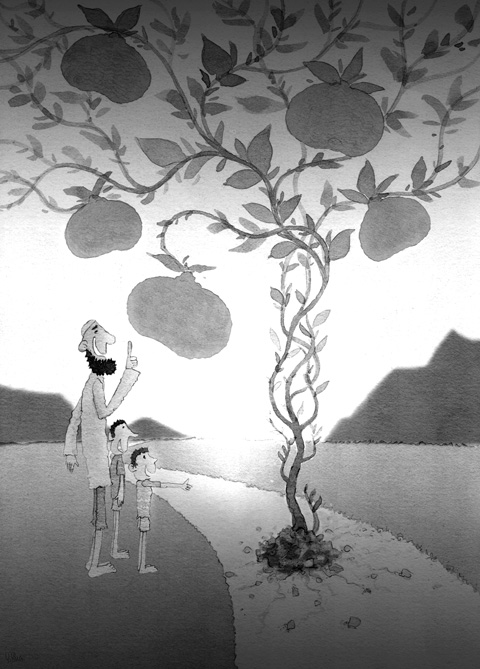
That “first step” was walking into the field to try to persuade the farmer to stop growing poppies and start growing pomegranates instead.
After the initial shock of seeing the large red-headed man striding through the field, the farmer agreed to stop cultivating poppies if Brett guaranteed to subsidize both him and his family until the pomegranate trees were grown and ready to harvest — a period of three to five years.
Having launched his pomegranate juice on to the UK market four years previously, Brett was keen to find good fruit and plough the profits into increasing production. His argument to the farmer that the crop would return two-and-a-half times what he got for the poppy harvest proved a compelling one.
Nangarhar — with a population of nearly 2 million people — is one of the more stable provinces in Afghanistan. The tribal chiefs of Helmand Province, the biggest producer of opium in the country, may be more difficult to convince. A UN survey found that Afghanistan cultivated 193,000 hectares of opium last year and now supplies 93 percent of the world’s opiates. The illegal trade is worth around US$2.6 billion a year to Afghanistan — one-third of the country’s GDP.
One year on, Brett was preparing to address a loyal jirga (grand assembly) of tribal chiefs from the 22 districts of Nangarhar Province to try to persuade them to follow the example of that first farmer.
As we reached Markoh, the car slowed in front of a dozen or so Afghan police armed with AK-47s. The police ushered us into a clearing at the end of a dirt road where more than 400 tribal chiefs and elders were sat cross-legged in an orchard under two brightly colored marquees. No one from the outside world — English or otherwise — had spoken to a gathering of these people before. All eyes were on Brett as he walked to the podium to speak, wearing a traditional Pathan hat and a long white jacket embroidered with red pomegranates.
He promised that he would help to raise money for the project and find markets for the fruit if they pledged to stop growing poppies. After several hours of deliberation, the elders made a historic decision, agreeing to cease poppy cultivation in the province from next year. Nangarhar would be poppy-free for the first time in 100 years.
Later that day Brett led a crowd back to the same field he had walked into a year earlier. The poppies had gone. The farmer was now standing under a sign that read “POM354 — this site has been acquired as an initiative of alternative livelihood.”
Brett shook hands with the farmer and planted the first pomegranate tree in the dry earth.
The tree-planting ceremony was only the latest chapter in Brett’s extraordinary life. Born in Swindon, southwest England, in 1970, into a religious, working class family, from the age of 10 he was sexually abused by his grandfather, the head of a local church. When, at the age of 15, James finally plucked up the courage to tell his mother about the abuse, she committed suicide. Burdened with guilt, James turned to drink, drugs and petty crime, shoplifting and selling cannabis. But in 1997 he began to turn his life around. After marrying and having two daughters, he started looking into more legitimate ways to make a living.
On a trip to Pakistan in 1999 Brett had his first taste of fresh pomegranate juice at a street market stall.
“It was very odd. As soon as I drank it I thought of the supermarkets in the UK and I knew I could turn it into something big,” he said.
In 2003 he launched Pomegreat juice, which soon caught the attention of the major supermarkets. Last year it sold 2 million liters a month and the company had a turnover of US$66 million. Having lost friends to heroin, there is a missionary zealotry about Brett’s campaign.
“POM354 isn’t about personal gain; it’s about personal growth,” he said. “I’m in it to help solve a problem that I care about.”
Two weeks ago Babrak Shinwari, a member of parliament for Nangarhar, arrived in the UK to discuss the future of the POM354 initiative. Having proved that pomegranates can be a viable economic alternative for farmers in Nangarhar, Brett intends to duplicate the model throughout the country.
Shinwari, who will run for the presidency of Afghanistan later this year, will stay with Brett at his remote farmhouse in Scotland to talk about how he can deliver on his promise at the jirga.
Since Brett planted the first tree, support for the project has gathered pace. Several food and drink companies have promised to help — they will carry the POM354 logo on their products and donate a percentage of each product to the cause. Britain’s largest drug charity, Addaction, is also behind the campaign.
Shinwari has worked closely with Afghan President Hamid Karzai since the first democratic elections in 2004 and has been a key player in helping to build trust in the country’s fragile government among tribal factions. He sees the replacement of the poppy with a viable alternative crop as a high priority and believes that for security to improve it is essential for the economy to prosper.
“There is a will in Afghanistan to cultivate alternative livelihoods and rebuild. POM354 is potentially the best alternative livelihood initiative to happen to Afghanistan. Brett is the first person to come from the international community who talked to the people for the benefit of the people,” Shinwari said.
UN and Afghan government figures show that a typical poppy farmer can expect to make around US$800 per hectare. At a conservative estimate, Brett says he has worked out that pomegranates could produce US$2,000 per hectare.
POM354 aims to help raise the money to subsidize the farmers while they wait for their first pomegranate harvest. Using the original farm in Markoh as a template, it will cost £24,000 (US$46,000) to subsidize the 16 families who live on the farm for the three years it will take for the trees to mature.
The scheme will also help to establish an export market for the region by signing up businesses. Funds will also be used to establish offices and factories to provide education and support for the farmers who are changing their crops.
It’s a task that would daunt most people, but Brett has already achieved more than anyone dreamed possible through his unorthodox methods and bloody-mindedness.
“It’s a big job, but if the international community get behind us it will happen — and who wouldn’t want to get rid of the heroin problem?” he said. “It’s a great opportunity for us all.”

The White House’s decision to take a 9.9 percent stake in Intel Corp is looking like very shrewd business indeed. Since the government bought in at US$20.47 a share last August, the US chipmaker’s surging stock price has delivered the US a US$43 billion return. One of the reasons the investment has so far proved so sound is that the White House has made sure of it. According to The Wall Street Journal, Howard personally pushed deals on Intel’s behalf with some of the most lucrative clients imaginable. They include Nvidia Corp, the company at the heart of the AI
A single photograph can cut through a lot of noise, but it can also be used to misrepresent the truth. At the very least, it can concentrate the mind on something that requires further investigation. On Monday last week, Ma Ying-jeou Foundation CEO Tai Hsia-ling (戴遐齡) and former National Security Council secretary-general King Pu-tsung (金溥聰) held a news conference in which they showed a photograph of former foundation CEO Hsiao Hsu-tsen (蕭旭岑), now Chinese Nationalist Party (KMT) deputy chairman. In the image Hsiao is seated next to Xiamen Taiwan Businessmen Association chairman Han Ying-huan (韓螢煥). The two men were holding
I first met Professor Ray Jiing (井迎瑞) as a film and documentary student at Shih Hsin University’s (SHU) Department of Radio Television and Film in 1988. The following year, he went on to become the director of the Chinese Taipei Film Archive — forerunner of the Taiwan Film and Audiovisual Institute (TFAI). Over his eight-year tenure, Jiing rescued and restored over 200 classic Taiwanese films. In 1997, he established the Graduate Institute of Studies in Documentary and Film Archiving at Tainan National University of the Arts (TNNUA), and I joined the program in his third cohort of students. Beyond a
A recent report concerning a student who is suing his teacher posed the question in its headline: Does failing a student in two subjects constitute bullying? The college student in Chiayi County apparently sought NT$2 million (US$63,603) in state compensation, but a court dismissed the case. The first reaction of many might have been to ask: What has happened to students nowadays? Some say that teachers have lost their authority, while others say students are overindulged. Some even start reminiscing over the days when “whatever the teacher says goes.” However, the real issue might be overlooked if emotional reactions like that are the


 RSS
RSS