


After the Republic of China (ROC) lost its UN seat in 1971, there have been many chances, especially throughout the 1970s, for the ROC to have gained recognition as “Taiwan” in international sports organizations, including the International Olympic Committee (IOC), thus putting it on equal footing with the People’s Republic of China (PRC).
In researching my doctoral dissertation Nationalism in International Politics: The Republic of China’s Sports Foreign Policy-Making and Diplomacy from 1972 to 1981, I examined newly opened materials relating to international sports organizations at the archives of the Ministry of Foreign Affairs. The materials recorded many instances of the international sports community offering to allow the ROC to use the name “Taiwan,” so as to avoid conflict with the PRC’s use of the name “China” and its status as the sole representative of China in the international sports community.
Unfortunately, these opportunities were spurned, primarily because of the Chinese nationalism asserted by the top leadership of the ROC government during the decade, a time during which the Taiwanese had little say in their government’s foreign policy decision-making. The ROC leadership insisted that there be some kind of “Chinese-ness” to the name under which the country competed. “Taiwan” was simply unacceptable to the authoritarian ROC government, therefore an ambiguous “Chinese Taipei” name was created in March 1981.
The most telling example of an opportunity that was lost is the 1976 Montreal Olympic Games. Then-IOC chairman Lord Killanin negotiated with the Canadian government several times from May to July 1976. By the eve of the 1976 Games’ opening ceremony, the IOC compromised by allowing the ROC to use its national flag and anthem but under the name “Taiwan,” or under the Olympic or no-name plaque. However, then-premier Chiang Ching-kuo (蔣經國) declared that each element of the “trinity” — national name, flag and anthem — was de rigueur. IOC and Canadian authorities’ suggestions on using “Taiwan,” the Olympic, or the no-name plaque were all unacceptable to the ROC at the time. As a result, the ROC withdrew completely from the 1976 Olympic Games.
Another example of the international sports community’s offer of the name “Taiwan,” as evidenced in the ministry’s archives, came from International Amateur Athletic Federation (IAAF) honorary treasurer Fred Holder’s letter to the secretary-general of the ROC Track and Field Association, Chi Cheng (紀政), on May 4, 1978. The letter pointed out: “My concern is that if both the Peking organization and the Taipei organization insist on being considered the only governing body for all-China, the majority view is likely to support Peking, simply because of the huge difference in population between the mainland and Taiwan.”
“On the other hand, if your association can accept the change of name to Taiwan, there will be widespread support for your association as the only effective governing body in the ‘territory’ of Taiwan … A refusal to change is likely to be interpreted as a refusal to accept a limitation of your jurisdiction to the island of Taiwan. Many member federations of the IAAF find it difficult to understand the reluctance to affiliate as Taiwan, when the name Taiwan is so widely used in promoting and identifying trade products. Under the name Taiwan there can be no doubt or confusion, and you have a clear right to continue in IAAF membership.”
There are numerous examples in the ministry’s archives of arguments concerning why “Taiwan” was not acceptable to the ROC government during the period. One repeated contention recorded in the ministry reports is that both parts of divided China are Chinese territories and the people in one part are no less Chinese than those in the other. Another argument holds that the jurisdiction of the ROC Olympic Committee (ROCOC) includes Penghu, Kinmen and Matsu in addition to Taiwan, and thus the name “Taiwan” does not reflect the “territorial extent” of the ROCOC. Furthermore, although it is true that most products from the ROC are labeled “made in Taiwan,” the trade practices of the ROC are such that the regional area of production is used for labeling. Some wines from Jinmen are labeled “made in Kinmen,” just as some perfume is labeled “made in Paris” and not “made in France.” Finally, it was argued that the people of the ROC were Chinese and not “Taiwanese,” so the word Taiwan was not appropriate.
The ROC government finally formulated the name “Chinese Taipei,” instead of accepting the offer of “Taiwan,” because “Chinese Taipei” signified an uncertain boundary that could exceed the ROC’s actual territory of control of Taiwan, Penghu, Kinmen and Matsu, whenever the ROC government wished to assert it.
Killanin explained clearly where this “uncertain boundary” conception came from as the Nagoya resolution establishing the name “Chinese Taipei” was being considered by the IOC executive board in October 1979: “The Constitution of the Republic of China Olympic Committee [1973] has also been studied. Article 1 of this Constitution reads — ‘The committee shall be called the Republic of China Olympic Committee, hereafter referred to as ROCOC. Its headquarters shall be situated where the national government has its seat, which is at present located in the city of Taipei.’”
“It appears that whilst the Olympic Committee in Taipei does not claim jurisdiction in any other area other than the surrounding islands, this article infers that it would move its seat with the Taipei government, which, unlike the Olympic Committee there, claims to be the government of China.”
In other words, “Chinese Taipei,” the name of the capital of the ROC, could one day become “Chinese Nanjing.”
“Chinese Taipei” could signify the “begonia leaf,” or boundary of the ROC, whereas “Taiwan” would unambiguously indicate the boundary of “Taiwan,” or “Taiwan, Penghu, Kinmen and Matsu.”
The ROC, the IOC and the PRC eventually agreed on the name “Chinese Taipei,” in English — one of the official languages of the IOC — on March 23, 1981, although on an “agree to disagree” basis. The agreement was actually signed only between the Chinese Taipei Olympic Committee and the IOC, without the PRC participating. The IOC agreed with the ROC that the Chinese Taipei Olympic Committee was on equal footing with all other national Olympic committees in the IOC.
While the PRC had already changed its policy through the 1970s from advocating complete expulsion of the ROC to a willingness to co-exist in international sports organizations — the PRC always regarded the Chinese Taipei Olympic Committee as a local body of the PRC Olympic committee. The PRC policy change was in fact a more relentless strategy, because it demonstrated considerable confidence after the US-PRC normalization of relations in 1979, and at the same time confirmed that Beijing already understood that the international organizations could not renounce the membership universality principle.
In addition, with the close of the Cultural Revolution, PRC domestic pressure to have scientific and sports exchanges with the outside world increased, leading to the country’s entry into international organizations.
Perhaps most importantly, the PRC also realized that the ROC’s urge to stay in the international community was growing stronger day by day. If China pushed too hard, Taiwan might seek de jure independence from China, which would be the ultimate defeat for the PRC’s reunification agenda. Therefore the PRC conditionally allowed Taiwan to participate in international affairs, which was the most pragmatic choice under the prevailing circumstances.
Catherine K. Lin received a doctorate in diplomatic history in May from Georgetown University and is an associate research fellow at the Division of International Affairs of the Taiwan Institute of Economic Research.
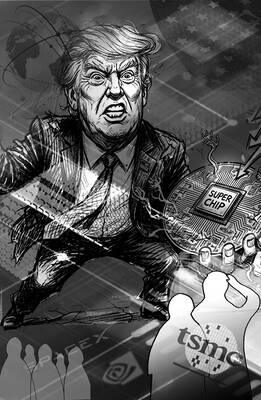
The White House’s decision to take a 9.9 percent stake in Intel Corp is looking like very shrewd business indeed. Since the government bought in at US$20.47 a share last August, the US chipmaker’s surging stock price has delivered the US a US$43 billion return. One of the reasons the investment has so far proved so sound is that the White House has made sure of it. According to The Wall Street Journal, Howard personally pushed deals on Intel’s behalf with some of the most lucrative clients imaginable. They include Nvidia Corp, the company at the heart of the AI
The Ministry of the Interior, working with the navy and coast guard, is organizing Taiwan’s first joint exercise simulating escort tankers carrying liquefied natural gas (LNG) and oil through a Chinese blockade. The drills simulate fuel transport along three maritime corridors leading toward Japan, the Philippines and the US. Deputy Minister of the Interior Sawyer Mars (馬士元) said that a blockade of the Taiwan Strait would amount to “almost a 100 percent blockade of the regional energy supply.” Minister of National Defense Wellington Koo said planning to counter a blockade is standard practice in Taipei. While the exercise is limited in
A single photograph can cut through a lot of noise, but it can also be used to misrepresent the truth. At the very least, it can concentrate the mind on something that requires further investigation. On Monday last week, Ma Ying-jeou Foundation CEO Tai Hsia-ling (戴遐齡) and former National Security Council secretary-general King Pu-tsung (金溥聰) held a news conference in which they showed a photograph of former foundation CEO Hsiao Hsu-tsen (蕭旭岑), now Chinese Nationalist Party (KMT) deputy chairman. In the image Hsiao is seated next to Xiamen Taiwan Businessmen Association chairman Han Ying-huan (韓螢煥). The two men were holding
In a Taiwanese university classroom, a lecturer asks in English: “Can anyone give me an example from Taiwan?” Students look down. No one answers. After class, one student writes on the course platform in Mandarin: “I understood the concept, but I didn’t know how to answer in English.” That moment highlights a key issue in Taiwan’s English-medium instruction (EMI) reform: It is not just about more English-taught courses, but whether students can learn, participate and belong. EMI expansion is part of the Bilingual 2030 policy and the Ministry of Education’s BEST Program, aiming to improve English ability, support EMI teaching


 RSS
RSS