


The Cabinet’s announcement on Thursday that it would raise the ceiling of China-bound investment by Taiwanese companies next month came as no surprise. Increasing investment in China — a proposal that has been the subject of heated debate for years — will help the administration realize its campaign promises.
The Cabinet has said that companies will be allowed to invest 60 percent of their net worth in China, up from ceilings of 20 percent to 40 percent depending on a business’ paid-in capital.
The change will also exempt companies with operational headquarters in Taiwan and subsidiaries of multinational companies from any restrictions on how much they can invest in China.
The idea of easing the investment caps was floated repeatedly by pan-blue lawmakers during the Democratic Progressive Party’s (DPP) eight-year administration. Both the Chinese Nationalist Party (KMT) and the People First Party favored relaxing restrictions, while the DPP government said it would need to draw up a complete set of measures before implementing such a change. The Taiwan Solidarity Union firmly opposed the idea, arguing that changing the investment ceilings would aggravate unemployment, hollow out the nation’s industries and increase capital outflow to China.
Now that the KMT enjoys complete control of both the Executive Yuan and the legislature, there are no real obstacles to this deregulation and other initiatives to relax regulations governing cross-strait economic links.
What remains unclear is whether the administration has thought through these changes and prepared effective measures to curb a potential outflow of capital. The government has also failed to make clear whether it has reached any deal with China to guarantee the interests of shareholders and investors in the case of an emergency situation.
The Cabinet’s quick move to relax the investment ceiling without showing any evidence that it is covering all the bases would seem to indicate that the decision-making process has been too rushed. For the sake of protecting our industries, however, the government cannot afford to be careless just to serve its political interests.
The idea that exempting companies with headquarters in Taiwan will encourage more businesses to set up their bases here or list their stocks on the local bourse does not take into account the pivotal factor for any company making such a decision: the general investment environment. Without a sound investment environment at home — which involves factors such as taxation, red tape, access to manpower and infrastructure — relaxing the restrictions on cross-strait investment is only likely to channel more funds out of the country.
What the government fails to recognize is that China’s investment environment is becoming riskier because of higher inflation and the rising cost of labor. The Cabinet’s expectations for the economic benefits of this deregulation should factor in these challenges for Taiwanese firms.
The Ministry of Economic Affairs hoped last week to deflect the criticism that this change could increase capital outflow to China, saying that it would speed up the process to allow Chinese capital into Taiwan.
But the Cabinet needs to be cautious on this front, too. Before letting Chinese investors enter the real estate and securities markets, it must address how to avoid short-term speculation by Chinese investors that could cause a bubble in the market.
Either way, the government’s announcements will not boost the morale of stock investors, who have watched the TAIEX fall by 24.85 percent since May.
What the market needs most right now is measures to contain imported inflation and boost domestic investment and consumer spending.
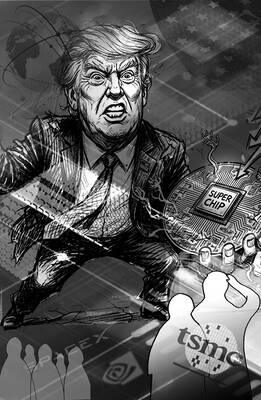
The White House’s decision to take a 9.9 percent stake in Intel Corp is looking like very shrewd business indeed. Since the government bought in at US$20.47 a share last August, the US chipmaker’s surging stock price has delivered the US a US$43 billion return. One of the reasons the investment has so far proved so sound is that the White House has made sure of it. According to The Wall Street Journal, Howard personally pushed deals on Intel’s behalf with some of the most lucrative clients imaginable. They include Nvidia Corp, the company at the heart of the AI
A single photograph can cut through a lot of noise, but it can also be used to misrepresent the truth. At the very least, it can concentrate the mind on something that requires further investigation. On Monday last week, Ma Ying-jeou Foundation CEO Tai Hsia-ling (戴遐齡) and former National Security Council secretary-general King Pu-tsung (金溥聰) held a news conference in which they showed a photograph of former foundation CEO Hsiao Hsu-tsen (蕭旭岑), now Chinese Nationalist Party (KMT) deputy chairman. In the image Hsiao is seated next to Xiamen Taiwan Businessmen Association chairman Han Ying-huan (韓螢煥). The two men were holding
I first met Professor Ray Jiing (井迎瑞) as a film and documentary student at Shih Hsin University’s (SHU) Department of Radio Television and Film in 1988. The following year, he went on to become the director of the Chinese Taipei Film Archive — forerunner of the Taiwan Film and Audiovisual Institute (TFAI). Over his eight-year tenure, Jiing rescued and restored over 200 classic Taiwanese films. In 1997, he established the Graduate Institute of Studies in Documentary and Film Archiving at Tainan National University of the Arts (TNNUA), and I joined the program in his third cohort of students. Beyond a
A recent report concerning a student who is suing his teacher posed the question in its headline: Does failing a student in two subjects constitute bullying? The college student in Chiayi County apparently sought NT$2 million (US$63,603) in state compensation, but a court dismissed the case. The first reaction of many might have been to ask: What has happened to students nowadays? Some say that teachers have lost their authority, while others say students are overindulged. Some even start reminiscing over the days when “whatever the teacher says goes.” However, the real issue might be overlooked if emotional reactions like that are the


 RSS
RSS