


The Mainland Democratic Movement Support Group (血脈相連大陸民主運動後援會) is unfamiliar to many in Taiwan’s younger generation.
But following the Tiananmen Square Massacre of June 4, 1989, it was a prominent activist group whose members secretly entered China to try to rescue threatened democracy activists.
Twenty years ago, it had more than 100 members, but that number dwindled over the years to less than a dozen.
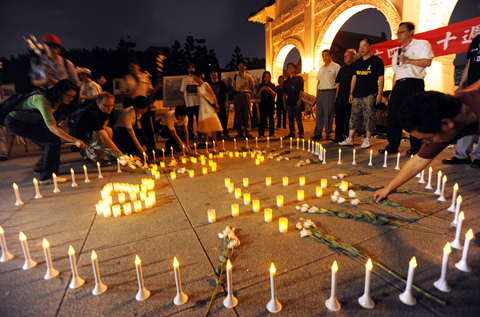
PHOTO: WANG YI-SUNG, TAIPEI TIMES
The remaining members got together to organize a series of events in Taipei’s Liberty Square to commemorate the 20th anniversary of the massacre on Wednesday night.
The events began at 6:04pm on Wednesday when former New Party legislators Yao Li-ming (姚立明) and Chien Ta (錢達) led supporters as they rode bikes around National Taiwan Democracy Memorial Hall 20 times.
At around 9pm, Yao, Chien, Chinese democracy activist Cai Lujun (蔡陸軍) and former Democratic Progressive Party chairman Shih Ming-teh (施明德) delivered speeches and sang songs to commemorate the tragedy before staging an overnight sit-in on the square.
Photos taken at Tiananmen in 1989 and a documentary on the massacre were also shown.
Participants lit candles for those who died during the massacre.
Despite heavy rainfall yesterday, several people still remained at Liberty Square.
One volunteer, Ms Liu (劉), sobbed on Wednesday as she told the group’s story.
On the evening of June 3, 1989, students at Beijing’s Tiananmen Square and supporters in Taipei’s Chiang Kai-shek Memorial Hall sang with each other via a radio broadcast, which was abruptly cut off around 11pm, soon after Taiwanese artist Chen Pai-chung broadcast from the square that the Chinese army had entered Beijing. The Chinese Communist Party (CCP) then began their crackdown on the protesters.
Chen called on volunteers to support the democracy movement after returning from China. Later in 1990, the group raised funds from overseas Chinese democracy activists to purchase a secondhand cargo ship, the Goddess of Democracy (民主女神號), hoping to sail between Taiwan and China to broadcast the truth about the incident. Unexpectedly, the Taiwanese government refused to approve the plan.
Tainan businessman Wu Meng-wu (吳孟武) later bought the ship, which is now berthed in Tainan’s Anping Harbor as part of exhibits related to the incident.
The group’s annual commemoration ceremony continued for 10 years but because of dwindling membership, the event was changed to biannual.
Even the song Wound of History (歷史的傷口), sung by a group of Taiwanese singers to show their support, has gradually been forgotten.
The group attempted to contact old members this year, but was unable to track many of them down.
Others said it “was inconvenient to participate in politics again,” as they were doing business with China.
Meanwhile, the lack of interest of both the Taiwanese government and public disheartened members.
“I cannot accept the CCP regime’s method of killing civilians with tanks,” another volunteer, Ms Chung (鍾), said.
“Our aims have been simple over the past 20 years. Although cross-strait relations have improved, we have not altered our original intentions,” she said.
“We do not intend to subvert or eliminate the CCP regime. We just want to awaken the outside world’s most basic humanitarian concerns,” Chung said.

NATIONAL SECURITY: Authorities are working to confirm the identities of the military personnel involved and investigating possible illegal conduct and regulatory violations Authorities are probing possible national security implications after Kinmen police and immigration officers on Sunday found a Chinese woman allegedly posing as a tourist while engaging in prostitution involving more than 10 military personnel. The woman, surnamed Chen (陳), has since been deported, authorities said, adding that investigators are still working to confirm the identities of those implicated, as the records only listed code names and aliases. The case stemmed from a report received by the Kinmen District Prosecutors’ Office on Friday last week from the Jinhu Precinct of the Kinmen County Police Bureau. On Sunday, police, along with the National Immigration

GLOBALGIVING: ‘ Caving to external pressure is not acceptable for an organization that has cultivated justice reform and human rights for 30 years,’ one NGO said A slew of non-government organizations (NGOs) have withdrawn from the GlobalGiving fundraising platform after it announced it would use “Chinese Taipei” instead of “Taiwan” from next month. The Taiwan Good Rice Association wrote on Facebook on Friday that it was informed on April 28 via a teleconference call of the change, which was made because the platform wanted to operate in China. Taiwan Good Rice is to terminate all cooperative relationships with GlobalGiving in response to the platform’s “unilateral and non-negotiable” decision to remove references to Taiwan, the NGO said. “Taiwan is in the official name of Taiwan Good Rice Association and the

HEAVY WEATHER: Typhoon Jangmi is due to crash straight into the Ryukyus as airlines look to shift flights to larger aircraft or cancel flights to Okinawa entirely Taiwan’s international air carriers announced flight adjustments over the weekend as Typhoon Jangmi is forecast to hit the Ryukyu Islands today and tomorrow. The Central Weather Administration (CWA) upgraded Jangmi from a tropical storm to a typhoon at 8am yesterday, with the eye located 580km south of Naha city. It was moving north at 19kph. Today, China Airlines’ CI-120, CI-121, CI-122 and CI-123 flights between Taoyuan and Naha, Okinawa, have been canceled as well as CI-132 and CI-133 between Kaohsiung and Naha. EVA Air’s BR-112, BR-113, BR-186 and BR-185 flights between Taoyuan and Naha are also canceled. Low-cost carrier Tigerair Taiwan canceled IT-230,
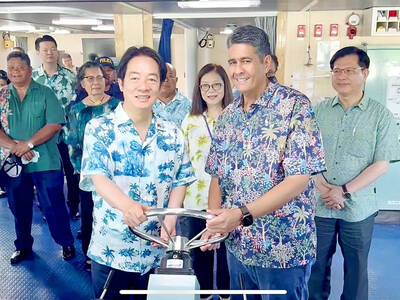
MULTIPRONGED APPROACH: China has sought to pressure Palau across a number of fronts, but the island nation has staunchly resisted overtures to ditch Taiwan Palau has been firm in backing Taiwan despite Chinese pressure that uses tourism economics, cyberattacks and criminal infiltration as tools to threaten the Pacific ally into renouncing its recognition of Taiwan as a sovereign state. The Presidential Office yesterday announced that Vice President Hsiao Bi-khim (蕭美琴) would visit Palau from Saturday to Wednesday next week at the invitation of Palauan President Surangel Whipps Jr. Whipps in April said in an interview that China had outspokenly asked Palau to “denounce Taiwan.” “And we have said: ‘We have no enemies, but nobody tells us who our friends are,’” he said. Whipps has told reporters multiple times


 RSS
RSS