


A veil has been drawn over the world’s media. Last weekend’s half-million strong protest against China and the administration of President Ma Ying-jeou (馬英九) barely rated a mention in major outlets. Instead, a trifling incident in Tainan involving a flatfooted Chinese delegation and poor security measures was blown out of proportion by local and international media and the government. Prosecutors are leading the charge and champing at the bit to kill a few chickens and scare a few monkeys — the chickens being the elderly and excitable hacks from the Democratic Progressive Party (DPP) and the monkeys those who dare oppose government policy on China.
Foreign commentators could be forgiven for seeing reports of another mass rally on the streets of Taipei and yawning. After all, such protests are not uncommon and almost never result in violence or significant disruption. In this case, however, the DPP protest marked the beginning of the end of Ma’s grace period as an engineer for cross-strait rapprochement. The tide has turned, and the nervousness of the Ma administration as it battles fiscal incompetence and ideological banality reflects this.
Mediocre governments, like mediocre individuals, revert to what they know best when placed under pressure, even if this is the opposite of what is required to change the situation to their advantage.
In the case of the Chinese Nationalist Party (KMT) and its proxies in the judicial system, this amounts to narrowing the gap between party and state so clumsily and risibly that ordinary people detect weakness and malice — and grow more nervous.
Consistent with the KMT’s legislative agenda, the government and judicial officers are politicizing agencies to the point where their neutrality should be called into question. The protests that will follow Chen Yunlin (陳雲林), chairman of China’s Association for Relations Across the Taiwan Strait (ARATS), are threatening to tap dissatisfaction over these developments, and could result in a deterioration that Ma manifestly does not have the skill to handle.
In other words, courtesy of Ma’s ineptitude, it seems inevitable that cross-strait detente was going to arrive hand in hand with civil unrest.
The irony of all this, of course, is that Ma was Washington’s preferred candidate. Yet the US seemed oblivious that the KMT government was going to have to deal with concerted opposition to its policies — and in the same manner as the ancien regime.
Representations have already been made to the US State Department about increasing abuse of speculative powers by local prosecutors and their disgraceful manipulation of the media. What kind of reception they will receive is hard to predict. On the one hand, the State Department boasts an admirable mechanism of global human rights analysis that culminates in an indispensable annual report. On the other, Secretary of State Condoleezza Rice has been tarred by the Bush administration’s attacks on fundamental judicial processes in the Guantanamo Bay debacle.
The likely scenario is that American Institute in Taiwan Director Stephen Young will have a few quiet words with President Ma or Premier Liu Chao-shiuan (劉兆玄) after the ARATS visit is over.
By that time, it may be too late. There is evidence that politicized members of the community are girding for something more dramatic. If this turns out to be the case, the State Department and the AIT might refer to an American classic of political thought, Civil Disobedience — referred to on this page in yesterday’s edition — before speaking out. There they might find insights into the entitlements of an unhappy citizenry in the face of a government that undermines civil liberties and the spirit of the law.
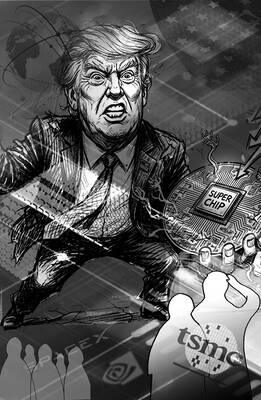
The White House’s decision to take a 9.9 percent stake in Intel Corp is looking like very shrewd business indeed. Since the government bought in at US$20.47 a share last August, the US chipmaker’s surging stock price has delivered the US a US$43 billion return. One of the reasons the investment has so far proved so sound is that the White House has made sure of it. According to The Wall Street Journal, Howard personally pushed deals on Intel’s behalf with some of the most lucrative clients imaginable. They include Nvidia Corp, the company at the heart of the AI
A single photograph can cut through a lot of noise, but it can also be used to misrepresent the truth. At the very least, it can concentrate the mind on something that requires further investigation. On Monday last week, Ma Ying-jeou Foundation CEO Tai Hsia-ling (戴遐齡) and former National Security Council secretary-general King Pu-tsung (金溥聰) held a news conference in which they showed a photograph of former foundation CEO Hsiao Hsu-tsen (蕭旭岑), now Chinese Nationalist Party (KMT) deputy chairman. In the image Hsiao is seated next to Xiamen Taiwan Businessmen Association chairman Han Ying-huan (韓螢煥). The two men were holding
I first met Professor Ray Jiing (井迎瑞) as a film and documentary student at Shih Hsin University’s (SHU) Department of Radio Television and Film in 1988. The following year, he went on to become the director of the Chinese Taipei Film Archive — forerunner of the Taiwan Film and Audiovisual Institute (TFAI). Over his eight-year tenure, Jiing rescued and restored over 200 classic Taiwanese films. In 1997, he established the Graduate Institute of Studies in Documentary and Film Archiving at Tainan National University of the Arts (TNNUA), and I joined the program in his third cohort of students. Beyond a
A recent report concerning a student who is suing his teacher posed the question in its headline: Does failing a student in two subjects constitute bullying? The college student in Chiayi County apparently sought NT$2 million (US$63,603) in state compensation, but a court dismissed the case. The first reaction of many might have been to ask: What has happened to students nowadays? Some say that teachers have lost their authority, while others say students are overindulged. Some even start reminiscing over the days when “whatever the teacher says goes.” However, the real issue might be overlooked if emotional reactions like that are the


 RSS
RSS