


When disaster strikes, non-governmental organizations (NGOs) are among the first on the scene. The UN estimates that there are now more than 37,000 international NGOs, with major donors relying on them more and more.
Inevitably, there are problems. Both the Rwandan genocide of 1994 and the 2004 Indian Ocean tsunami saw chaotic competition among NGOs. Yet there have also been landmark successes. More than 1,400 NGOs operating in 90 countries helped to get 123 countries to ratify the treaty banning landmines. But the sheer scale of the disaster relief "industry" -- plus the longer-term development efforts of NGOs -- is raising serious concerns about how to measure their performance.
Flexibility allows NGOs to be innovative in ways that organizations like the UN often cannot. But there are few international rules on what an NGO actually is, and the lack of control can lead to unpredictable consequences. In Chad recently, the French NGO Zoe's Ark tried to smuggle children out of the country without obtaining permission from either parents or the government. Among the questions being asked by NGOs, the UN and national donors is how to prevent the recurrence of past mistakes. The wake-up call for most NGOs came after the Rwandan genocide, when hundreds of small organizations tried to set up ad hoc operations in refugee camps in the Democratic Republic of Congo and Tanzania. Some camps turned into staging posts for armed factions. In the ensuing chaos, more than 50,000 refugees died from cholera.
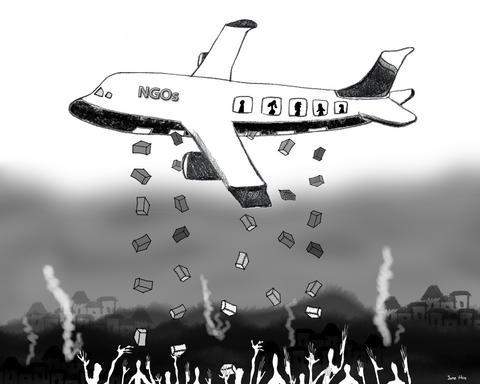
ILLUSTRATION: JUNE HSU
There was also mayhem following the Indian Ocean tsunami. At one point, more than 400 NGOs were on the ground in Aceh, Indonesia, competing for resources, personnel and funding. Many of the lessons learned in Rwanda were forgotten or ignored as smaller NGOs with little or no experience in dealing with disasters caused much of the confusion.
The situation in Indonesia led the UN to adopt a new "cluster" system to improve coordination. And, after a review of the Rwanda debacle, 400 NGOs and UN organizations working in 80 countries got together in the Sphere Project to develop a common humanitarian mandate and handbook of standards outlining the minimum performance required of any NGO working in a disaster zone.
As post-intervention review becomes more common, a basic framework for evaluating the impact of NGOs has appeared. Rather than simply looking at project inputs and outputs, the emphasis has turned towards measuring the overall impact of an operation. The idea is to find out if the lives of the people on the receiving end were changed for the better in any sustained way.
More and more donors are also insisting that NGOs provide measurable proof that they make a difference. That sounds fine in theory, but in practice there are drawbacks. By demanding quantifiable results, donors may force program managers to choose easily achieved targets over less measurable actions that accord with sound humanitarian principles. Or reporting about aid programs may be skewed to keep donor funds flowing. The greatest danger is that humanitarian relief will be tailored to meet donors' demands, rather than actual needs.
Until recently, the record on evaluating responses to humanitarian emergencies has been patchy at best. CARE, as both a relief and development agency, can take a long-term approach to disasters, matching emergency relief with a rehabilitation and recovery phase. But this is not an option for NGOs that focus only on emergency responses. Once their allotted time is up -- or their funds run out -- they tend to pack up and leave.
Even for NGOs that stick around, determining their relief efforts' impact in the middle of a crisis is difficult, if not impossible. Emergencies are chaotic: staff and resources are stretched, the local population is very unlikely to be able to provide meaningful feedback and pre-crisis baseline data are largely unavailable, so comparisons are complicated. Moreover, all too often, events move too quickly to be measured accurately. And, until recently, donors who were willing to pay for relief were less likely to finance follow-up evaluations. As a result, emergency relief evaluations often rely on little more than guesswork and assumptions.
A 2004 report by the Humanitarian Policy Group (HPG) cited a survey carried out in Ethiopia after UN agencies said that humanitarian efforts had averted widespread famine in 2000. The claim sounded credible until the subsequent survey showed that the area's crude mortality rate had actually risen to six times the normal base rate. Most of the deaths were from communicable diseases, which malnourished people may well have contracted after crowding into feeding centers. The HPG therefore recommended long-term monitoring of future humanitarian responses, and said that success or failure should be judged in a broad context rather than by a narrow focus on a specific project.
Many people who survive an earthquake or a flood, for instance, may soon face another crisis if the disaster also destroys their only means of earning a living. New and more sophisticated analytical tools are needed to understand these long-term effects, along with sufficient training to ensure that new methods are applied properly in the field. A recent innovation has been the Coping Strategy Index, devised by the World Food Program and CARE, which analyzes how people cope with short-term food crises while also taking into account their future vulnerability to hunger.
NGOs do the lion's share of the world's humanitarian work, and some mistakes are inevitable. But as we deepen our experience of humanitarian relief and development, we must learn the lessons of the past and understand how much more there is to know.
Robert Glasser is secretary-general of CARE International.
Copyright: Project Syndicate/Europe's World
The conflict in the Middle East has been disrupting financial markets, raising concerns about rising inflationary pressures and global economic growth. One market that some investors are particularly worried about has not been heavily covered in the news: the private credit market. Even before the joint US-Israeli attacks on Iran on Feb. 28, global capital markets had faced growing structural pressure — the deteriorating funding conditions in the private credit market. The private credit market is where companies borrow funds directly from nonbank financial institutions such as asset management companies, insurance companies and private lending platforms. Its popularity has risen since
On March 22, 2023, at the close of their meeting in Moscow, media microphones were allowed to record Chinese Communist Party (CCP) dictator Xi Jinping (習近平) telling Russia’s dictator Vladimir Putin, “Right now there are changes — the likes of which we haven’t seen for 100 years — and we are the ones driving these changes together.” Widely read as Xi’s oath to create a China-Russia-dominated world order, it can be considered a high point for the China-Russia-Iran-North Korea (CRINK) informal alliance, which also included the dictatorships of Venezuela and Cuba. China enables and assists Russia’s war against Ukraine and North Korea’s
An article published in the Dec. 12, 1949, edition of the Central Daily News (中央日報) bore a headline with the intimidating phrase: “You Cannot Escape.” The article was about the execution of seven “communist spies,” some say on the basis of forced confessions, at the end of the 713 Penghu Incident. Those were different times, born of political paranoia shortly after the Chinese Nationalist Party (KMT) relocated to Taiwan following defeat in China by the Chinese Communist Party (CCP). The phrase was a warning by the KMT regime to the local populace not to challenge its power or threaten national unity. The
The Iran war has exposed a fundamental vulnerability in the global energy system. The escalating confrontation between Iran, Israel and the US has begun to shake international energy markets, largely because Iran is disrupting shipping through the Strait of Hormuz. This narrow waterway carries roughly one-third of the world’s seaborne oil, making it one of the most strategically sensitive energy corridors in the world. Even the possibility of disruption has triggered sharp volatility in global oil prices. The duration and scope of the conflict remain uncertain, with senior US officials offering contradictory signals about how long military operations might continue.


 RSS
RSS