


The Hong Kong entertainment world scandal this Lunar New Year over the spread of Edison Chen's (陳冠希) sex photos on the Internet has revealed as much -- or more -- about the media and the public as about Chen and his ex-girlfriends. It is alleged that the computer shop that Chen had sent his laptop to for repair somehow managed to get ahold of the pictures and posted them on the Internet.
The local police are still investigating how the photos of Chen, a young pop idol, were leaked, while new photos continued to be uploaded on the Internet. CNN blamed Chen for his failure to protect his ex-girlfriends.
Gillian Chung (
The fact that she had to face the public to explain the incident shows that a woman's lust for sex still carries a stigma that can turn an innocent- looking pop singer into a "slut" overnight.
With the advance of electronic technology, more and more people are filming their own porno movies to spice up their sex lives. And according to the new code of morals, this act does not necessarily make somebody a pervert. Chung should not be seen as a slut simply because she had pictures taken during sex. In fact, exposing herself to the media's numerous cameras to apologize to the public was quite unnecessary.
These photos only showed that celebrities, too, have sex lives, nothing more. Let's not forget that she and the other girls and even Chen are all victims of the incident. The public should focus on her professional performance instead of her private life. Chen may be stupid enough to place his private photos in a position where they could be stolen, but that doesn't mean there was a "dirty" secret to hide. They are just a bunch of pictures that reveal human beings' instinctive craving for the joy of sex.
In fact, those who should take the blame for the incident are the people who leaked the photos, those who downloaded them, and the media who made it headline news everyday. Curiosity can indeed kill a cat. Let's pray that the victims of the incident, under close moral scrutiny from the public and the media, will not take extreme measures to escape forever from the gaze of the cameras.
If the incident holds a lesson for the public, it is to never trust the guy you turn your laptop over to.
Wei-ling Chen
Taipei
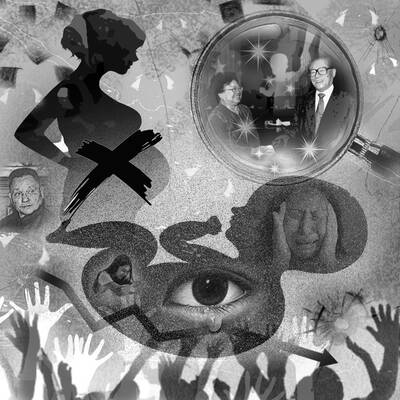
Jan. 1 marks a decade since China repealed its one-child policy. Just 10 days before, Peng Peiyun (彭珮雲), who long oversaw the often-brutal enforcement of China’s family-planning rules, died at the age of 96, having never been held accountable for her actions. Obituaries praised Peng for being “reform-minded,” even though, in practice, she only perpetuated an utterly inhumane policy, whose consequences have barely begun to materialize. It was Vice Premier Chen Muhua (陳慕華) who first proposed the one-child policy in 1979, with the endorsement of China’s then-top leaders, Chen Yun (陳雲) and Deng Xiaoping (鄧小平), as a means of avoiding the
The immediate response in Taiwan to the extraction of Venezuelan President Nicolas Maduro by the US over the weekend was to say that it was an example of violence by a major power against a smaller nation and that, as such, it gave Chinese President Xi Jinping (習近平) carte blanche to invade Taiwan. That assessment is vastly oversimplistic and, on more sober reflection, likely incorrect. Generally speaking, there are three basic interpretations from commentators in Taiwan. The first is that the US is no longer interested in what is happening beyond its own backyard, and no longer preoccupied with regions in other
A recent piece of international news has drawn surprisingly little attention, yet it deserves far closer scrutiny. German industrial heavyweight Siemens Mobility has reportedly outmaneuvered long-entrenched Chinese competitors in Southeast Asian infrastructure to secure a strategic partnership with Vietnam’s largest private conglomerate, Vingroup. The agreement positions Siemens to participate in the construction of a high-speed rail link between Hanoi and Ha Long Bay. German media were blunt in their assessment: This was not merely a commercial win, but has symbolic significance in “reshaping geopolitical influence.” At first glance, this might look like a routine outcome of corporate bidding. However, placed in

The last foreign delegation Nicolas Maduro met before he went to bed Friday night (January 2) was led by China’s top Latin America diplomat. “I had a pleasant meeting with Qiu Xiaoqi (邱小琪), Special Envoy of President Xi Jinping (習近平),” Venezuela’s soon-to-be ex-president tweeted on Telegram, “and we reaffirmed our commitment to the strategic relationship that is progressing and strengthening in various areas for building a multipolar world of development and peace.” Judging by how minutely the Central Intelligence Agency was monitoring Maduro’s every move on Friday, President Trump himself was certainly aware of Maduro’s felicitations to his Chinese guest. Just


 RSS
RSS