


Rising oil wealth is lifting Islamic banking -- banking that adheres to the laws of the Koran and its prohibition against charging interest -- into the financial mainstream.
Big banks, including Citigroup, HSBC and Deutsche Bank, as well as financial capitals like London, Tokyo and Hong Kong, are all going into the Islamic banking business. An estimated 300 Islamic financial institutions hold at least US$500 billion in assets, and deposits are increasing more than 10 percent a year.
In addition to Islamic loans, there are Islamic bonds, Islamic credit cards and even Islamic derivatives. Loans and bonds that conform to the Koran are already available in the US. And Britain, Japan and Thailand are contemplating issuing Islamic bonds of their own.
In Islamic banking, financiers are required to share borrowers' risks, meaning that depositors are treated more like shareholders, earning a portion of profits. Financing deals resemble lease-to-own arrangements, layaway plans, joint purchase and sale agreements, or partnerships.
"This is an industry on its way from a niche industry to becoming a truly global industry," said Khawaja Mohammad Salman Younis, the managing director for operations in Malaysia for Kuwait Finance House, the world's second-largest Islamic bank after Al-Rajhi Bank.
"In the next three to five years you'll see Islamic banks coming out in Australia, China, Japan and other parts of the world," he said.
The stampede into Islamic finance is mostly an effort to tap an estimated US$1.5 trillion in funds sloshing around the Middle East, largely from higher oil prices. While a lot of this oil money was parked in the US, Britain and Switzerland before Sept. 11, 2001, bankers say many wealthy Arabs are investing closer to home, in part to avoid increased scrutiny. At the same time, many Middle Eastern investors are eager to capitalize on Asia's breakneck growth.
By some estimates, as much as US$800 billion of Arab money has moved from the US and Europe to other regions. Those investments have helped spark an economic revival throughout the Muslim world at a time of increasing religious conservatism among Islam's 1.6 billion faithful.
SHARIAH-COMPLIANT
The result is expanding demand for financial services that adhere to Islamic law (Shariah).
"The middle class have the luxury of making these Islamic versus non-Islamic decisions," said Nordin Abdullah, who runs KasehDia, a firm in Kuala Lumpur that advises companies on how to comply with Shariah. "They're educated and have money."
Last year, Saudi Arabia's largest lender, National Commercial Bank, overhauled its entire retail business to make it Shariah-compliant. Tunisia and Morocco authorized their first Islamic banks this year.
And while the biggest Islamic banks are in the wealthy Gulf states, the most attractive potential markets are in Turkey and North Africa and among Europe's Muslims. Indonesia, the most populous Muslim nation with more than 190 million Muslims, is the mother lode.
Malaysia, a predominantly Muslim nation with a secular government and a fast-growing, export-driven economy, has emerged as a center for the industry's development. Here, even some non-Muslims are taking advantage of a growing range of Islamic products offering competitive returns.
For instance, David Ong-Yeoh, a public relations executive tired of fretting over his the rising interest rate on his adjustable rate mortgage, refinanced to a 30-year fixed loan from an Islamic financial institution. Now, he pays regular installments that include a predetermined profit margin for the bank.
"The terms are better than on conventional loans," Ong-Yeoh, 41, said.
Islamic finance also avoids practices prohibited under Shariah: Islamic bankers cannot receive or provide funds for anything involving alcohol, gambling, pornography, tobacco, weapons or pork.
Proponents of Islamic banking say these are limits any socially conscious investor can support, Muslim or not. They also envision wider appeal for Islamic banking's ban on interest, which stems from the Koran's prohibition against usury.
CONDEMNED IN THE BIBLE
That's a view that has a long religious and historical tradition. Charging high interest rates to lend money is repeatedly condemned in the Bible. The Greek philosopher Aristotle denounced it, the Romans limited it, and the early Christian church prohibited it.
Western theologians eventually distinguished interest from usury, and it was reintroduced to Christians and Muslims around the time of the Renaissance.
But when Britain took advantage of Egypt's mounting foreign debt in 1875 to buy Egypt's stake in the Suez Canal and occupy the country, it generated a backlash against traditional banking in the Muslim world. The belief that all interest charges are unjust now underpins Islamic finance.
"It's about respecting the interests of the different parties, avoiding taking advantage of any situation of any counter-party and putting in place fair treatment," said Rasheed Mohammed al-Maraj, governor of the central bank of Bahrain.
Hoarding is frowned on in the Koran, so savings earn no return unless put to productive use.
"Money should be used for creating better value in the country or the economy," Maraj said. "Money cannot generate money."
Islamic banks cannot simply trade money either.
"In the Islamic finance model, the banks are supposed to mobilize funds through a fund management concept," said Rafe Haneef, head of Islamic banking in Asia for Citigroup.
Indeed, Islamic banking is supposed to function more like private equity firms than conventional banking.
"Private equity is an Islamic concept," Haneef said.
Proponents say this risk-sharing requirement helps reduce the kind of abuses that led to the subprime mortgage mess. Scholars consider it un-Islamic to overload a customer with debt or invest in a company with excessive debt.
But this approach has inherent problems. Because Islamic financial transactions must have an underlying asset, Islamic bankers tend to have high exposure to real estate and construction projects. Hedging that exposure is difficult -- though Islamic derivatives exist, scholars differ on whether they are permissible under the Koran.
"There's a general acceptance that risk needs to be managed and therefore some form of financial instrument needs to be developed," said Zeti Akhtar Aziz, governor of Malaysia's central bank.
But "in Islamic finance you can't have such securities," he added. "We need to be able to look at some of the issues that revolve around this."
Islamic financial institutions have to depend on their own boards of Shariah scholars to approve every product. Shariah scholars are rare, and those with financial understanding even rarer, so many scholars sit on several boards, earning up to US$100,000 in retainers.
"If they're complaining there is a shortage, what are they doing to solve this problem?" asked Sheikh Nizam Yaquby, a scholar based in Bahrain who sits on the boards of Citigroup, AIG and HSBC, among others.
He noted that Shariah scholars still earn less than accountants or corporate lawyers.
As part of longstanding efforts to develop the industry, Malaysia has created scholarships and training programs. Zeti's father, Ungku Abdul Aziz, established the first modern Islamic financial institution, Tabung Haji, in 1962 to help poor Malays finance pilgrimages to Mecca and to mobilize rural savings.
Later, the Malaysian government set up Islamic banks as part of a reformist platform to promote national development and blunt the appeal of fundamentalist Islamic political rivals.
CONVERTING TO ISLAM
In early 2001, the government began offering tax incentives aimed at converting at least a fifth of the nation's assets to Islamic finance by 2010. (Currently, they make up roughly 12 percent.) With China siphoning away some economic opportunities from Malaysia, Islamic finance has become part of a broader effort to lure tourism, trade and investment from the Middle East.
"We are trying to position ourselves as being acceptable to the Middle East, to petrodollars," said Wong Fook-Wah, chief executive of RAM Rating Services in Kuala Lumpur. "Hopefully they'll fund economic growth in Malaysia."
In the early 1990s, Malaysia devised the first Islamic bond, or sukuk, an accomplishment it expanded on in 2002 by issuing the first global sukuk, raising US$600 million. Now the global sukuk market totals US$82.2 billion, with Malaysia accounting for two-thirds of it.
But as the price of oil has rebounded, Islamic finance has boomed elsewhere.
Sukuk issuance in the Gulf is set to overtake Malaysia. Britain, which licensed its first Islamic bank in 2004, plans to issue its own sukuk. Japan's Bank for International Cooperation is planning a US$300 million sukuk. And in July, a Texas-based oil firm, East Cameron Partners, issued the first US sukuk, raising US$165.7 million.
Clearly, faith is not the only thing driving the market. At Kuwait Finance House's Malaysian unit, Younis said, 40 percent of its depositors and 60 percent of its borrowers are non-Muslims.
"We look at these things just like Apple or Berkshire Hathaway," said E-lene Kee, a Buddhist corporate lawyer who advises clients to use Islamic loans to finance construction projects.
Ong-Yeoh feels the same.
"It's just taking advantage of the system," he said.
After taking out an Islamic loan for his home, he took another for his car.
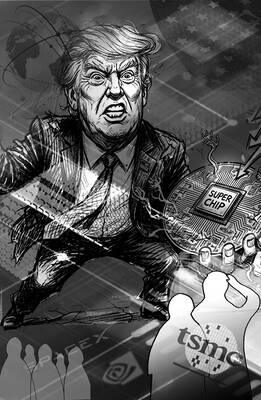
The White House’s decision to take a 9.9 percent stake in Intel Corp is looking like very shrewd business indeed. Since the government bought in at US$20.47 a share last August, the US chipmaker’s surging stock price has delivered the US a US$43 billion return. One of the reasons the investment has so far proved so sound is that the White House has made sure of it. According to The Wall Street Journal, Howard personally pushed deals on Intel’s behalf with some of the most lucrative clients imaginable. They include Nvidia Corp, the company at the heart of the AI
A single photograph can cut through a lot of noise, but it can also be used to misrepresent the truth. At the very least, it can concentrate the mind on something that requires further investigation. On Monday last week, Ma Ying-jeou Foundation CEO Tai Hsia-ling (戴遐齡) and former National Security Council secretary-general King Pu-tsung (金溥聰) held a news conference in which they showed a photograph of former foundation CEO Hsiao Hsu-tsen (蕭旭岑), now Chinese Nationalist Party (KMT) deputy chairman. In the image Hsiao is seated next to Xiamen Taiwan Businessmen Association chairman Han Ying-huan (韓螢煥). The two men were holding
I first met Professor Ray Jiing (井迎瑞) as a film and documentary student at Shih Hsin University’s (SHU) Department of Radio Television and Film in 1988. The following year, he went on to become the director of the Chinese Taipei Film Archive — forerunner of the Taiwan Film and Audiovisual Institute (TFAI). Over his eight-year tenure, Jiing rescued and restored over 200 classic Taiwanese films. In 1997, he established the Graduate Institute of Studies in Documentary and Film Archiving at Tainan National University of the Arts (TNNUA), and I joined the program in his third cohort of students. Beyond a
A recent report concerning a student who is suing his teacher posed the question in its headline: Does failing a student in two subjects constitute bullying? The college student in Chiayi County apparently sought NT$2 million (US$63,603) in state compensation, but a court dismissed the case. The first reaction of many might have been to ask: What has happened to students nowadays? Some say that teachers have lost their authority, while others say students are overindulged. Some even start reminiscing over the days when “whatever the teacher says goes.” However, the real issue might be overlooked if emotional reactions like that are the


 RSS
RSS