


Under the most optimistic scenario, a "people power" uprising topples the iron-fisted generals who have ruled Myanmar for a half century. Democracy icon Aung San Suu Kyi is freed from years of house arrest and announces general elections.
The world cheers.
But were such events to unfold -- and many say the junta is sure to tumble one day -- Myanmar's long anguish might simply give way to chaos.
After a collective sigh of relief from a long-suffering population, some experts foresee a "nightmare scenario" -- resurgent ethnic insurgencies, gutted institutions, clashes among leaders with no experience in democracy and continuing aftershocks from the junta's ruinous economic policies in one of the world's poorest nations.
TRANSITION
"The transition to civilian rule is bound to be extremely difficult, given the fact that the country has not had a truly civilian government since 1962," says Bertil Lintner, one of several Myanmar experts who believe elements of the military would have to be retained to guide the country through such turbulent times.
Following the junta's crackdown on protesters, many in the international community -- including the US -- have renewed calls for democracy in Myanmar.
However, the country's chief backer, China, has stressed stability and a gradual transition over sudden regime change, a view shared by some of Myanmar's Southeast Asian neighbors.
Abruptly jettisoning the military, it is feared, would have dire consequences. There are too few qualified civilians left to run the country, and disbanding the army might imperil security, much as it did after Iraq's forces were sent home after the fall of Iraqi president Saddam Hussein.
"You've had, over the past 40 years, the army slowly become really not just a dominant state institution but practically the only state institution, even at the local level," said Thant Myint-U, author of a recent book on his homeland, The River of Lost Footsteps.
Buddhist monks, numbering some half a million, took the leading role in recent protests and remain a highly revered and potentially effective force for change, but cannot by their own precepts step in to govern the country.
Not only does the 400,000-strong army wield the guns -- turning them on a rebellious citizenry as it did in recent weeks -- but it has taken over all major business enterprises and all but the routine tasks of government.
PRIVILEGED
A state-within-a-state as well as a privileged class, the military provides its own with relatively good schools, health facilities, housing and jobs, while the public copes with a shattered infrastructure on less than US$1 a day.
"Rebuilding these structures at the same time as easing the army out of its overall government role is an almost unprecedented task. It's hard for me to think of another situation in which that has happened peacefully," said Thant Myint-U, a former UN official.
Democracy may not find fertile soil in Myanmar, which has passed through a thousand years of feudalism, 124 years of British colonial rule and 45 years of military dictatorship, with a tumultuous, 14-year experiment in democracy sandwiched in between.
The last generation that participated in free elections is rapidly passing. Repeated crackdowns have decimated the ranks of younger pro-democracy activists, and many others are pursuing new lives abroad.
Although hugely popular inside Myanmar and internationally, the 62-year-old Aung Sang Suu Kyi remains untested as a political leader. Before emerging to lead an anti-government uprising in 1988, she had spent most of her life abroad, despite being the daughter of Myanmar's martyred founding father, General Aung San. The Nobel Peace Prize laureate has spent 12 of the last 18 years under house arrest.
"She's probably the only person who could counsel patience and moderation and be able to bring a large part of the population with her," Thant Myint-U said. "This will be important for the transition, but beyond that it's impossible to know how well she would be able to cope with the challenges of day-to-day government."
FEAR
Many among the educated in Myanmar fear these are bound to be legion -- from the confrontational politics that marred the country's flirtation with democracy to a dearth of human capital in the wake of what critics consider one of the military's worst offenses: a "war on education."
Universities, regarded hotbeds of dissent, were shut down for nearly seven out of the 12 years following the 1988 uprising. In many schools, textbooks, if they exist at all, must be shared, library shelves are all but empty and science is taught without laboratories by teachers on starvation wages.
"Maybe that is what the military really wanted, the elimination of an educated population. Whether it was or not, that is what has occurred," said Josef Silverstein, a retired academic from Rutgers University who has studied Myanmar for more than half a century.
And it is uncertain whether members of the large educated Burmese exile community would return to the country should the junta fall -- or how well they could integrate and contribute, says Thant Myint-U, an exile himself who has lived abroad since leaving the country as a young boy.
Were the international community to offer generous aid to a post-junta Myanmar, Thant Myint-U fears the ruined infrastructure -- physical and human -- could absorb little of it just as the people's economic expectations were skyrocketing. And it's questionable whether the international community would offer effective assistance.
"Suppose there was change, is the world preparing to deal with this in a nonpolitical way? I don't think so," said Georgetown University professor David Steinberg, who returned from a rare visit to Myanmar last week.
ARROGANCE
"There is a lot of silly thinking going on, not for political purposes but out of moral indignation, and in the case of the United States there is a degree of arrogance built in that we have the capacity to force change on other people," he said.
Possibly the greatest challenge would be preventing fresh outbreaks of the insurgencies among ethnic minorities that have plagued Myanmar and served as one pretext for the military's clinging to power. The regime often claims that it alone stands between national unity and a breakup of the country.
Given deep-seated hatreds, simmering tensions and continued warfare between the government and some ethnic insurgents like the Karen, Karenni and Shan, a fragmentation is possible should the Myanmar military abruptly disintegrate.
But others say some elements of the military might actually help.
"Look at Indonesia," said Lintner, author of several books on Myanmar. "Many feared a Balkanization after the fall of Suharto but, in the end, the transition went much more smoothly than expected. In Indonesia, democracy actually turned out to be useful for solving ethnic conflicts. Now, a liberally minded ex-general is president, so why not in Burma?"
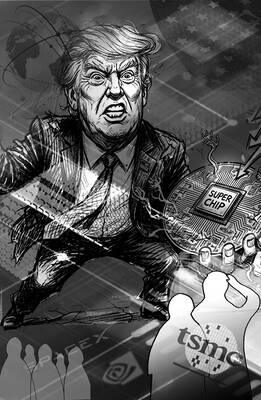
The White House’s decision to take a 9.9 percent stake in Intel Corp is looking like very shrewd business indeed. Since the government bought in at US$20.47 a share last August, the US chipmaker’s surging stock price has delivered the US a US$43 billion return. One of the reasons the investment has so far proved so sound is that the White House has made sure of it. According to The Wall Street Journal, Howard personally pushed deals on Intel’s behalf with some of the most lucrative clients imaginable. They include Nvidia Corp, the company at the heart of the AI
A single photograph can cut through a lot of noise, but it can also be used to misrepresent the truth. At the very least, it can concentrate the mind on something that requires further investigation. On Monday last week, Ma Ying-jeou Foundation CEO Tai Hsia-ling (戴遐齡) and former National Security Council secretary-general King Pu-tsung (金溥聰) held a news conference in which they showed a photograph of former foundation CEO Hsiao Hsu-tsen (蕭旭岑), now Chinese Nationalist Party (KMT) deputy chairman. In the image Hsiao is seated next to Xiamen Taiwan Businessmen Association chairman Han Ying-huan (韓螢煥). The two men were holding
I first met Professor Ray Jiing (井迎瑞) as a film and documentary student at Shih Hsin University’s (SHU) Department of Radio Television and Film in 1988. The following year, he went on to become the director of the Chinese Taipei Film Archive — forerunner of the Taiwan Film and Audiovisual Institute (TFAI). Over his eight-year tenure, Jiing rescued and restored over 200 classic Taiwanese films. In 1997, he established the Graduate Institute of Studies in Documentary and Film Archiving at Tainan National University of the Arts (TNNUA), and I joined the program in his third cohort of students. Beyond a
A recent report concerning a student who is suing his teacher posed the question in its headline: Does failing a student in two subjects constitute bullying? The college student in Chiayi County apparently sought NT$2 million (US$63,603) in state compensation, but a court dismissed the case. The first reaction of many might have been to ask: What has happened to students nowadays? Some say that teachers have lost their authority, while others say students are overindulged. Some even start reminiscing over the days when “whatever the teacher says goes.” However, the real issue might be overlooked if emotional reactions like that are the


 RSS
RSS