


He is not as well known as former US vice president Al Gore, but among green campaigners, no one has a bigger role in tackling climate change than Ma Jun (
Ma, 39, has emerged as the powerful voice of a budding green movement that is forcing industry and China's tightly run state to be more accountable for the long-term consequences of their rush to get rich.
He founded the Institute of Public and Environmental Affairs, which is among those leading the charge to clean up the air and rivers of China, a monumental task. Pollution is leaking beyond its borders. Sand storms caused by desertification blast across the Korea Peninsula and Japan all the way over the Pacific to the US. And as the dump for 50 billion tonnes of effluent annually, the rivers' toxic discharges threaten marine life hundreds of miles beyond China's seas.
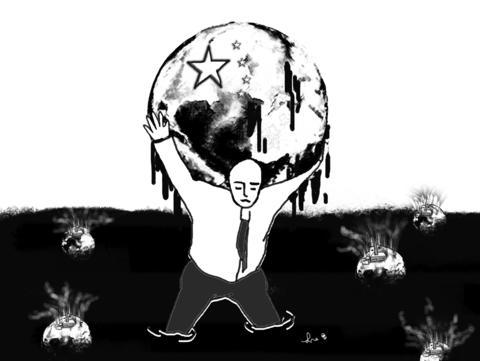
The country's environmental importance was apparent last month when US President George W. Bush said he would not sign up to ambitious new goals to prevent global warming unless China was involved. Chinese President Hu Jintao (
Ma has cause for optimism. The former journalist switched to activism in 1997 after hearing Chinese hydro-engineers boast that the Yellow River was a model of water management, even though it was so over-dammed and exploited that it failed to reach the sea on more than 200 days each year. That inspired Ma to write an influential book warning of an impending crisis.
There was not much an ordinary citizen could do then, when green campaigners were considered a threat to a government fixated with economic growth regardless of the environmental cost. But much has changed. Since 2003, Chinese Premier Wen Jiabao (
Ma's institute's online China Water Pollution Map -- www.ipe.org.cn -- names and shames the worst offending regions and companies. It is a symbol of a new kind of social activism in China: pragmatic rather than idealistic, and relying more on maps and data than votes and speeches to lobby for change.
If polluting companies want their names removed from the map they have to accept an environmental audit from a third party and act on any problems. This has prompted a response by 30 companies, mostly multinationals. Six have already agreed to audits. Among them, Panasonic Battery in Shanghai which is refitting its factory's water system.
"It is not just because of us," Ma said. "But it is really good. They sent a big delegation to our office to explain their actions and they have invited us to go and check their plant."
Not everyone is as receptive. Ma says Pepsi, General Motors and five or six British firms are among those who have not responded. There are 80 multinationals among the 5,500 violators listed, but they face the fiercest criticism.
Ma is unapologetic.
"Multinationals are more sensitive to public pressure because they have bigger brand names and they have made commitments to be environmentally sensitive. Chinese firms are not used to this kind of pressure yet," he said.
To make domestic firms feel the heat, he plans to target their overseas buyers and suppliers.
"Globalized manufacturing and procurement mean that a lot of high-polluting, heavy duty jobs are transferred to China," Ma said. "We will ask major companies, such as Wal-Mart, Microsoft and IBM to put pressure on their Chinese suppliers."
New laws have been implemented on environmental protection in China and the latest five-year plan includes ambitious targets to cut pollution by 10 percent and improve energy efficiency by 20 percent. But these fine-sounding directives run up against resistance by local authorities still focused on rapid development, and fear from companies that environmental concerns will drive them out of business.
"Managers from one big Chinese noodle company came here and told me, `We are just a farmers' company. Think how it will impact on us.' But I tell them the rules are made by the government. Every firm should comply. It doesn't mean they can't compete," Ma said.
So how does it feel for the head of a small campaign to have executives from some of the world's biggest companies knocking at his door to explain themselves?
"It shows that China has bottlenecks. Environmental problems cannot be resolved here the way they are resolved in other countries. I heard that 80 percent of the environmental problems in the US are solved in court. That can't happen here," Ma said.
These "bottlenecks" are the one-party state with no independent justice system, no political accountability and no free media. For decades, there was nothing to stop Chinese Communist Party cadres and factory bosses from pumping out poisons.
However, the market economy has given consumers more choice, the media have greater freedom and businesses are gradually paying attention to corporate social responsibility.
"This is a lucky time for us because central government leaders have changed their mindset," Ma said. "We have a vibrant economy. There is over-supply of goods. That means strong competition and more consumer power."
His next project is an air quality map. There is still no comprehensive data for carbon emissions despite China's G8 promise of significant achievements in this area. Ma says China needs time to come to terms with climate change. His goal is to ensure China's natural heritage is not destroyed by economic growth.
"China is moving forward. Developing countries are not the real culprits. Rich countries must take responsibility," he said.
Taiwan’s higher education system is facing an existential crisis. As the demographic drop-off continues to empty classrooms, universities across the island are locked in a desperate battle for survival, international student recruitment and crucial Ministry of Education funding. To win this battle, institutions have turned to what seems like an objective measure of quality: global university rankings. Unfortunately, this chase is a costly illusion, and taxpayers are footing the bill. In the past few years, the goalposts have shifted from pure research output to “sustainability” and “societal impact,” largely driven by commercial metrics such as the UK-based Times Higher Education (THE) Impact
History might remember 2026, not 2022, as the year artificial intelligence (AI) truly changed everything. ChatGPT’s launch was a product moment. What is happening now is an anthropological moment: AI is no longer merely answering questions. It is now taking initiative and learning from others to get things done, behaving less like software and more like a colleague. The economic consequence is the rise of the one-person company — a structure anticipated in the 2024 book The Choices Amid Great Changes, which I coauthored. The real target of AI is not labor. It is hierarchy. When AI sharply reduces the cost
I wrote this before US President Donald Trump embarked on his uneventful state visit to China on Thursday. So, I shall confine my observations to the joint US-Philippine military exercise of April 20 through May 8, known collectively as “Balikatan 2026.” This year’s Balikatan was notable for its “firsts.” First, it was conducted primarily with Taiwan in mind, not the Philippines or even the South China Sea. It also showed that in the Pacific, America’s alliance network is still robust. Allies are enthusiastic about America’s renewed leadership in the region. Nine decades ago, in 1936, America had neither military strength
The Presidential Office on Saturday reiterated that Taiwan is a sovereign, independent nation after US President Donald Trump said that Taiwan should not “go independent.” “We’re not looking to have somebody say: ‘Let’s go independence because the United States is backing us,’” Trump said in an interview with Fox News aired on Friday. President William Lai (賴清德) on Monday said that the Republic of China (ROC) — Taiwan’s official name — and the People’s Republic of China (PRC) are not subordinate to each other. Speaking at an event marking the 40th anniversary of the establishment of the Democratic Progressive Party (DPP), Lai said


 RSS
RSS