


Imagine that the Taiwanese government for some reason forcibly sent back a few hundred Japanese or US passengers -- all who held legal visas to come here -- as they prepared to land at Taiwan Taoyuan International Airport. It would be a major human rights violation against foreigners in Taiwan. Imagine the lengthy media reports of these passengers' anger, the level of criticism that would be leveled against government officials at every level and the charges of dereliction of duty.
But that's a different story. Instead, a group of Taiwanese on their way to the Hong Kong, Special Administrative Region of China, were going to arrive close to the same time that the Chinese leader Hu Jintao (
The ceremonies praised the success of the "one country, two systems" model. Only a few Taiwanese media reported on these Taiwanese being turned back ? the Liberty Times (the Taipei Times' sister paper), Formosa TV, Chinese Television System, TVBS and the China Times.
These exceptions aside, the vast majority of media outlets were either blind to the event or gave only the briefest sketch of what happened. This begs the question: How much of our media is controlled by the Chinese Communist Party? And why are they only reporting on the celebrations and Hong Kong's glorious scenery?
It is true that the majority of the victims were Falun Gong students. But if Falun Gong students' legal and human rights can be violated, who knows what other Taiwanese person can be persecuted?
We all know that Falun Gong practioners are not the only ones to be oppressed by the Chinese Communist Party over the years. A short list would include Taiwanese businessmen, religious figures, democracy activists, people who belong to "objectionable" associations, the Uygur people, journalists and the countless Chinese cheated by corrupt public figures. One by one, each of these groups has suffered at the hands of the CCP.
Their goals are justice and a government that respects liberties and the rule of law. They want an end to collusion with and control over the media that prevents expositions on the injustice occurring throughout China. They only hope to see everyone respected and an end to cruel behavior.
However, the Chinese media can do nothing under the control of the system. Only a few respected journalists are still struggling to end censorship and expose corruption and privilege. Unfortunately, these people, just like other human rights activists, are often forced to resign, held in detention, and see their organizations closed down. For most of the media, they can merely play the role of a mouthpiece willingly or unwillingly under various regulations, in order to present the false appearance of peace and prosperity.
Isn't Taiwan a free society? Shouldn't its free media uncover all faults so as to protect people's rights?
Many friends in the media told me that their supervisors ordered them not to report anything about Falun Gong and its logo should never appear on TV because Chinese leaders do not like it. As a result, many Taiwanese media no longer report about it.
Behind the self-censorship, I believe that no journalist likes his or her freedoms curtailed. So what causes it? Lures or threats?
Various business and private exchanges between the two sides of the Taiwan Strait are close.
The Taiwanese media certainly has the responsibility to protect people's right to know, as well as to supervise cross-strait human rights conditions. Hence, the amount of reporting local media do on cross-strait human right issues is a key index of freedom.
Flora Chang is a professor at National Taiwan University's Graduate Institute of Journalism.
TRANSLATED BY JASON COX AND EDDY CHANG
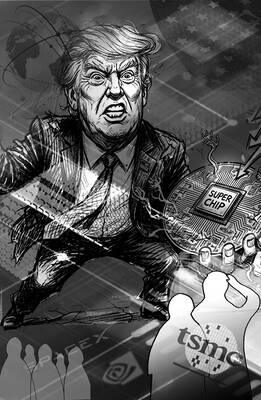
The White House’s decision to take a 9.9 percent stake in Intel Corp is looking like very shrewd business indeed. Since the government bought in at US$20.47 a share last August, the US chipmaker’s surging stock price has delivered the US a US$43 billion return. One of the reasons the investment has so far proved so sound is that the White House has made sure of it. According to The Wall Street Journal, Howard personally pushed deals on Intel’s behalf with some of the most lucrative clients imaginable. They include Nvidia Corp, the company at the heart of the AI
In a Taiwanese university classroom, a lecturer asks in English: “Can anyone give me an example from Taiwan?” Students look down. No one answers. After class, one student writes on the course platform in Mandarin: “I understood the concept, but I didn’t know how to answer in English.” That moment highlights a key issue in Taiwan’s English-medium instruction (EMI) reform: It is not just about more English-taught courses, but whether students can learn, participate and belong. EMI expansion is part of the Bilingual 2030 policy and the Ministry of Education’s BEST Program, aiming to improve English ability, support EMI teaching
A single photograph can cut through a lot of noise, but it can also be used to misrepresent the truth. At the very least, it can concentrate the mind on something that requires further investigation. On Monday last week, Ma Ying-jeou Foundation CEO Tai Hsia-ling (戴遐齡) and former National Security Council secretary-general King Pu-tsung (金溥聰) held a news conference in which they showed a photograph of former foundation CEO Hsiao Hsu-tsen (蕭旭岑), now Chinese Nationalist Party (KMT) deputy chairman. In the image Hsiao is seated next to Xiamen Taiwan Businessmen Association chairman Han Ying-huan (韓螢煥). The two men were holding
The Ministry of the Interior, working with the navy and coast guard, is organizing Taiwan’s first joint exercise simulating escort tankers carrying liquefied natural gas (LNG) and oil through a Chinese blockade. The drills simulate fuel transport along three maritime corridors leading toward Japan, the Philippines and the US. Deputy Minister of the Interior Sawyer Mars (馬士元) said that a blockade of the Taiwan Strait would amount to “almost a 100 percent blockade of the regional energy supply.” Minister of National Defense Wellington Koo said planning to counter a blockade is standard practice in Taipei. While the exercise is limited in


 RSS
RSS