


Nothing is more ordinary than taking a map and going sightseeing. But there is a power structure associated with tourism and maps.
Let's look at tourism first. Sometimes the government combines society and culture to make landscapes into scenery. Scenery is infused with values and ideas that rulers want to propagate.
For example, many places in Taiwan have a list of highlighted travel destinations known as the "eight scenic areas." What areas these are change from period to period. In the Qing Dynasty, these were often places where officials gathered to admire the view, write poetry about it and recite poems together with local scholars, thereby winning them over and gaining favors.
Scenic spots can reinforce the legitimacy of a ruler through a system of legends and symbols.
For example, when Taiwan was under Japanese rule, the Japanese government planted cherry trees to encourage the tradition of admiring cherry blossoms. When the Chinese Nationalist Party (KMT) government arrived, it planted plum trees instead.
Now we have entered a democratic society in which information is freely available and leaders are not able to use information as they used to. But they can still use it to promote their interests.
In the travel guide Insight City Guide: Taipei, published in conjunction with Ma Ying-jeou (馬英九) when he was mayor, the assassination attempt on President Chen Shui-bian (陳水扁) on March 19, 2004, the eve of the last presidential election, is described as an election stunt. The book tells foreign travelers that calling people "Taiwanese" might make Mainlanders who came to Taiwan after the war feel uncomfortable. This is how a politician uses tourism as an instrument for power.
Maps reveal this, too. The book The Power of Maps by Denis Wood tells us that the usefulness of maps is in how they advance agendas. The agendas are often hidden, but they can be detected in map symbols and legends.
After the KMT arrived in Taiwan, it changed the names of Taipei's streets to those of Chinese cities according to their location relative to one another. But it was only in 1973 that the party formulated the "Regulations on the Compilation and Erection of Street Name Signs and Doorplates in Taipei City" (台北市道路名牌暨門牌編釘辦法) in order to base this practice in law.
The fourth clause of the law states that streets should be named after provinces, cities, historical sites, mountains and rivers in China. That's why Chinese visitors to Taipei feel very much at home when they walk through the streets. Meanwhile, the government has turned a deaf ear to many people who want this legacy of colonial rule to be changed.
The Taipei City Government recently published a tourist map of Taipei in simplified characters prior to attending a tourism expo in Beijing. On this map, the Presidential Office ceased to exist, and "President Chiang's Grass Mountain Chateau" became "Mr Chiang Kai-shek's Chateau." Not surprisingly, this map was also printed when Ma was mayor.
Likewise, Ma exercised his municipal power to implement Hanyu Pinyin Romanized street names and block amendments to the regulations on street names that would have allowed more local names to take their place.
But to outsiders, especially those from China, the impression is that Ma has relinquished power and that he has made Taipei into a city that will not offend visiting Chinese.
In the context of Ma's recent bout of "localization" in his book Taiwan Spirit, one can only think that perhaps China is where Ma's spirit really soars.
Tseng Wei-chen is a political commentator.
Translated by Anna Stiggelbout
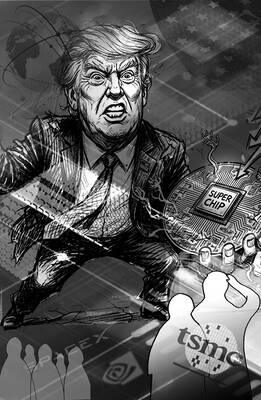
The White House’s decision to take a 9.9 percent stake in Intel Corp is looking like very shrewd business indeed. Since the government bought in at US$20.47 a share last August, the US chipmaker’s surging stock price has delivered the US a US$43 billion return. One of the reasons the investment has so far proved so sound is that the White House has made sure of it. According to The Wall Street Journal, Howard personally pushed deals on Intel’s behalf with some of the most lucrative clients imaginable. They include Nvidia Corp, the company at the heart of the AI
A single photograph can cut through a lot of noise, but it can also be used to misrepresent the truth. At the very least, it can concentrate the mind on something that requires further investigation. On Monday last week, Ma Ying-jeou Foundation CEO Tai Hsia-ling (戴遐齡) and former National Security Council secretary-general King Pu-tsung (金溥聰) held a news conference in which they showed a photograph of former foundation CEO Hsiao Hsu-tsen (蕭旭岑), now Chinese Nationalist Party (KMT) deputy chairman. In the image Hsiao is seated next to Xiamen Taiwan Businessmen Association chairman Han Ying-huan (韓螢煥). The two men were holding
I first met Professor Ray Jiing (井迎瑞) as a film and documentary student at Shih Hsin University’s (SHU) Department of Radio Television and Film in 1988. The following year, he went on to become the director of the Chinese Taipei Film Archive — forerunner of the Taiwan Film and Audiovisual Institute (TFAI). Over his eight-year tenure, Jiing rescued and restored over 200 classic Taiwanese films. In 1997, he established the Graduate Institute of Studies in Documentary and Film Archiving at Tainan National University of the Arts (TNNUA), and I joined the program in his third cohort of students. Beyond a
A recent report concerning a student who is suing his teacher posed the question in its headline: Does failing a student in two subjects constitute bullying? The college student in Chiayi County apparently sought NT$2 million (US$63,603) in state compensation, but a court dismissed the case. The first reaction of many might have been to ask: What has happened to students nowadays? Some say that teachers have lost their authority, while others say students are overindulged. Some even start reminiscing over the days when “whatever the teacher says goes.” However, the real issue might be overlooked if emotional reactions like that are the


 RSS
RSS