


The results of the Democratic Progressive Party's (DPP) legislative primaries have two political implications. One is that some talented politicians from different generations were eliminated from the legislature. The other is that the "democratic war" between Taiwan's two sides will get even fiercer. Most of the politicians who were eliminated were better known as rational politicians than political warriors. The intensification of Taiwan's "democratic war" is both the cause and result of the rise of the warriors and the decline of the doves within the DPP.
There are two factors in Taiwan's constitutional structure that have contributed to the rise of the warriors and the intensification of the conflict. The first is the halving of the number of legislative seats, and the other is the system of presidential authority and direct presidential elections. The former means that the nomination process has become extremely fierce, while the latter strengthens the vicious party system and the polarized opposition that comes with it.
The reduction of legislative seats from 225 to 113 has already assured that at least half of the current legislators will lose their jobs. It has also guaranteed an extremely fierce nomination process. Tough competition is not necessarily a bad thing. The issue is what the candidates are competing on.
This recent primary was clearly not a contest between the different candidates' ability to govern -- namely, who can achieve the party's vision of the future. Rather, it was a contest of their fighting spirit -- who has more hate and vicious battle tactics.
Why have hate and strife become the parties' standard for choosing candidates? This is the eve of the democratic war, and Taiwan's two social forces have consolidated their power in preparation for the ultimate battle.
Party competition has come to be seen as a battle between us and them. Moderates are viewed by parties as weak in the face of the enemy and their loyalty is questioned. This is why the DPP legislative primary resulted in the rise of the warriors.
Taiwan's democratic war has its origins in the historical conflict between the two local and foreign societies, but it is also continuously fed by the viscious two-party system. The presidential authority and direct presidential elections have solidified a system in which each party works to hinder the other, while not allowing room for choice within the party itself. The injuries that result from a system in which presidential elections pit half of the population against the other hardly need explaining.
The people who ardently support the presidential system and who devote themselves to presidential campaigns can broadly be classified as those who support the democratic war. They believe that the opposing camp should be wiped out and that their own camp, by winning the presidential election, can bring about the other side's complete destruction.
Faced with the escalating democratic war and the loss of some of the DPP's political talent in the legislative primary, there are two possible constitutional solutions. The first is to immediately amend the Constitution to increase the number of seats divided proportionally between the political parties. The second is to promote a new political force for Taiwan.
For some time now there have been calls to push for an eighth round of constitutional amendment to implement a Cabinet system. This arrangement could alleviate the harmful opposition between the two parties, accompany a reasonable increase in the number of legislative seats and give moderate forces more room to breathe. In fact, the legislature has already had proposals for two different versions of a Cabinet system.
However, former Chinese Nationalist Party (KMT) chairman Ma Ying-jeou (
Former DPP chairman Lin I-hsiung (
Perhaps we could adopt the "Five Yesses and Five Noes" plan proposed by the Civic Alliance for Parliamentarianism and increase the ratio of seats allotted to political parties' legislators-at-large to equal the 79 single-district seats, which includes aboriginal representatives.
When a new constitution is implemented -- sometime during the next president's term at the earliest -- the seventh Legislative Yuan could also include valuable former DPP legislators who had been knocked out in the primary process, such as Shen Fu-hsiung (沈富雄), Hong Chi-chang (洪奇昌) and Lo Wen-chia (羅文嘉).
Regardless of whether or not the amendment succeeds, Taiwan needs a new political force. In this country a moderate political party has always been lacking. Although the moderates in the DPP primary are generally well liked, they were unable to navigate the party's nomination system. This demonstrates that moderate attitudes are unable to survive within the DPP.
But fractured public opinion could still be hoping for social unity, and be weary of the moderate and rational localization forces in the democratic war. It is regrettable that the DPP, as it seeks to lead Taiwan, has abandoned representing this moderate force.
Without it being represented in politics, Taiwan will continue to sink further into the polarization of its democratic war.
To stop the slaughter, we need peace-keeping troops for "humanitarian intervention," otherwise the battle will rage on. If a new political party is formed to join the year-end legislative elections, then the talented DPP legislators who fell in the primary would still have a chance to be elected as legislators-at-large. Most importantly, Taiwan cannot continue to sink into opposition between two societies. The third society must rise, and it must have a political force.
Jou Yi-cheng is a student at the Johns Hopkins School of Advanced International Studies in Washington.
TRANSLATED BY MARC LANGER
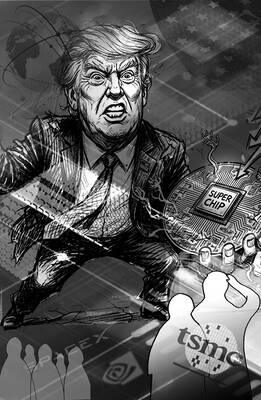
The White House’s decision to take a 9.9 percent stake in Intel Corp is looking like very shrewd business indeed. Since the government bought in at US$20.47 a share last August, the US chipmaker’s surging stock price has delivered the US a US$43 billion return. One of the reasons the investment has so far proved so sound is that the White House has made sure of it. According to The Wall Street Journal, Howard personally pushed deals on Intel’s behalf with some of the most lucrative clients imaginable. They include Nvidia Corp, the company at the heart of the AI
A single photograph can cut through a lot of noise, but it can also be used to misrepresent the truth. At the very least, it can concentrate the mind on something that requires further investigation. On Monday last week, Ma Ying-jeou Foundation CEO Tai Hsia-ling (戴遐齡) and former National Security Council secretary-general King Pu-tsung (金溥聰) held a news conference in which they showed a photograph of former foundation CEO Hsiao Hsu-tsen (蕭旭岑), now Chinese Nationalist Party (KMT) deputy chairman. In the image Hsiao is seated next to Xiamen Taiwan Businessmen Association chairman Han Ying-huan (韓螢煥). The two men were holding
I first met Professor Ray Jiing (井迎瑞) as a film and documentary student at Shih Hsin University’s (SHU) Department of Radio Television and Film in 1988. The following year, he went on to become the director of the Chinese Taipei Film Archive — forerunner of the Taiwan Film and Audiovisual Institute (TFAI). Over his eight-year tenure, Jiing rescued and restored over 200 classic Taiwanese films. In 1997, he established the Graduate Institute of Studies in Documentary and Film Archiving at Tainan National University of the Arts (TNNUA), and I joined the program in his third cohort of students. Beyond a
A recent report concerning a student who is suing his teacher posed the question in its headline: Does failing a student in two subjects constitute bullying? The college student in Chiayi County apparently sought NT$2 million (US$63,603) in state compensation, but a court dismissed the case. The first reaction of many might have been to ask: What has happened to students nowadays? Some say that teachers have lost their authority, while others say students are overindulged. Some even start reminiscing over the days when “whatever the teacher says goes.” However, the real issue might be overlooked if emotional reactions like that are the


 RSS
RSS