


The world is in the midst of a great political transformation, in which climate change has moved to the center of national and global politics. For politicians in persistent denial about the need to act, including US President George W. Bush, Australian Prime Minister John Howard and Canadian Prime Minister Stephen Harper, there is no longer any place to hide.
The science is clear -- significant changes to the climate are being caused by man, and the electorate's demand for action is growing. Though unlikely just a few months ago, a strong global agreement by 2010, one that will set a path for action for decades to come, now stands a good chance of being implemented.
Political leaders in countries that produce coal, oil, and gas like the US, Australia, and Canada have pretended that climate change is a mere hypothesis. For several years, the Bush administration tried to hide the facts from the public, deleting references to climate changes caused by humans from government documents and even trying to suppress statements by leading government scientists. ExxonMobil and other companies have paid lobbyists to try to distort the public debate.
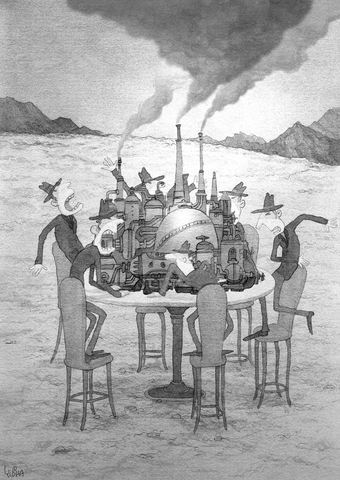
Yet truth has triumphed over political maneuvers. The climate itself is sending a powerful and often devastating message. Hurricane Katrina made the US public aware that global warming would likely raise the intensity of destructive storms. Australia's great drought this past year has similarly made a mockery of Howard's dismissive attitude toward climate change.
Scientists themselves have operated with great seriousness of purpose in educating the public. We can thank the UN for that. The UN sponsors the Intergovernmental Panel on Climate Change (IPCC), a worldwide body of hundreds of climate scientists who report every few years to the public on the science of climate change.
This year, the IPCC is releasing its fourth round of reports, starting with the one issued early this month. That report was unequivocal. There is a powerful scientific consensus that human activity, mainly the burning of fossil fuels -- coal, oil, gas -- as well as deforestation and other factors leads to massive emissions of carbon dioxide into the air. This is causing climate change, which is accelerating and poses serious risks to the planet.
The single biggest threat comes from the production and consumption of energy for electricity, transport, and heating and cooling buildings. But the world's scientists and engineers, as well as global technology leaders such as General Electric, are also sending a clear message: we can solve the problem at modest cost if we put our best thinking and action into real solutions.
By shifting to alternative energy sources, economizing on energy use, and capturing and safely storing the carbon dioxide produced by fossil fuels, global society can limit its emissions of carbon dioxide to prudent levels at an estimated cost of under 1 percent of global income. The changeover to a sustainable energy system will not come quickly, and will require new kinds of electrical power plants, new kinds of automobiles, and green buildings,which economize on energy use.
The process will take decades, but we must start now and act on a global basis, using carbon taxes and emission permits to create market-based incentives for companies and individuals to make the necessary changes. Those incentives will come at modest cost and huge benefit, and they can be designed to protect the poor and shift the climate-change burden to those who can afford it.
A reasonable timetable is possible. By the end of this year, all of the world's governments should begin negotiations on a climate-change system for the years after 2012, when the current Kyoto Protocol expires. Basic principles should be established next year, and by 2009, the world community, including the two largest emitters of carbon dioxide, the US and China, should be ready to make a serious deal, which should be concluded by 2010 and ratified in time to replace the Kyoto Protocol.
The Kyoto Protocol was the first attempt at such a system, but it applied only to rich countries and set only modest objectives. The richest country and biggest contributor to global climate change, the US, didn't even sign. Neither did Australia. Canada signed but has failed to act. Huge energy consumers like China and India, which must be part of any meaningful solution, also refused to sign and face serious responsibilities under the Kyoto agreement. All of that will have to change. All countries will have to shoulder their responsibilities to the rest of the world and to future generations.
There is now a way for individuals and companies to make their own voices heard. The Earth Institute at Columbia University, which I direct, hosted a Global Roundtable of leading businesses, environmental groups, and other international organizations to reach a consensus to help inform the upcoming negotiations. The Roundtable produced an important Statement of Principles and a longer overall statement that has been signed by many of the world's largest businesses, including those based in the US, Europe, Canada, China, and India. Many of the world's leading scientists signed, too.
Global climate change requires global decisions, and initiatives like the Roundtable Statement show that we can find areas of agreement for powerful action. It's time for the world's political holdouts to join that effort.
Jeffrey Sachs is professor of economics and director of the Earth Institute at Columbia University. Copyright: Project Syndicate
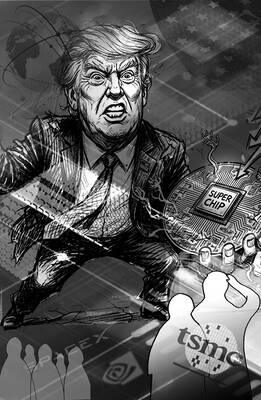
The White House’s decision to take a 9.9 percent stake in Intel Corp is looking like very shrewd business indeed. Since the government bought in at US$20.47 a share last August, the US chipmaker’s surging stock price has delivered the US a US$43 billion return. One of the reasons the investment has so far proved so sound is that the White House has made sure of it. According to The Wall Street Journal, Howard personally pushed deals on Intel’s behalf with some of the most lucrative clients imaginable. They include Nvidia Corp, the company at the heart of the AI
The Ministry of the Interior, working with the navy and coast guard, is organizing Taiwan’s first joint exercise simulating escort tankers carrying liquefied natural gas (LNG) and oil through a Chinese blockade. The drills simulate fuel transport along three maritime corridors leading toward Japan, the Philippines and the US. Deputy Minister of the Interior Sawyer Mars (馬士元) said that a blockade of the Taiwan Strait would amount to “almost a 100 percent blockade of the regional energy supply.” Minister of National Defense Wellington Koo said planning to counter a blockade is standard practice in Taipei. While the exercise is limited in
A single photograph can cut through a lot of noise, but it can also be used to misrepresent the truth. At the very least, it can concentrate the mind on something that requires further investigation. On Monday last week, Ma Ying-jeou Foundation CEO Tai Hsia-ling (戴遐齡) and former National Security Council secretary-general King Pu-tsung (金溥聰) held a news conference in which they showed a photograph of former foundation CEO Hsiao Hsu-tsen (蕭旭岑), now Chinese Nationalist Party (KMT) deputy chairman. In the image Hsiao is seated next to Xiamen Taiwan Businessmen Association chairman Han Ying-huan (韓螢煥). The two men were holding
I first met Professor Ray Jiing (井迎瑞) as a film and documentary student at Shih Hsin University’s (SHU) Department of Radio Television and Film in 1988. The following year, he went on to become the director of the Chinese Taipei Film Archive — forerunner of the Taiwan Film and Audiovisual Institute (TFAI). Over his eight-year tenure, Jiing rescued and restored over 200 classic Taiwanese films. In 1997, he established the Graduate Institute of Studies in Documentary and Film Archiving at Tainan National University of the Arts (TNNUA), and I joined the program in his third cohort of students. Beyond a


 RSS
RSS