


For a few hundred years, when science and mathematics were enjoying a period of great invention, one region of the world stood out. Masters of these disciplines were revered there, medicine advanced quickly, and the average person was curious about how nature worked. Not surprisingly, this region was globally respected.
In the other half of the known planet, scientists were punished, even killed. Mathematics was outlawed as irreligious and alien, and was later made subservient to religion. The standard of living was low.
The prosperous region was the Islamic Middle East, while an ignorant Europe remained poor. Both regions were religiously governed (historians differ about the role and natures of the religions in this context), but science flourished only in one of them. Now, of course, the roles of the Islamic Middle East and the West are reversed.
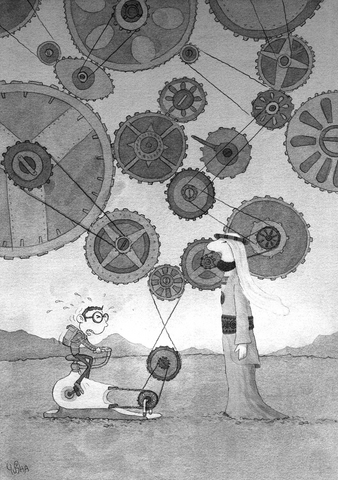
Since World War II, the US has been the world's undisputed leader in science. Throughout this period, the brightest students were drawn away from their native lands, attracted by superior research universities and opportunities. Until recently, more than half of all mathematics, science, and engineering graduate students in the US were foreign-born. Many of these talents stayed after graduation, and both industry and government took advantage of this.
Meanwhile, Islamic cultures entered a historical phase in which science was equated with Western influence and eschewed. Even in countries where oil revenues could fuel a significant amount of research, Arab rulers did not encourage such investment, with the result that their societies have not prospered as much as they might have.
Recently, a desire for greater political respect has spurred Islamic nations to invest in technology, which is most visible in Pakistani and Iranian nuclear ambitions. But while such weapons carry political weight, the science behind them is mundane and old.
More meaningful is the respect that comes from incubating insights, rather than the products of past discoveries. Imagine the influence that would be generated by a Pakistani institute that was the world leader in cancer research. Would the political rhetoric shift if researchers in Oman discovered a key to suppressing AIDS?
This is one unclaimed opportunity. But another exists, and not just for Islamic societies. The US has made profound missteps recently.
"Matters of faith" have been substituted for science across government, from the president down. Top researchers have had their reports changed by political operatives when the facts contradicted official belief. Encouraged by a religiously influenced administration, school systems are shifting their focus from science to "values."
Since the terrorist attacks of September 2001, entry visas are fewer and more difficult to obtain, staunching the flow of young talent into US universities. Major scientific organizations have protested, without result. At the same time, tax laws have been revised to make investors wealthier in the near term, discouraging long-term investment in research.
Half a trillion dollars was committed to the war in Iraq, an amount roughly equal to the sponsorship of all basic research for the last thousand years. Even if the US avoids a fundamentalist dark age, it clearly risks losing its global research dominance.
Japan recognized the link between political clout and science in the 1980s. Japan's chief industrialist, Akio Morita, the chairman of Sony, and the right-wing politician Shintaro Ishihara gave a series of speeches that were collected and published in 1986 as a book called The Japan that Can Say No.
They outlined a national strategy in which world influence was understood to flow from scientific leadership. The key idea was that military power could be made obsolete if the "food chain" of military technologies was controlled by other nations. The book's title refers to Japan's plan to "say no" to US military influence once Japan controlled key military technologies.
Building a knowledge-based economy using oil wealth is clearly possible. For example, Texas, like most southern US states, was once economically poor and declining. Although it had oil revenue, the flow of dollars into an economy, by itself, does not boost prosperity as much as one might think. So Texas decided to devote its oil money to an educational endowment. Today, that endowment is roughly equal to that of Harvard University and is spread over 15 different universities.
The effect has been staggering -- aerospace manufacturing has almost disappeared from California, but is booming in Texas. Telecom research centers and consortia have flocked to Texas, even from the Canadian telecommunications giant Nortel. Although manufacturing in the US is in crisis, Texas has one of the strongest manufacturing economies in the world.
There is no reason that the same outcome could not be achieved in the Middle East. First, however, the Islamic world must rediscover and embrace its proud heritage.
H.T. Goranson is the lead scientist of Sirius-Beta Corp and was a senior scientist with the US Defense Advanced Research Projects Agency. Copyright: Project Syndicate
Taiwan’s higher education system is facing an existential crisis. As the demographic drop-off continues to empty classrooms, universities across the island are locked in a desperate battle for survival, international student recruitment and crucial Ministry of Education funding. To win this battle, institutions have turned to what seems like an objective measure of quality: global university rankings. Unfortunately, this chase is a costly illusion, and taxpayers are footing the bill. In the past few years, the goalposts have shifted from pure research output to “sustainability” and “societal impact,” largely driven by commercial metrics such as the UK-based Times Higher Education (THE) Impact
History might remember 2026, not 2022, as the year artificial intelligence (AI) truly changed everything. ChatGPT’s launch was a product moment. What is happening now is an anthropological moment: AI is no longer merely answering questions. It is now taking initiative and learning from others to get things done, behaving less like software and more like a colleague. The economic consequence is the rise of the one-person company — a structure anticipated in the 2024 book The Choices Amid Great Changes, which I coauthored. The real target of AI is not labor. It is hierarchy. When AI sharply reduces the cost
I wrote this before US President Donald Trump embarked on his uneventful state visit to China on Thursday. So, I shall confine my observations to the joint US-Philippine military exercise of April 20 through May 8, known collectively as “Balikatan 2026.” This year’s Balikatan was notable for its “firsts.” First, it was conducted primarily with Taiwan in mind, not the Philippines or even the South China Sea. It also showed that in the Pacific, America’s alliance network is still robust. Allies are enthusiastic about America’s renewed leadership in the region. Nine decades ago, in 1936, America had neither military strength
The Presidential Office on Saturday reiterated that Taiwan is a sovereign, independent nation after US President Donald Trump said that Taiwan should not “go independent.” “We’re not looking to have somebody say: ‘Let’s go independence because the United States is backing us,’” Trump said in an interview with Fox News aired on Friday. President William Lai (賴清德) on Monday said that the Republic of China (ROC) — Taiwan’s official name — and the People’s Republic of China (PRC) are not subordinate to each other. Speaking at an event marking the 40th anniversary of the establishment of the Democratic Progressive Party (DPP), Lai said


 RSS
RSS