


As globalization proceeds, with the help of ever-faster communications, faster travel and more powerful multinational corporations, a new cosmopolitan social class seems to be emerging. These citizens of the world are developing loyalties to each other that cross national boundaries.
I was at a dinner the other night with Yale World Fellows, a carefully selected group of professionals, representing every major country of the world, who spend a semester at Yale University. It was an unusual experience, because I began to feel that none of these people were really foreign to me. It seemed they were probably easier to talk to than the local Americans who were waiting on us and serving food.
Of course, a cosmopolitan class is hardly new. In fact, 50 years ago, in his classic book Social Theory and Social Structure, the late sociologist Robert Merton described the results of a case study of influential people in a typical US town, Rovere, New Jersey. As a sociologist, he chose this tiny town to study how people relate to each other and influence each other, just as biologists study tiny worms with only a few hundred cells so that they can study how each cell relates to an organism as a whole.
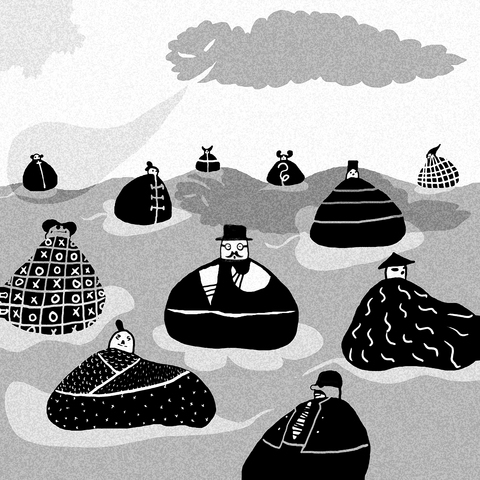
Merton discovered a strong pattern. Rovere's influential people seemed to be sharply divided into "cosmopolitan influentials," who habitually orient themselves with respect to the world at large, and "local influentials," who orient themselves with respect to their own town. As he and his assistants interviewed people, the division between the two groups became more intriguing, and significant, in his mind.
Merton did not say that the cosmopolitan influentials were influential outside Rovere -- apparently none of them was. What stood out instead was their habitual frame of reference, which was tied to their personal identities. When Merton engaged people in conversation, any topic would remind the cosmopolitan influentials of the world at large, while local influentials were reminded of things in their own town.
Cosmopolitan influentials, Merton said, tended to hang their success on their general knowledge, whereas locals relied on their friendships and connections. The cosmopolitan influentials were often uninterested in meeting new people in town -- the locals wanted to know everyone. The cosmopolitan influentials tended to take positions in local government that reflected their broad expertise -- board of health, housing committee, or board of education. The local influentials tended to be in positions that they got through their local popularity -- street commissioner, mayor, or township board member.
The cosmopolitan influential in the town is like the medical specialist -- the local influential is like the family doctor. Merton concluded: "It appears that the cosmopolitan influential has a following because he knows, the local influential because he understands."
The local influentials, Merton discovered, spoke affectionately of their town, as if it were a unique place, and often said they would never leave. The cosmopolitans spoke as if they might leave any day.
What was true in Merton's day is becoming even more starkly true in today's globalized economy. What I find particularly striking is the sense of loyalty developing among cosmopolitans.
After the World Fellows Dinner, the Fellow from Namibia was extolling to me, in impeccable and relaxed English, the beautiful vacation homes I might find (and even buy) there. I felt as if I could perhaps fall into a relationship with him that might work against the interests of the locals in Namibia. I could picture doing that, and he and I would be allies, if I let it happen.
I was left wondering why this is happening on such a scale now. Obviously, improved communications technology plays a role. But how much does that explain the impression that the division between cosmopolitans and locals is so much wider now?
One must realize that individuals choose whether to play the role of cosmopolitan or local, and how much to invest in that role. People make a conscious choice to become either cosmopolitans or locals, depending on their own personal talents and the perceived returns from making the choice.
In the twenty-first century, the new information age creates opportunities not just to be cosmopolitan in spirit and orientation, but to forge strong connections with other cosmopolitans. The cosmopolitans have shared experiences -- they are directly communicating with each other across the globe. Many cosmopolitans around the world now also share the English language, the new lingua franca.
The term "global village" was first popularized in the late 1960s by Canadian communications maven Marshall McLuhan in response to the already powerful communications media of that day. But McLuhan could not have anticipated the cosmopolitan class, because he could not have anticipated the immense development of direct interpersonal communications media that allow cosmopolitans around the world to form friendships.
The cosmopolitans tend to be increasingly wealthy, and their wealth helps mark them as cosmopolitan. Thus, economic inequality is felt differently in today's world. Perhaps it is accepted resignedly, as the cosmopolitan class is too amorphous and ill-defined to be the target of any social movement. There is no spokesperson for the cosmopolitan class, no organization that could be blamed for what is happening.
I fear for the future. How will the cosmopolitan class behave as their role in the world economy continues to strengthen? How unfeeling will they come to be about the people who share their neighborhoods? Most importantly, if resentment by the locals emerges, what political consequences will result?
Robert Shiller is professor of economics at Yale University and chief economist at MacroMarkets LLC, which he co-founded. Copyright: Project Syndicate
KMT Chairwoman Cheng Li-wun’s (鄭麗文) recent visit to Beijing and her upcoming visit to Washington will serve as a high-level test of her diplomatic mettle. In Beijing, Cheng was received with symbolic gestures, a warm reception, and high-level access. In Washington, she will receive far less pomp and far sharper questions about the KMT’s vision for the future of Taiwan. Her challenge will be to persuade Washington that the KMT’s engagement with China can coexist with strong deterrence. Cheng’s April 7-12 visit to mainland China coincided with an intense period of conflict in Iran. Despite the strategic significance of Cheng’s trip,

The closure of the Strait of Hormuz has sent the vast Asian chemicals industry into a tailspin. Deprived of the likes of Qatari natural gas and Saudi Arabian oil, the region’s fertilizer and plastics plants are slowing production or even shutting down. Everywhere except China, that is. In petrochemicals, China is unique. As well as a traditional industry that uses oil and gas as feedstock, it has parallel output that relies on its abundant domestic coal. Unsurprisingly, India and other regional powers want to copy and paste the Chinese method. This would not be easy — or climate friendly. The
US President Donald Trump recently repeated his claim that “Taiwan stole America’s chip industry,” reigniting public debate on the issue. As a former Taiwanese minister of economic affairs and an entrepreneur deeply involved in semiconductor supply chain development, I feel a responsibility to clarify this misunderstanding. From the perspective of global industrial evolution and the economic principle of comparative advantage, such a statement appears overly simplistic and risks obscuring the essence of the issue. The rise of Taiwan’s semiconductor industry was not built on “replacing America,” but rather emerged as a result of countries pursuing different development paths within the
The Presidential Office on Saturday reiterated that Taiwan is a sovereign, independent nation after US President Donald Trump said that Taiwan should not “go independent.” “We’re not looking to have somebody say: ‘Let’s go independence because the United States is backing us,’” Trump said in an interview with Fox News aired on Friday. President William Lai (賴清德) on Monday said that the Republic of China (ROC) — Taiwan’s official name — and the People’s Republic of China (PRC) are not subordinate to each other. Speaking at an event marking the 40th anniversary of the establishment of the Democratic Progressive Party (DPP), Lai said


 RSS
RSS