


In the desert of North Africa is a vast source of energy that holds the promise of a carbon-free, nuclear-free electrical future for the whole of Europe, if not the world.
We are not talking about the vast oil and gas deposits underneath Algeria and Libya, or uranium for nuclear plants, but something far simpler -- the sun. And in vast quantities. Every year it pours down the equivalent of 1.5 million barrels of oil of energy for every square kilometer.
Many people think of solar power as a few panels on the roof of a house producing hot water or a bit of electricity. But according to two reports prepared for the German government, Europe, the Middle East and North Africa should be building vast solar farms in North Africa's deserts using a simple technology that more resembles using a magnifying glass to burn a hole in a piece of paper than any space age technology.
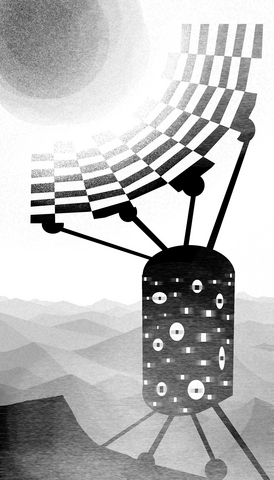
Two German scientists, Gerhard Knies and Franz Trieb, calculate that covering just 0.5 percent of the world's hot deserts with a technology called concentrated solar power (CSP) would provide the world's entire electricity needs, with the technology also providing desalinated water to desert regions as a valuable byproduct, as well as air conditioning for nearby cities.
Focusing on Europe, North Africa and the Middle East, they say, Europe should build a new high-voltage direct current electricity grid to allow the easy, efficient transport of electricity from a variety of alternative sources. Britain could put in wind power, Norway hydro, and central Europe biomass and geo-thermal. Together the region could provide all its electricity needs by 2050 with barely any fossil fuels and no nuclear power. This would allow a 70 percent reduction in carbon dioxide emissions from electricity production over the period.
CSP technology is not new. There has been a plant in the Mojave desert in California for the past 15 years. Others are being built in Nevada, southern Spain and Australia. There are different forms of CSP but all share in common the use of mirrors to concentrate the sun's rays on a pipe or vessel containing some sort of gas or liquid that heats up to around 400oC and is used to power conventional steam turbines.
The mirrors are very large and create shaded areas which can be used for horticulture irrigated by desalinated water generated by the plants. The cold water that can also be produced for air conditioning means there are three benefits.
"It is this triple use of the energy which really boosts the overall energy efficiency of these kinds of plants up to 80 percent to 90 percent," Knies said.
This form of solar power is also attractive because the hot liquid can be stored in large vessels which can keep the turbines running for hours after the sun has gone down, avoiding the problems associated with other forms of solar power.
The two German reports put an approximate cost on power derived from CSP. This is now around US$50 per barrel of oil equivalent for the cost of building a plant. That cost is likely to fall sharply, to about US$20, as the production of the mirrors reaches industrial levels.
It is about half the equivalent cost of using the photovoltaic cells that people have on their roofs. So CSP is competitive with oil, currently priced around US$60 a barrel.
Knies says CSP is not yet competitive with natural gas for producing electricity alone. But if desalination and air conditioning are added CSP undercuts gas and that is without taking into account the cost of the carbon emissions from fossil fuels. The researchers say a relatively small amount of the world's hot deserts -- only about half a percent -- would need to be covered in solar collectors to provide the entire world's electrical needs.
The desert land is plentiful and cheap but, more importantly, there is roughly three times as much sunlight in hot deserts as in northern Europe. This is why the reports recommend a collaboration between countries in Europe, the Middle East and Africa to construct a high-voltage direct current (HVDC) grid for the sharing of carbon-free energy.
Alternating current cables, which now form the main electricity grids in Europe, are not suitable for long distance transport of electricity because too much is lost on the way.
Trieb, of the German Air and Space Agency, says the advantage of the HVDC system is that the loss in transport is only about 3 percent per 1,000km, meaning losses between North Africa and Britain of about 10 percent.
"Contrary to what is commonly supposed it is entirely feasible, and cost-effective, to transmit solar electricity over long distances. Solar electricity imported to Europe would be amongst the cheapest source of electricity and that includes transporting it," he said. "CSP imports would be much less vulnerable to interruption than are current imports of gas, oil and uranium."
Algeria already exports huge quantities of oil and gas to Europe via pipelines but has a vast potential resource in sunlight that could make it a complete energy supplier to Europe. Many members of the OPEC oil cartel, which have worried that alternative energies would kill demand for their oil, are blessed with hot, sunny deserts that could become a further source of energy income.
The two reports make it clear that an HVDC grid around Europe and North Africa could provide enough electricity by 2050 to make it possible to phase out nuclear power and hugely reduce the use of fossil fuels.
An umbrella group of scientists has been formed across the region called the Trans-Mediterranean Renewable Energy Cooperation (TREC) but the idea has yet to excite the imagination of the British government in spite of the recent Stern review on climate change.
"Most politicians on the world stage, particularly [British Prime Minister] Tony Blair and [US President] George Bush, appear to have little or no awareness of CSP's potential let alone a strategic vision for using it to help build global energy and climate security," Neil Crumpton, renewables specialist at Friends of the Earth, said.
European Commission President Jose Manuel Barroso said recently that he wanted to see the EU develop a common energy strategy based on low carbon emissions.
The TREC scientists hope German Chancellor Angela Merkel will use next year's joint presidency of the EU and G8 leading economies to push for an agreement on a European HVDC grid and the launch of a widespread CSP program.
The outlook is not promising. More than 30 countries last week agreed to spend US$13.6 billion on an experimental fusion reactor in France which critics say will not produce any electricity for 50 years, if at all.
That amount of money would provide a lot of CSP power, a proven, working and simple technology that would work now, not in 2056.
Dan Lewis, energy expert at the Economic Research Council, calculates that CSP costs US$3 million to US$5 million per installed megawatt, one-fifth the cost of fusion.
"Fusion is basically a job creation scheme for plasma physicists," he said.
Crumpton agreed.
"Nuclear power accounts for just 3.1 percent of global energy supply and would be hard pushed to provide more. Yet CSP could supply 30 percent or 300 percent of future energy demand far more simply, safely and cost effectively. In the wake of the Stern report the enlightened investment is on hot deserts, not uranium mines or oil wells," he said.
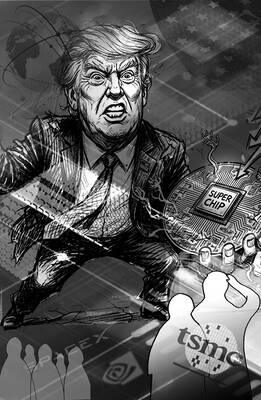
The White House’s decision to take a 9.9 percent stake in Intel Corp is looking like very shrewd business indeed. Since the government bought in at US$20.47 a share last August, the US chipmaker’s surging stock price has delivered the US a US$43 billion return. One of the reasons the investment has so far proved so sound is that the White House has made sure of it. According to The Wall Street Journal, Howard personally pushed deals on Intel’s behalf with some of the most lucrative clients imaginable. They include Nvidia Corp, the company at the heart of the AI
A single photograph can cut through a lot of noise, but it can also be used to misrepresent the truth. At the very least, it can concentrate the mind on something that requires further investigation. On Monday last week, Ma Ying-jeou Foundation CEO Tai Hsia-ling (戴遐齡) and former National Security Council secretary-general King Pu-tsung (金溥聰) held a news conference in which they showed a photograph of former foundation CEO Hsiao Hsu-tsen (蕭旭岑), now Chinese Nationalist Party (KMT) deputy chairman. In the image Hsiao is seated next to Xiamen Taiwan Businessmen Association chairman Han Ying-huan (韓螢煥). The two men were holding
I first met Professor Ray Jiing (井迎瑞) as a film and documentary student at Shih Hsin University’s (SHU) Department of Radio Television and Film in 1988. The following year, he went on to become the director of the Chinese Taipei Film Archive — forerunner of the Taiwan Film and Audiovisual Institute (TFAI). Over his eight-year tenure, Jiing rescued and restored over 200 classic Taiwanese films. In 1997, he established the Graduate Institute of Studies in Documentary and Film Archiving at Tainan National University of the Arts (TNNUA), and I joined the program in his third cohort of students. Beyond a
A recent report concerning a student who is suing his teacher posed the question in its headline: Does failing a student in two subjects constitute bullying? The college student in Chiayi County apparently sought NT$2 million (US$63,603) in state compensation, but a court dismissed the case. The first reaction of many might have been to ask: What has happened to students nowadays? Some say that teachers have lost their authority, while others say students are overindulged. Some even start reminiscing over the days when “whatever the teacher says goes.” However, the real issue might be overlooked if emotional reactions like that are the


 RSS
RSS