


Far from the political upheaval in Washington and the continuing carnage in Iraq, the navies of the Pacific are girding themselves to provide more of the maritime security that is vital to their expanding economies.
In particular, the US and Asian navies are seeking to prevent the terror that has been spreading on land in Asia from moving to sea where it would threaten the lifelines of all but the landlocked nations of the region. These navies, however, are not doing so well in working together to prevent the shipment of nuclear weapons and missiles from North Korea to terrorists in Southeast Asia or elsewhere.
Led by South Korea, which has been seeking an accommodation with North Korea, several navies have balked at searching North Korean ships on the high seas.
A US naval intelligence report on terror in Asia says: "The number and lethality of attacks are growing as smaller, decentralized jihadist groups increase the violence against local political, security, and communal targets."
Many assaults occurred in the Philippines and southern Thailand.
This year, the report said, 1,015 people have been killed in 491 attacks, compared with 880 killed in 373 assaults last year. Safe havens for terrorists have been discovered in Bangladesh, the site of much civil strife, in Myanmar, Laos and Papua New Guinea.
Both US naval intelligence and the International Maritime Bureau in Kuala Lumpur, Malaysia, which tracks piracy worldwide, reported a decline in sea robbery as navies and coast guards have gone on the offensive.
Piracy around Indonesia dropped to 40 incidents in the January-September period, compared with 61 in the same time last year. Even so, Indonesia still had the world's worst record for piracy.
The potential for a link-up between pirates and terrorists remains, the intelligence report says.
Some 70,000 ships pass through the Straits of Malacca and the South China Sea every year carrying half of the world's oil and a third of its commerce. A ship scuttled or blown up in those sea-lanes would cause unpredictable economic and political disruption.
The US Chief of Naval Operations, Admiral Michael Mullen, told a recent naval symposium in Honolulu: "These ideologues, pirates, proliferators, criminals and terrorists are prevalent throughout the coastal regions that we are all obligated to protect."
He asserted: "Without maritime cooperation, we cannot hope to effectively battle these forces of instability."
The US Navy, however, has urged other navies to take on the greater share of responsibility for countering those predators. In Asia, colonialism ended only a few decades ago and Asians are sensitive to anything that they perceive encroaches on their sovereignty.
Aware of that, Admiral Gary Roughead, who commands the US Pacific Fleet, told the conference: "I made it clear that I don't want to be patrolling in other people's waters."
Similarly, the commander of all US forces in the Pacific, Admiral William Fallon, told Indonesian officers last February: "It's your neighborhood, you should do it yourself."
Mullen, Roughead, and leaders of 15 other navies gathered in Honolulu behind closed doors earlier this month for the annual Western Pacific Naval Symposium. A US Navy spokesman said the Proliferation Security Initiative, which US President George Bush said in Singapore was intended to halt the seaborne spread of nuclear material, was not discussed.
To combat piracy and terror, the US for several years has advocated having the world's 90,000 ships emulate aircraft, almost every one of which is monitored whenever it is in the air. Requiring ships to transmit an automatic identification system and having that information fed into collecting points would be critical.
Then, if a ship started to sail off its plotted track, a navy, coast guard, or law enforcement vessel -- or aircraft -- would check it out.
Roughead said some nations, such as Singapore, now require every ship that enters its waters have such a system. Since pirates usually use high-speed boats displacing less than 300 tonnes, Roughead said they should be included in any monitoring system.
The main task before the navy leaders was to find ways to gather and move information faster than pirates or terrorists could make decisions.
The technology exists and much of the discussion centered on methods of communicating quickly.
When Mullen was asked whether this effort would be a distraction from the US Navy's main mission of fighting wars, he was emphatic: "No, you pay me not to go to war. You pay me to prevent war. This is all part of the deterrence of war."
Richard Halloran is a writer based in Hawaii.
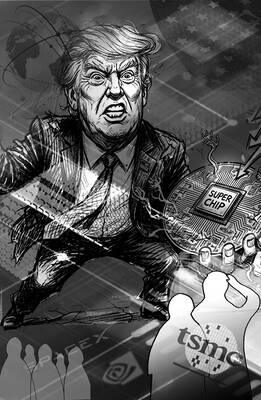
The White House’s decision to take a 9.9 percent stake in Intel Corp is looking like very shrewd business indeed. Since the government bought in at US$20.47 a share last August, the US chipmaker’s surging stock price has delivered the US a US$43 billion return. One of the reasons the investment has so far proved so sound is that the White House has made sure of it. According to The Wall Street Journal, Howard personally pushed deals on Intel’s behalf with some of the most lucrative clients imaginable. They include Nvidia Corp, the company at the heart of the AI
A single photograph can cut through a lot of noise, but it can also be used to misrepresent the truth. At the very least, it can concentrate the mind on something that requires further investigation. On Monday last week, Ma Ying-jeou Foundation CEO Tai Hsia-ling (戴遐齡) and former National Security Council secretary-general King Pu-tsung (金溥聰) held a news conference in which they showed a photograph of former foundation CEO Hsiao Hsu-tsen (蕭旭岑), now Chinese Nationalist Party (KMT) deputy chairman. In the image Hsiao is seated next to Xiamen Taiwan Businessmen Association chairman Han Ying-huan (韓螢煥). The two men were holding
I first met Professor Ray Jiing (井迎瑞) as a film and documentary student at Shih Hsin University’s (SHU) Department of Radio Television and Film in 1988. The following year, he went on to become the director of the Chinese Taipei Film Archive — forerunner of the Taiwan Film and Audiovisual Institute (TFAI). Over his eight-year tenure, Jiing rescued and restored over 200 classic Taiwanese films. In 1997, he established the Graduate Institute of Studies in Documentary and Film Archiving at Tainan National University of the Arts (TNNUA), and I joined the program in his third cohort of students. Beyond a
A recent report concerning a student who is suing his teacher posed the question in its headline: Does failing a student in two subjects constitute bullying? The college student in Chiayi County apparently sought NT$2 million (US$63,603) in state compensation, but a court dismissed the case. The first reaction of many might have been to ask: What has happened to students nowadays? Some say that teachers have lost their authority, while others say students are overindulged. Some even start reminiscing over the days when “whatever the teacher says goes.” However, the real issue might be overlooked if emotional reactions like that are the


 RSS
RSS