


Chinese President Hu Jintao's (
With China's US trade surplus reaching US$200 billion last year, US sentiment is leaning toward taking strong measures. A recent congressional bill has called for imposing a 27.5 percent punitive tariff on Chinese imports.
The trade imbalance is more complicated than the currency issue per se. Globalization has strengthened the ability of capital to flow to wherever investment promises the highest return; likewise, competitive manufactured products from low-wage economies will flow in the other direction. That is why China fascinates US investors, among others, and why US customers buy Chinese products.
To be sure, the exchange rate has an impact on investment and trade. But, even with China's efforts to loosen the yuan-dollar linkage, it is arguable whether revaluation could save US jobs or improve the US trade balance. After all, China is not alone: India and other competitive developing countries pose a similar challenge to the US.
Nevertheless, for China's part, it now seems to be a good time to reflect on how to increase the country's value-added exports, as well as focus on environmental protection and sustainability. Thus, there is scope for a compromise that recognizes both sides' legitimate concerns.
The Chinese government is hastening its shopping spree in the US these days, pushing up the yuan's exchange rate slowly but steadily. A sensible US policy on China would be to accept gradual currency appreciation, rather than a large revaluation, as the US' economic vitality stems from its own innovation rather than from concessions by the Chinese government.
A more difficult issue for Hu could be IPR. China's recent campaign to crack down on pirating needs to be encouraged, but far more needs to be done. However, while the US government and US companies question whether the Chinese are willing and able to enforce such rights, this issue must be put in historical perspective.
IPR protection is related to economic development, so the question should be whether China has reached the stage at which effective protection is possible.
There is a positive side to such problems, however, namely that their very emergence reflects the deepening and broadening of bilateral relations. Indeed, Sino-US interaction has been so strong that the two presidents met five times last year.
For example, the two states share a common interest in anti-terrorism efforts, and they have been collaborating to ensure container security and combat human trafficking. Their coordinated efforts to divert North Korea peacefully from its nuclear course have also vindicated bilateral cooperation when both sides can define a common security stake.
Similarly, the two countries have a common interest in stabilizing China's relations with Taiwan. The current formula, maintaining the "status quo," offers the highest common denominator. With this strategic understanding, there is good reason to expect that Hu's talks with Bush on Taiwan's recent termination of the National Unification Council will serve to reduce tensions. China and the US both have much to gain by thwarting Taiwan's apparent moves toward independence.
Nevertheless, to US eyes, other contentious issues are now emerging in relations with China. The recently released National Security Strategy outlines three, in particular: China's global trade expansion, its military transparency and its relations with "misruling" states.
The political cost of a serious compromise on these matters would be high for China, but it does no harm to analyze and discuss them. Among the issues, military transparency seems to be the most sensitive and difficult to address.
Nevertheless, given the large size of China's armed forces, which currently stand at 2.3 million, a rough calculation would indicate that average monthly spending per soldier is at most 2,500 yuan (US$312). But if China wants to raise the military budget to improve the quality of its army, the demands of fiscal stability could make military transparency important for domestic reasons, and China might no longer view it as being off limits in its relations with the US.
Above all, we must bear in mind the maturation of Sino-US relations in recent years. A mature bilateral relationship is one in which even difficult issues can be discussed routinely. There is no question that such a framework has already been established in relations with the US. We will now see how Hu uses that framework -- and thus what imprint he leaves on the bilateral relationship -- in meeting the current challenges.
Shen Dingli is executive dean of the Institute of International Studies and deputy director of the Center for American Studies at Fudan University.
Copyright: Project Syndicate
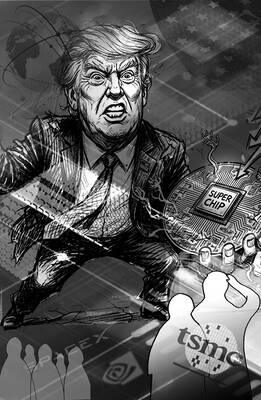
The White House’s decision to take a 9.9 percent stake in Intel Corp is looking like very shrewd business indeed. Since the government bought in at US$20.47 a share last August, the US chipmaker’s surging stock price has delivered the US a US$43 billion return. One of the reasons the investment has so far proved so sound is that the White House has made sure of it. According to The Wall Street Journal, Howard personally pushed deals on Intel’s behalf with some of the most lucrative clients imaginable. They include Nvidia Corp, the company at the heart of the AI
A single photograph can cut through a lot of noise, but it can also be used to misrepresent the truth. At the very least, it can concentrate the mind on something that requires further investigation. On Monday last week, Ma Ying-jeou Foundation CEO Tai Hsia-ling (戴遐齡) and former National Security Council secretary-general King Pu-tsung (金溥聰) held a news conference in which they showed a photograph of former foundation CEO Hsiao Hsu-tsen (蕭旭岑), now Chinese Nationalist Party (KMT) deputy chairman. In the image Hsiao is seated next to Xiamen Taiwan Businessmen Association chairman Han Ying-huan (韓螢煥). The two men were holding
I first met Professor Ray Jiing (井迎瑞) as a film and documentary student at Shih Hsin University’s (SHU) Department of Radio Television and Film in 1988. The following year, he went on to become the director of the Chinese Taipei Film Archive — forerunner of the Taiwan Film and Audiovisual Institute (TFAI). Over his eight-year tenure, Jiing rescued and restored over 200 classic Taiwanese films. In 1997, he established the Graduate Institute of Studies in Documentary and Film Archiving at Tainan National University of the Arts (TNNUA), and I joined the program in his third cohort of students. Beyond a
A recent report concerning a student who is suing his teacher posed the question in its headline: Does failing a student in two subjects constitute bullying? The college student in Chiayi County apparently sought NT$2 million (US$63,603) in state compensation, but a court dismissed the case. The first reaction of many might have been to ask: What has happened to students nowadays? Some say that teachers have lost their authority, while others say students are overindulged. Some even start reminiscing over the days when “whatever the teacher says goes.” However, the real issue might be overlooked if emotional reactions like that are the


 RSS
RSS