


In his book The World is Flat, Thomas Friedman, a US columnist who has served as a visiting professor at Harvard, sounds a warning about China's economic growth. According to Friedman, China will very quickly reach a point at which further economic growth will be impossible unless political reform takes place. Without freedom of the press, without healthy public and social institutions, it will be impossible to root out corruption. The economy will be stifled in the absence of an efficient legal system.
Friedman goes on to say that without transparency in government, without a voice for the people's complaints, there is no way that China will be able to deal with its inevitable future economic decline.
This brings to mind a recent report on views expressed by James Keith, senior adviser for the US State Department's Bureau of East Asia and Pacific Affairs, during a congressional hearing last week titled "What keeps China's leaders awake at night, and what are US leaders doing in response." In the report, US officials questioned whether there will come a day when violent mass protests, of which there has been an alarming increase, get out of hand.
What environmental disasters, they asked, will result from China's rapid economic growth? Will the huge income gap lead to social unrest in rural areas? And how is China to handle Taiwan's president, who is increasingly moving toward formal independence?
The report also included comments by US National Intelligence Director John Negroponte that China's domestic oppression could seriously endanger national stability and jeopardize its foreign policy.
Let us now look at former Taipei cultural chief Lung Ying-tai's (
All this reminds me of certain official statistics released by China, which put the number of mass protests last year at 87,000, a vast increase from the previous year's figure of 74,000. It reminds me of other reports, such as how, with the scrapping of the China Youth Daily supplement the Freezing Point, the media in China has been given the cold shoulder.
It reminds me of reports of China's major problems with water pollution, and how something like 70 percent of China's rivers and lakes are seriously polluted by industrial waste and untreated sewage.
On the surface there seems to be little connection between the issues outlined above. But in fact, they all point to one phenomenon: China's ever more serious breakdown of political, social, economic and financial order, as well as potential chaos resulting from corruption, environmental pollution and industrial safety issues.
In other words, if China continues to resist reform, the situation will become even more unstable and domestic unrest could worsen. If it does come to this, there will be serious implications for the economies of both China and Taiwan. These problems will be more serious and more complex than the issues of independence or unification, or the scrapping of the National Unification Council and National Unification Guidelines. Taiwan had better prepare itself.
Lee Yung-ming is an associate professor in the department of aerospace and systems engineering at Feng Chia University.
Translated by Paul Cooper

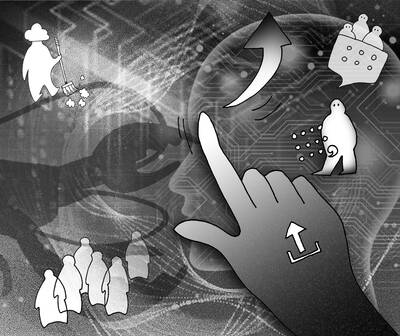
Weeks into the craze, nobody quite knows what to make of the OpenClaw mania sweeping China, marked by viral photos of retirees lining up for installation events and users gathering in red claw hats. The queues and cosplay inspired by the “raising a lobster” trend make for irresistible China clickbait. However, the West is fixating on the least important part of the story. As a consumer craze, OpenClaw — the AI agent designed to do tasks on a user’s behalf — would likely burn out. Without some developer background, it is too glitchy and technically awkward for true mainstream adoption,
A delegation of Chinese Nationalist Party (KMT) officials led by Chairwoman Cheng Li-wun (鄭麗文) is to travel to China tomorrow for a six-day visit to Jiangsu, Shanghai and Beijing, which might end with a meeting between Cheng and Chinese President Xi Jinping (習近平). The trip was announced by Xinhua news agency on Monday last week, which cited China’s Taiwan Affairs Office (TAO) Director Song Tao (宋濤) as saying that Cheng has repeatedly expressed willingness to visit China, and that the Chinese Communist Party (CCP) Central Committee and Xi have extended an invitation. Although some people have been speculating about a potential Xi-Cheng
Chinese Nationalist Party (KMT) Chairwoman Cheng Li-wun (鄭麗文) is leading a delegation to China through Sunday. She is expected to meet with Chinese President Xi Jinping (習近平) in Beijing tomorrow. That date coincides with the anniversary of the signing of the Taiwan Relations Act (TRA), which marked a cornerstone of Taiwan-US relations. Staging their meeting on this date makes it clear that the Chinese Communist Party (CCP) intends to challenge the US and demonstrate its “authority” over Taiwan. Since the US severed official diplomatic relations with Taiwan in 1979, it has relied on the TRA as a legal basis for all
The ongoing Iran conflict is putting Taiwan’s energy fragility on full display — the island of 23 million people, home to the world’s most advanced semiconductor manufacturing, is highly dependent on imported oil and gas, especially that from the Middle East. In 2025, 69.6 percent of Taiwan’s crude oil and 38.7 percent of liquified natural gas were sourced from the Middle East. In the same year, 62 percent of crude oil and 34 percent of LNG to Taiwan went through the Strait of Hormuz. Taiwan’s state-run oil company CPC Corp’s benchmark crude oil price (70 percent Dubai, 30 percent Brent)


 RSS
RSS