


Israeli politics is undergoing its most dramatic changes in 30 years. The realignment of parties and leaders is all the more remarkable because the latest developments -- Prime Minister Ariel Sharon's decision to leave the ruling Likud party, the defeat of Shimon Peres as the Labor party's chairman, and Labor's withdrawal from Sharon's grand coalition government -- were utterly unexpected. So it is all the more important to comprehend the significance of these changes for the future of Israel, the region, and the Arab-Israeli conflict.
Israel's political system is, to put it simply, coming to the end of its second era. From independence in 1948 until 1977, the Labor party was dominant, before giving way to an opposition coalition of conservative, nationalist, and centrist parties allied in the Likud bloc. Since then, the two parties have taken turns in power, sometimes in grand coalitions and often in partnership with smaller parties.
On the surface, party competition has been between "left" and "right," or "hawks" and "doves." The truth, of course, is more complex. Social class and economic issues, overshadowed by the persistence of more existential concerns -- physical security and the continued existence of the state -- have played a much less important role in Israel than in other societies.
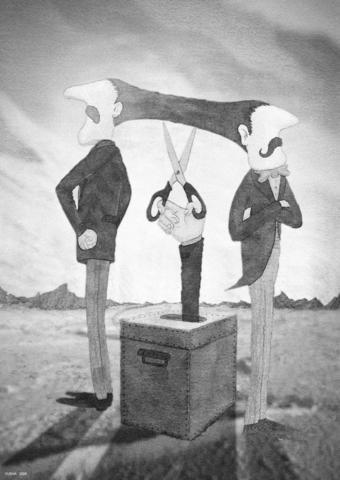
Here, the political divide could be defined as "optimists" versus "pessimists." The former, as in Labor, believed that some day a force would emerge among Arabs and Palestinians ready to make peace on a reasonable basis; the latter, as in Likud, were more doubtful.
For years, the argument remained an abstraction, a debate over what might happen in the future, until the Oslo agreement with the Palestine Liberation Organization (PLO) in 1993 put the competing perspectives to the test. Since 2000, when PLO leader Yasser Arafat rejected a political settlement and instead launched a five-year war of terrorism, there have been few optimists left.
The subsequent intellectual realignment in Israel has given rise to a new national consensus. It is now generally accepted that, as the left has always insisted, Israel should be ready to withdraw from the West Bank and Gaza Strip and accept a Palestinian state in exchange for real peace. But it is also accepted that, as the right has always maintained, there is no partner ready to make real peace. In this context, Sharon gained two landslide election victories as a hardliner, but implemented a moderate policy, including a full withdrawal from the Gaza Strip.
This is where Israel stands today, facing a political upheaval fueled by two developments.
First, Sharon moved the Likud to the center, making it the hegemonic party, while destroying every stereotype about his personality, methods, and worldview. For the same reason, though, many within Likud view Sharon -- who helped found the party -- as a traitor. Sharon now needs to institutionalize his reforms, even if he now needs to establish another party to do so.
Second, the Labor party has proven politically bankrupt, with its only conceivable leader being the 82-year-old Shimon Peres and its anachronistic dovish optimism the source of much ridicule. As a result -- and helped by low voter turnout -- the party's leadership primary was won by Amir Peretz, an outsider and populist who wants to revitalize Labor by putting social and economic issues at the forefront, which means withdrawing from the national unity coalition with Likud.
Despite having to form a new party, Sharon will probably win the next election, which he has called for February. Peretz's strategy may draw voters from other parties on the left, but Labor will most likely lose centrist voters (and those for whom national security is paramount) to Sharon.
Paradoxically, all of this will mean both a great deal in principle and perhaps little in practice. With Sharon enjoying a strong public mandate for a moderate policy, Israel will be more ready than ever to make a deal with the Palestinians, Syria, and the Arab world in general for a comprehensive diplomatic solution to the conflict.
Yet, given the chaos and paralysis that increasingly characterize Palestinian politics, that opportunity will go untaken. The rising power of Hamas, which openly proclaims its strategy of increasing terrorism and its goal of destroying Israel, reinforces that trend.
The same can be said of Syria, whose hardline government is turning toward a dangerously adventurous militancy.
Sharon might decide on partial withdrawals and dismantling of settlements on the West Bank. But it is now widely recognized that such changes are a response to dim prospects of real progress toward peace. Holding onto territory as a bargaining chip makes less sense if there is no one with whom to bargain.
Instead, Israel will continue to prioritize its own security, strengthening its defenses against terrorism and consolidating control over the relatively small portions of the West Bank that it intends to claim as part of an eventual diplomatic settlement.
A byproduct of this strategy, combined with ongoing Palestinian attacks, has been growing international sympathy with Israel.
That, too, could continue if the current political realignment proves permanent, enabling Sharon to win over the center and even moderate left for his program.
Nothing is assured, of course. Sharon's threat to quit Likud could be mere posturing, the still popular Benjamin Netanyahu could emerge as a powerful rival on his right, and Peretz might yet shape Labor into a serious contender on his left.
Nevertheless, the national consensus has shifted, shaking all assumptions about Israeli politics. The February elections will put those assumptions to their severest test in decades.
Barry Rubin is director of the GLORIA Center at Israel's Interdisciplinary University and editor of the Middle East Review of International Affairs.
Copyright: Project Syndicate
The Comedy Club on Fuxing N Road in Taipei was vandalized with paint bombs mixed with feces on May 29, allegedly because one of its performers had satirized Chinese President Xi Jinping (習近平). The incident has triggered concerns about the growing threat from China’s cross-border repression within Taiwan. On the day of the attack, a comedian surnamed Huang (黃), who is known for mocking Xi, was the headline performer. The Comedy Club founder said the assault was obviously politically motivated. China, which Freedom House said “conducts the most sophisticated, extensive and far-reaching campaign of transnational repression in the world,” has
China’s Taiwan Affairs Office spokesperson Zhu Fenglian (朱鳳蓮) at a press conference last week repeated the same, tired line, claiming that Taiwan’s future should be “decided jointly by the more than 1.4 billion Chinese people, including Taiwan compatriots.” The statement is absurd. Virtually every word is incorrect, with some parts mistaken to an astonishing degree. First, the People’s Republic of China (PRC) has never included Taiwan. When the Republic of China’s (ROC) original five-colored flag was established in 1912, Taiwan was still under Japanese rule. When the PRC was founded in 1949, Taiwan was under the control of president Chiang
Just before dawn on Jan. 17, a Chinese military drone crossed for the first time into Taiwanese airspace above a disputed coral reef in the South China Sea. The reconnaissance aircraft lingered over Pratas Island (Xisha Island, 西沙群島) for a few minutes, while Taipei issued warnings to leave over international radio frequencies. China said the flight was a “normal” training mission. Taiwan called it “provocative and irresponsible.” On the other side of the world, officials in Europe saw the maneuver as part of a long-term Chinese plan to salami-slice away Taiwanese control over its territory and, eventually, force its unification with China. EU officials
Following the outbreak of conflict in Iran, TikTok was flooded with videos targeting Taiwanese users. Many featured artificial intelligence (AI)-generated anchors posing as Taiwanese broadcasters with localized traditional Chinese subtitles. The videos warned of imminent social collapse due to liquefied natural gas shortages, blamed the Democratic Progressive Party and its alleged failed energy policies for a fabricated crisis, and used recycled footage from unrelated events to create the impression Taiwan stood on the edge of systemic breakdown. By saturating the information environment with falsehoods or selectively edited material designed to trigger emotional responses, malign actors can exploit cognitive vulnerabilities and


 RSS
RSS