


Most journalistic accounts of the new forms of electronic money misleadingly spin the story as the emergence of yet another convenience for the technologically pampered. So what if we can pull out a "smart card" rather than carry coins? Big deal. These new forms of money sound like power windows on cars, or remote control for TV sets. Maybe we'd be better off without these gadgets.
But media coverage has failed to look far enough into the future, and to comprehend the full extent of the changes that will be wrought by new forms of electronic money, as people and businesses invent new ways of doing business. Electronic money is not a channel changer: As it develops, it will help transform the world economy.
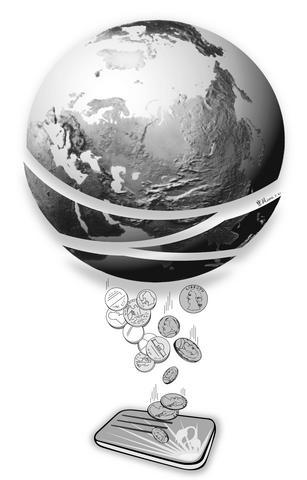
Two benefits of electronic money stand out, and will likely contribute to its growth. Most important, it will have profound intellectual benefits by creating incentives for the active pursuit of ideas. Second, electronic money will advance globalization, expanding the scope and versatility of the Internet and making it easier for people to interact constructively with others around the world. Taken together, these two benefits will enable millions of minds to work together far more effectively than ever before.
To understand electronic money's potential significance, consider the invention of coins, the first form of true money, in Lydia (now Turkey) in the 7th century BC and, independently, in China. This was an important advance, and thus one that spread quickly.
The reason is straightforward. Before the invention of coins, commerce depended on precious metals. But the amounts had to be cut to the size of the transaction and weighed out with balance scales. People had to carry the scales, accompanying weights, and sometimes even tools to cut the metal, just to be able to transact. Archeologists still find elaborate (and probably expensive in those days) two-pan balance scales and weights on sunken bronze-age merchant ships. Most people didn't have them.
Another difficulty with using undifferentiated precious metals for exchange was that some trust or expertise was required to assure people that the metal was pure. The same problem occurred with other commodities that people tried to use for exchange, such as gems or shells; their value was too uncertain.
As a result of these obstacles, it was hard to carry out small transactions before the invention of standardized and identical coins, and trade must have been largely confined to big deals between major parties. With the introduction of coins, it became possible to develop many new kinds of business. One could easily establish and operate a business selling food by the serving or providing small household items to anyone who happened to pass by.
But, most importantly, the invention of coins greatly enhanced the spread of knowledge. After the invention of coins, it became easy to sell books, lessons and instructions. The development of coins is part of the reason that both the classical world around ancient Lydia and China in the Han Dynasty were so advanced compared to other parts of the world.
The lesson is that the magnitude of transaction costs and contracting costs ultimately determine much of an economy's structure. As new forms of money reduce these costs, the richness and complexity of our economy will be increased. Lower transaction costs mean that exchange can be dramatically more fine-grained. With the latest forms of electronic money we can sell millions of little things, to millions of different people all over the world. Nowhere is this more important than in the realm of ideas.
Credit-card companies now routinely charge the firms accepting credit card payments US$0.25, plus between 2 percent and 3 percent of the amount transferred per payment. This fee structure makes it difficult to run a business selling items for less than US$10, and impossible to run a business selling items for less than US$1: Transaction costs eat up the profits.
Through superior payments software, micropayments companies like Paypal (founded in 1998), Yaga (founded in 2000), Peppercoin (founded in 2001) and BitPass (founded in 2002) are able to offer much lower transaction costs than credit-card companies, greatly expanding the number of transactions. A company can now charge people less than US$1 for a service (such as viewing a Web page), and get significant returns by high volume.
There are skeptics who say that the public is resistant to buying digital content, because people are accustomed to getting it for free. That is what people used to say years ago about cable TV. Excellent TV programming is not given away for free. Neither are other substantial intellectual creations. These skeptics overlook the profound changes that new technologies gradually make in our habits as we discover their possibilities.
Already, we have seen the success of Apple's iTunes, which sells music for US$0.99 per song. Created last year, the iTunes Music Store recently surpassed its 100 millionth sale. That is certainly high volume. What iTunes sells is one form of intellectual content. Other forms will follow.
It will be exciting to see what new forms of intellectual content are invented in coming years and decades. The economic revolution -- both online and offline -- that will be triggered as we learn how to use electronic money may be as profound as that wrought by our ancient ancestors' invention of coins.
Robert Shiller is professor of economics at Yale University, and author of Irrational Exuberance and The New Financial Order: Risk in the 21st Century.
Copyright: Project Syndicate

The White House’s decision to take a 9.9 percent stake in Intel Corp is looking like very shrewd business indeed. Since the government bought in at US$20.47 a share last August, the US chipmaker’s surging stock price has delivered the US a US$43 billion return. One of the reasons the investment has so far proved so sound is that the White House has made sure of it. According to The Wall Street Journal, Howard personally pushed deals on Intel’s behalf with some of the most lucrative clients imaginable. They include Nvidia Corp, the company at the heart of the AI
A single photograph can cut through a lot of noise, but it can also be used to misrepresent the truth. At the very least, it can concentrate the mind on something that requires further investigation. On Monday last week, Ma Ying-jeou Foundation CEO Tai Hsia-ling (戴遐齡) and former National Security Council secretary-general King Pu-tsung (金溥聰) held a news conference in which they showed a photograph of former foundation CEO Hsiao Hsu-tsen (蕭旭岑), now Chinese Nationalist Party (KMT) deputy chairman. In the image Hsiao is seated next to Xiamen Taiwan Businessmen Association chairman Han Ying-huan (韓螢煥). The two men were holding
I first met Professor Ray Jiing (井迎瑞) as a film and documentary student at Shih Hsin University’s (SHU) Department of Radio Television and Film in 1988. The following year, he went on to become the director of the Chinese Taipei Film Archive — forerunner of the Taiwan Film and Audiovisual Institute (TFAI). Over his eight-year tenure, Jiing rescued and restored over 200 classic Taiwanese films. In 1997, he established the Graduate Institute of Studies in Documentary and Film Archiving at Tainan National University of the Arts (TNNUA), and I joined the program in his third cohort of students. Beyond a
A recent report concerning a student who is suing his teacher posed the question in its headline: Does failing a student in two subjects constitute bullying? The college student in Chiayi County apparently sought NT$2 million (US$63,603) in state compensation, but a court dismissed the case. The first reaction of many might have been to ask: What has happened to students nowadays? Some say that teachers have lost their authority, while others say students are overindulged. Some even start reminiscing over the days when “whatever the teacher says goes.” However, the real issue might be overlooked if emotional reactions like that are the


 RSS
RSS