


AT first glance it is remarkable. Moscow has the same wide streets, exhilarating Metro and extraordinary Stalinist gothic architecture mingling with bulbous church cupolas that it had under communism. But now it is unmistakably capitalist. Luxury-car showrooms and ads for extravagant perfumes jostle for attention; rush-hour traffic jams could be in New York or Los Angeles.
This is a city of 10 million people where unemployment is negligible, property prices are ballooning, clubs are booked out and problems of the transition to capitalism seem to be receding. Moscow is leading; Russia must soon follow.
Yet scratch the surface and you start to see how deep and perhaps unmendable are the wounds from communism.
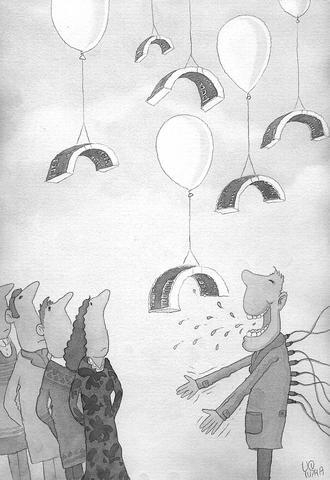
ILLUSTRATION: YU SHA
Moscow may have full employment but living standards are chronically low. For most, it is a daily struggle to survive, one Muscovite told me. The newly emerging upper middle class of executives may be doing well, but average salaries are a few hundred US dollars a month. Prices may be a third lower than in the West, but that scarcely compensates.
Alcoholism is rife. Life expectancy is falling.
Moscow has the headquarters of nearly all big Russian enterprises. It is the seat of government in a highly centralized country of 145 million. Oil revenues from what is in effect a petro-economy, with 28 percent of GDP represented by the oil and gas sector, flow through it.
The inequality between Moscow and the rest of the country is stunning, but inequality is the new fact of Russian life. If life is tough in Moscow, what it must be like in the rest of Russia -- where wages are much less -- scarcely bears thinking about.
Small wonder Mikhail Fradkov, confirmed as prime minister last week, declared that his first objective -- faithfully echoing President Vladimir Putin -- was to alleviate poverty.
Despite economic growth, largely driven by ever-higher oil revenues and high oil prices, it's hard to be sanguine. Breaking out of the cycle of endemically low productivity, low wages and an economic structure that grows less competitive by the year -- the privatized and protected Russian car industry has yet to launch a new model -- requires more investment.
That in turn requires a system of corporate organization and finance capable of lifting investment, and a business class willing to make it. That is what Russia does not have.
The new oligarchs are criticized for their wealth -- 36 new billionaires own 24 percent of Russian GDP -- but that misses the point. Their riches might be excusable if they had discharged their part of the privatization bargain: to build great businesses and accept a reciprocal obligation to the society of which they are part.
The addition to the rich list of Elena Baturina, wife of the mayor of Moscow -- thanks to her construction company Inteko -- is a case in point. Few in Moscow believe she could have achieved her wealth without her husband, although nothing can be proved.
This is where the legacy of communism, and indeed Russia's pre-communist past, hangs over the country like a pall. Authoritarian traditions run deep; there is no conception of pluralism.
In company law, and more importantly business practice, minority shareholders, for example, are powerless. In a takeover, either the victim owner or the managers simply whisk the company's assets away during the negotiations, leaving minority shareholders -- and the new owners -- with nothing but an empty shell when the transaction is complete.
The idea that minority shareholders can and should, either culturally or legally, hold owners and managers to account for their actions comes from another, pluralist, planet. The majority owner is tsar or tsarina of all he or she surveys.
Revenues are channelled through offshore tax havens. Fraud, racketeering and corruption are ubiquitous. Honest-to-God investment and business-building is not the prevailing culture.
One of the designers of the privatization program told me that in retrospect he wished Russia had not imported the Western doctrine of limited liability: it made oligarch owners too cavalier and irresponsible about business. There needed to be the threat of bankruptcy for the new private oligarchs to learn the value of business integrity.
This is the tragedy of Putin's arrest of Mikhail Khodorkovsky, ex-head of the giant oil company Yukos. Under pressure from Wall Street, Khodorkovsky had decided that Yukos' affairs had to be more transparent, thus providing Putin with the evidence of tax fraud that others keep hidden.
Russian business has learned there are no rewards for Western-style transparency and decent corporate governance.
Putin's actions were instinctively Russian. Here was an opportunity to cut down an alternative source of power. Had Khodorkovsky been closer to the Kremlin, he might have been spared.
Another lesson learned: keep close to the Kremlin.
In Russia this is understood as a crisis of liberalism, and while there is regret and disillusion that the promise of the 1990s -- Russia moving quickly to become a rich liberal capitalist democracy -- has not been kept, there is little sense of fury.
Most Russians I have spoken to seem resigned to the new political and economic reality. They live in a managed democracy where parliamentary and presidential majorities are engineered, the press is docile and the secret services are again dominant. Centralized command and control of the economy is once again being reasserted. Maybe this is inevitable in Russia.
If so, Russia is condemned to endemic poverty, inequality and monumental accretion of unaccountable power in the private and public sector alike. The case for democratic pluralism is not that it's a nice-to-have aspect of Western governments. It's absolutely central to the way our civil societies and capitalism function.
Holding politicians and business to account is the way they are made to discharge their obligations. For Russia to consign liberalism -- and with it pluralism -- to the dustbin is to throw away the route out of its crisis.
The designers of shock therapy in the 1990s never made this point; aping American conservative thinking, they just saw "private" as best, without understanding the subtle interconnections between a vital public realm, independent law and vigorous capitalism.
Desperate, some in Russia are wondering if the European economic and social model, and closer partnership with the European Union, are now the only ways to resurrect the legitimacy of capitalism and pluralism. They are right, and the EU needs to respond.
Watching Russia's top rock band, Leningrad, playing at a party in a disused tank factory, or being knocked back by the originality of Russian art at the Tretyakov, it is obvious that Russia is European -- and it needs to assert that dimension in its culture fast. That is what young Russians ardently want.
We in Europe need to show we understand. Our opening up to this stricken country is the precondition for it becoming like us; otherwise a darker Russia will soon become our neighbor.
On Monday, the day before Chinese Nationalist Party (KMT) Chairwoman Cheng Li-wun (鄭麗文) departed on her visit to China, the party released a promotional video titled “Only with peace can we ‘lie flat’” to highlight its desire to have peace across the Taiwan Strait. However, its use of the expression “lie flat” (tang ping, 躺平) drew sarcastic comments, with critics saying it sounded as if the party was “bowing down” to the Chinese Communist Party (CCP). Amid the controversy over the opposition parties blocking proposed defense budgets, Cheng departed for China after receiving an invitation from the CCP, with a meeting with
Chinese Nationalist Party (KMT) Chairwoman Cheng Li-wun (鄭麗文) is leading a delegation to China through Sunday. She is expected to meet with Chinese President Xi Jinping (習近平) in Beijing tomorrow. That date coincides with the anniversary of the signing of the Taiwan Relations Act (TRA), which marked a cornerstone of Taiwan-US relations. Staging their meeting on this date makes it clear that the Chinese Communist Party (CCP) intends to challenge the US and demonstrate its “authority” over Taiwan. Since the US severed official diplomatic relations with Taiwan in 1979, it has relied on the TRA as a legal basis for all
A delegation of Chinese Nationalist Party (KMT) officials led by Chairwoman Cheng Li-wun (鄭麗文) is to travel to China tomorrow for a six-day visit to Jiangsu, Shanghai and Beijing, which might end with a meeting between Cheng and Chinese President Xi Jinping (習近平). The trip was announced by Xinhua news agency on Monday last week, which cited China’s Taiwan Affairs Office (TAO) Director Song Tao (宋濤) as saying that Cheng has repeatedly expressed willingness to visit China, and that the Chinese Communist Party (CCP) Central Committee and Xi have extended an invitation. Although some people have been speculating about a potential Xi-Cheng
The ongoing Iran conflict is putting Taiwan’s energy fragility on full display — the island of 23 million people, home to the world’s most advanced semiconductor manufacturing, is highly dependent on imported oil and gas, especially that from the Middle East. In 2025, 69.6 percent of Taiwan’s crude oil and 38.7 percent of liquified natural gas were sourced from the Middle East. In the same year, 62 percent of crude oil and 34 percent of LNG to Taiwan went through the Strait of Hormuz. Taiwan’s state-run oil company CPC Corp’s benchmark crude oil price (70 percent Dubai, 30 percent Brent)


 RSS
RSS