


If Africa's problems could be solved with some showbiz glamor, warmhearted philanthropy and some good old-fashioned political rhetoric, then the World Economic Forum in Davos has shown the way.
A panel discussion Thursday about the G-8 and Africa showed the typical "Davos mix" of politics, business and show business when it put former US president Bill Clinton, rock music star Bono and Microsoft billionaire-philanthropist Bill Gates on the same stage, along with three heads of government: British Prime Minister Tony Blair, South African President Thabo Mbeki and Nigerian President Olusegun Obasanjo.

ILLUSTRATION: YUSHA
Bono, by now a well-established figure at the WEF with his advocacy group DATA (Debt, AIDS and Trade in Africa), and Clinton, as head of a foundation in his own name doing AIDS relief work in Africa, showed their skill at handling and winning an audience with remarks which combined high purpose, medium-brow humor and low-down political campaign oratory. Blair just managed to hold his own.
"My position as a rock star is to make leaders' lives comfortable when they get things right," Bono said. Then, after a pause: "And to make them feel miserable when they don't."
He visibly enjoyed the laughter as he sat back, looking every bit the rock figure in his designer sunglasses, black leather jacket, black T-shirt, dark jeans and a silver earring.
A comic moment came later on when panel moderator, French TV journalist and author Christine Ockrent asked the Irish musician, "Now, if you were the president of Britain..." The audience, including Blair who was sitting next to Bono, all laughed at the gaffe.
This gave Bono a chance to deliver another few lines.
"Well, it's something we Irish have been looking at for years," he said, looking over to Blair. "Actually, though, I wouldn't want to move to a smaller house."
Then he and the resident of 10 Downing Street smiled and shook hands to a mixture of audience applause and the clicking of dozens of telegraph-lensed cameras off on the periphery of the main plenary hall. Nobody seemed to mind that Bono had once used the same line on President George W. Bush.
Clinton enjoyed the moment but possibly sensed he was being upstaged, and his political instincts took over as he worked the audience, which included Hollywood film star Richard Gere, billionaire financier George Soros and many multinational corporation chief executive officers.
Mentioning his own accomplishment in working for debt relief of Africa's poorest nations, Clinton first started out in a bipartisan mode by praising some aspects of Bush's "Millennium Challenge" initiative to help Africa.
The former president then showed his talent for boiling down complex policy issues into some core and clear points in discussing specific nations' needs. Then, warming up, he went into the political rhetoric mode.
"The president [Bush] has just asked for US$80 billion for the Iraq war for one year," he said. "Let's get real. For a pittance of that we could double America's international aid in all these areas. This is cheap, this is clean." The audience erupted in applause.
Clinton then took aim at French President Jacques Chirac's proposals from the day before for "experimental" levies to raise large sums of aid. While such proposals "get good press," the former president said, "I would hate to see us getting diverted to debating that. Let's don't get divided here."
Blair, himself no slouch when it comes to a quick retort and witty turn of phrase, also scored with a one-liner. Ockrent asked him how he felt about Chirac's proposal for an international tax on financial transactions.
"With interest," Blair replied, his face going from dead pan to pleasure as the audience laughed at the pun.
Then he went on to dismiss Chirac's proposals with faint praise and said "the key thing is to agree that the end objective should be to boost aid."
If Bono and Clinton worked the audience from the political and show business side of the panel, Bill Gates sought to convince the CEOs in the audience with his trademark "can-do optimism" about tackling the problems of Africa.
Conceding that aid programs often suffered from a "bad image," Gates said the answer is to speak the language of businesses in order to "show results." He cited his philanthropy, the GAVI global alliance on vaccines as an example.
"For every 1,000 dollars given out can save a life. So for billions of dollars you're saving millions of lives," Gates said.
As to spreading such a message: "Get smart philanthropists to come in and testify ... it will draw people in. The problem now is visibility."
Obasanjo put an almost Sunday-sermon touch to the discussion when he said that the tsunami disaster had done something for himself personally.
"I thought the milk of human kindness had been sapped," he said. "But the way that all the world came around ... gives me hope."
Later, he summed up what many people in the audience were thinking about the three panelists who had starred in the 75-minute give-and-take session.
"Bono, thank you for your heart. Bill [Gates] thank you for your heart. Bill [Clinton], thank you for your heart, " the Nigerian leader said.
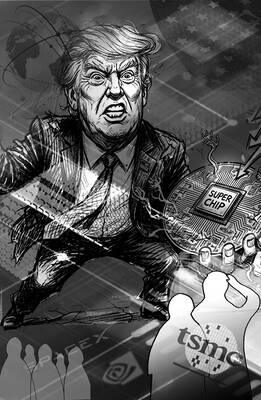
The White House’s decision to take a 9.9 percent stake in Intel Corp is looking like very shrewd business indeed. Since the government bought in at US$20.47 a share last August, the US chipmaker’s surging stock price has delivered the US a US$43 billion return. One of the reasons the investment has so far proved so sound is that the White House has made sure of it. According to The Wall Street Journal, Howard personally pushed deals on Intel’s behalf with some of the most lucrative clients imaginable. They include Nvidia Corp, the company at the heart of the AI
A single photograph can cut through a lot of noise, but it can also be used to misrepresent the truth. At the very least, it can concentrate the mind on something that requires further investigation. On Monday last week, Ma Ying-jeou Foundation CEO Tai Hsia-ling (戴遐齡) and former National Security Council secretary-general King Pu-tsung (金溥聰) held a news conference in which they showed a photograph of former foundation CEO Hsiao Hsu-tsen (蕭旭岑), now Chinese Nationalist Party (KMT) deputy chairman. In the image Hsiao is seated next to Xiamen Taiwan Businessmen Association chairman Han Ying-huan (韓螢煥). The two men were holding
I first met Professor Ray Jiing (井迎瑞) as a film and documentary student at Shih Hsin University’s (SHU) Department of Radio Television and Film in 1988. The following year, he went on to become the director of the Chinese Taipei Film Archive — forerunner of the Taiwan Film and Audiovisual Institute (TFAI). Over his eight-year tenure, Jiing rescued and restored over 200 classic Taiwanese films. In 1997, he established the Graduate Institute of Studies in Documentary and Film Archiving at Tainan National University of the Arts (TNNUA), and I joined the program in his third cohort of students. Beyond a
A recent report concerning a student who is suing his teacher posed the question in its headline: Does failing a student in two subjects constitute bullying? The college student in Chiayi County apparently sought NT$2 million (US$63,603) in state compensation, but a court dismissed the case. The first reaction of many might have been to ask: What has happened to students nowadays? Some say that teachers have lost their authority, while others say students are overindulged. Some even start reminiscing over the days when “whatever the teacher says goes.” However, the real issue might be overlooked if emotional reactions like that are the


 RSS
RSS