


In January 2002, US President George W. Bush delivered the State of the Union address, pointing out that states like North Korea, Iran and Iraq constitute "an axis of evil." Earlier this month, the Secretary of State-designate Condoleezza Rice mentioned in a Senate committee considering her nomination that in the world there remain "outposts of tyranny" and the US stands with oppressed people everywhere, in Cuba, Myanmar, and North Korea, and Iran, and Belarus, and Zimbabwe.
Rice pointed out that "as long as the broader Middle East remains a region of tyranny, despair and anger, it will produce extremists and movements that threaten the safety of Americans and our friends."
On Jan. 20, in Bush's second inauguration speech, he vowed that it is the policy of the US to seek and support the growth of democratic movements and institutions in every nation and culture with the ultimate goal of ending tyranny in the world.
Bush is well aware that freedom needs to be chosen, and that eradicating tyranny cannot rely only on force. The US has no intention of imposing its systems on other countries but it has declared that it will, if necessary, defend itself as well as its allies with military force.
Taken together with Rice's remarks, Bush's inauguration speech has revealed that in his second term, he has three diplomatic missions.
First, unite the community of democratic countries and establish an international community founded on the rule of law and shared values. Second, eradicate the threat faced by the community of democratic countries and reduce the elements that constitute terrorism. Third, spread the idea of freedom and democracy across the world.
The international media's response to Bush's diplomatic claims is that even though the US has substantial military capability, it is still no easy task to implement democracy all over the globe. The European countries have asked the Bush administration to put more effort into negotiation, while royal families in the Middle East are skeptical of Bush's greater Middle East initiative. If the US is determined to push ahead with its policy to promote freedom all over the world, this will also have repercussions for China.
However, Bush excluded countries such as China, Vietnam and Laos that are practicing a socialist market economy from the list of the "outposts of tyranny." This shows that the main goal of the Bush administration is to implement freedom and democracy and root out terrorism and proliferation of weapons of mass destruction.
Bush will also see if people are well-treated in certain countries and consider it a yardstick of reviewing bilateral relationships. Unlike the former president Jimmy Carter's unsophisticated human rights diplomacy, Bush is still a believer in pragmatism.
At a public hearing, Rice pointed out that a majority of Asian nations hope that the US can engage in Asian affairs proactively, by playing a dominant role and continuing to exert its influence in Asia, since these Asian nations do not want to see such an influential role be replaced by China. She also believes that there is still a long way before China ranks equally with the US in economic terms. Also, that the rise of China has not endangered the US' influential position in Asia. Rice further stated that the US continues to seek a candid, cooperative, and constructive relationship with China.
In Bush's second term, the US' primary decision-making body for diplomatic policy will shift to the Department of State, led by Rice. Emphasis will be put on public diplomacy. US Trade Representative Robert Zoelick will take over the post as Rice's deputy, and US Ambassador to South Korea Christopher Hill will be appointed as assistant secretary of state for East Asia.
After former secretary of state Colin Powell's deputy, Richard Armitage, and assistant secretary of state James Kelly step down, Victor Cha, a Korean-American specialist on Korea, and Michael Green and Dennis Wilder, two specialists on Japan, will be sworn in as members of the National Security Council. It is obvious that the US has put great weight on its security concerns in Northeast Asia, particularly North Korea.
If Hill takes over the position as assistant secretary of State for East Asia, he will be the US' second ambassador to South Korea to take such an assignment. It is regarded as an indicator of the Bush administration's focus to solve the nuclear issue on the Korean Peninsula. As for Hill's successor, American Institute in Taiwan Director Douglas Paal and Ambassador to Australia Tom Schieffer are likely to be two possible candidates.
From Bush's second inaugural speech, we learn that his government wants to promote liberty and freedom in the world; he used "free," "freedom" or "liberty" 49 times throughout the speech. Bush's government once said that the US and Taiwan must collaborate, and that it wanted to introduce Taiwan's democratic experience to other countries. Taiwan, in fact, does not have much influence in China-US relations.
As a result, the statements about US diplomatic goals, along with Taiwan's recent formation of a new Cabinet and its review of diplomacy based on democracy present a ray of hope in the currently poor state of US-Taiwan mutual trust.
Lin Cheng-yi is the director of the Institute of European and American Studies at Academia Sinica.
TRANSLATED BY DANIEL CHENG AND LIN YA-TI
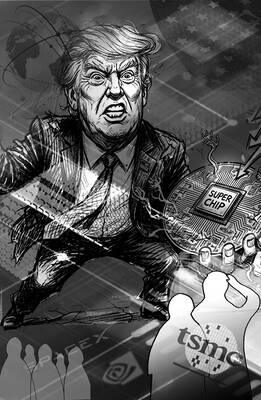
The White House’s decision to take a 9.9 percent stake in Intel Corp is looking like very shrewd business indeed. Since the government bought in at US$20.47 a share last August, the US chipmaker’s surging stock price has delivered the US a US$43 billion return. One of the reasons the investment has so far proved so sound is that the White House has made sure of it. According to The Wall Street Journal, Howard personally pushed deals on Intel’s behalf with some of the most lucrative clients imaginable. They include Nvidia Corp, the company at the heart of the AI
A single photograph can cut through a lot of noise, but it can also be used to misrepresent the truth. At the very least, it can concentrate the mind on something that requires further investigation. On Monday last week, Ma Ying-jeou Foundation CEO Tai Hsia-ling (戴遐齡) and former National Security Council secretary-general King Pu-tsung (金溥聰) held a news conference in which they showed a photograph of former foundation CEO Hsiao Hsu-tsen (蕭旭岑), now Chinese Nationalist Party (KMT) deputy chairman. In the image Hsiao is seated next to Xiamen Taiwan Businessmen Association chairman Han Ying-huan (韓螢煥). The two men were holding
I first met Professor Ray Jiing (井迎瑞) as a film and documentary student at Shih Hsin University’s (SHU) Department of Radio Television and Film in 1988. The following year, he went on to become the director of the Chinese Taipei Film Archive — forerunner of the Taiwan Film and Audiovisual Institute (TFAI). Over his eight-year tenure, Jiing rescued and restored over 200 classic Taiwanese films. In 1997, he established the Graduate Institute of Studies in Documentary and Film Archiving at Tainan National University of the Arts (TNNUA), and I joined the program in his third cohort of students. Beyond a
A recent report concerning a student who is suing his teacher posed the question in its headline: Does failing a student in two subjects constitute bullying? The college student in Chiayi County apparently sought NT$2 million (US$63,603) in state compensation, but a court dismissed the case. The first reaction of many might have been to ask: What has happened to students nowadays? Some say that teachers have lost their authority, while others say students are overindulged. Some even start reminiscing over the days when “whatever the teacher says goes.” However, the real issue might be overlooked if emotional reactions like that are the


 RSS
RSS