


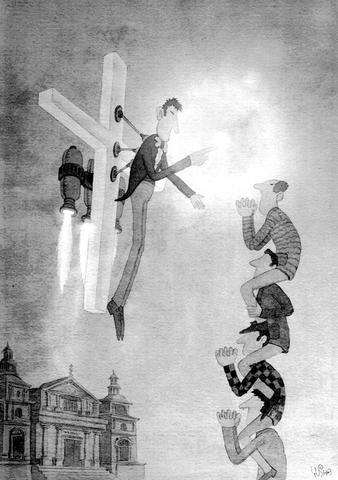
A week in the US, such as I have just spent, is enough to make anybody feel a trifle fed up with God, or rather with the relentless invocation of the deity by American politicians, led by their president. No public occasion would be complete without the blessing of the Almighty being sought for whatever endeavor tops the agenda, most prominently the war in Iraq. The appeal to faith, seldom mere ritual, is usually founded upon conviction.
There is an attractive rationalist case for insisting that candidates for election anywhere in the world are required to sign a declaration forswearing religious affiliation. Had this been done in Ireland a couple of generations ago, think what we would have been spared.
YUSHA
Few modern political careers are compatible with religious principle. Government by atheists would relieve us of the irksome moral conceit that impels US President George W. Bush and British Prime Minister Tony Blair to do deplorable things while remaining convinced that slots are kept open for them in heaven.
Even among the enemies of democracy, at the extreme end of the scale it is easier to deal with the Irish Republican Army, whose ambitions are political, than Osama bin Laden, with whom there can be no negotiation, only global submission to Islam.
I am not in the least anti-
religious. If pressed I would des-cribe myself as a social Anglican. Yet I find myself increasingly eager to be governed by politicians who profess no pretensions to a hot line to a higher power.
The West may find that the struggle against militant Islam is an inescapable challenge of the 21st century, extending far more widely than the present engagement with a few thousand fanatics. Most of us wish to explore every avenue of accommodation before reconciling ourselves to armed conflict. Yet we now face another four years at the mercy of a US president who perceives his own God as foremost among White House advisors and regards the contest with Islam as already begun.
The last British prime minister before Blair to perceive himself in a special relationship with the Almighty was Gladstone. Yet, oddly enough, Gladstone strongly resisted General Charles Gordon's attempts to force Christian Britain into military confrontation with Islam in Sudan in 1884.
British foes of the Mahdi used many of the same arguments for deposing him as were deployed by Bush and Blair against former Iraqi president Saddam Hussein: shocking tyrant; unspeakably brutal to his own people; threat to the stability of the region. Yet Gladstone rejected calls for intervention until Gordon, by calculated self-immolation in Khartoum, excited British public opinion to such a pitch that Gladstone felt compelled to act.
A relief force was belatedly dispatched up the Nile, which failed to reach Gordon in time, and withdrew amid much public anger at home.
This might be described as Gladstone's first Gulf war. Its anticlimactic conclusion provoked bitter criticism: for the failure to finish the job and depose the Mahdi.
The Mahdi died, of course, leaving his Sudanese empire in the hands of a successor, the Khalifa. The British launched their second Gulf war against Sudan in 1898, in a spirit of unfinished business not dissimilar from that which prevailed in the White House last year.
Kitchener duly disposed of the Khalifa and his Dervish followers at the battle of Omdurman, with an application of firepower ruthless enough to delight US Secretary of Defense Donald Rumsfeld.
The British thereafter ran Sudan for half a century. Their benign stewardship became the best excuse for an imperialist adventure that otherwise possessed no justification whatever.
Interestingly, while the British felt pleased with themselves for having squashed Mahdism, they did not represent Omdurman as a triumph for Christianity. It was perceived simply as a victory for the Union flag (to use the British flag's official name).
Some of us would feel more comfortable today if US and allied foreign policy could be discussed solely in temporal terms, without bringing God into the deal at all. One of the more grotesque landmarks of the Bush presidency was established this time last year, when the Los Angeles Times revealed that a top general was touring Christian fundamentalist churches assuring congregations that he knew "our side" would prevail in the struggle with Muslim extremism "because our God is a real God" and the other side's was a phoney.
Now, every army has its share of lunatics. The litmus test is how their political masters treat them. The world waited in vain for Rumsfeld to sack this grotesque Strangelovian, whose words seemed to undermine every possibility of constructive engagement with Islam.
It never happened, of course. I was in Washington while the little drama was being played out. A defense academic said to me sardonically: "This administration will never sack a general for saying things that every senior figure in the Cabinet believes." And so it proved.
Bob Woodward vividly records in his book Plan of Attack an exchange with Bush, in which he asked whether the president had discussed the Iraq invasion with his father before making the decision to act. No, said Bush. He preferred to consult his "higher father."
Many of us at the mercy of the US president, which means most of the world, tremble in the face of this sort of thing. Even in the darkest days of 1940, Winston Churchill never seriously invoked the deity, though he had vastly better reason to do so than either Bush or Blair. Nor did Margaret Thatcher.
Today, the distortion of biblical teaching by American Christian fundamentalists, almost all allies of Bush, to support Israeli imperialist claims on the West Bank, significantly increases the difficulties of achieving a settlement in the Middle East. The political leverage exerted by the fundamentalists in the US against any surrender of biblical territory to Muslims is likely to grow greater, not smaller.
Most of us recognize that
constructive action to rescue the Palestinians would do far more for the West's long-term security than the draconian anti-terrorist legislation introduced by Bush and now Blair. Yet no prominent Western statesman dares publicly to question the role that God's American hijackers play in making the world more dangerous.
I am not making a case for the appeasement of the West's Islamic critics and enemies, but merely for policies likely to diminish the
fertility of terrorist recruiting prairies, based upon treating their religion with common respect. Christian Crusaders were a menace to international peace in the 12th and 13th centuries, Christian missionaries in the 19th. God spare us from assertively Christian -- or Muslim or Jewish -- national leaders in the 21st, if that request is not blasphemous.
Max Hastings is a former editor of the Daily Telegraph and the London Evening Standard.
The conflict in the Middle East has been disrupting financial markets, raising concerns about rising inflationary pressures and global economic growth. One market that some investors are particularly worried about has not been heavily covered in the news: the private credit market. Even before the joint US-Israeli attacks on Iran on Feb. 28, global capital markets had faced growing structural pressure — the deteriorating funding conditions in the private credit market. The private credit market is where companies borrow funds directly from nonbank financial institutions such as asset management companies, insurance companies and private lending platforms. Its popularity has risen since
On March 22, 2023, at the close of their meeting in Moscow, media microphones were allowed to record Chinese Communist Party (CCP) dictator Xi Jinping (習近平) telling Russia’s dictator Vladimir Putin, “Right now there are changes — the likes of which we haven’t seen for 100 years — and we are the ones driving these changes together.” Widely read as Xi’s oath to create a China-Russia-dominated world order, it can be considered a high point for the China-Russia-Iran-North Korea (CRINK) informal alliance, which also included the dictatorships of Venezuela and Cuba. China enables and assists Russia’s war against Ukraine and North Korea’s
An article published in the Dec. 12, 1949, edition of the Central Daily News (中央日報) bore a headline with the intimidating phrase: “You Cannot Escape.” The article was about the execution of seven “communist spies,” some say on the basis of forced confessions, at the end of the 713 Penghu Incident. Those were different times, born of political paranoia shortly after the Chinese Nationalist Party (KMT) relocated to Taiwan following defeat in China by the Chinese Communist Party (CCP). The phrase was a warning by the KMT regime to the local populace not to challenge its power or threaten national unity. The
After thousands of Taiwanese fans poured into the Tokyo Dome to cheer for Taiwan’s national team in the World Baseball Classic’s (WBC) Pool C games, an image of food and drink waste left at the stadium said to have been left by Taiwanese fans began spreading on social media. The image sparked wide debate, only later to be revealed as an artificially generated image. The image caption claimed that “Taiwanese left trash everywhere after watching the game in Tokyo Dome,” and said that one of the “three bad habits” of Taiwanese is littering. However, a reporter from a Japanese media outlet


 RSS
RSS