


Their story is the hardest to tell: that of the Iraqi civilians who have remained in the besieged city of Fallujah. They have no embedded Western journalists to speak for them, only a few Iraqi correspondents. They cannot leave their homes because of the risk of constant sniper fire. They have no water to drink, no electricity. If they are injured, they have nowhere to go.
Suddenly, the bitter urban war that many feared would greet the advancing coalition troops during their invasion in March last year and which failed to materialize has become a reality in Fallujah and is threatening elsewhere.
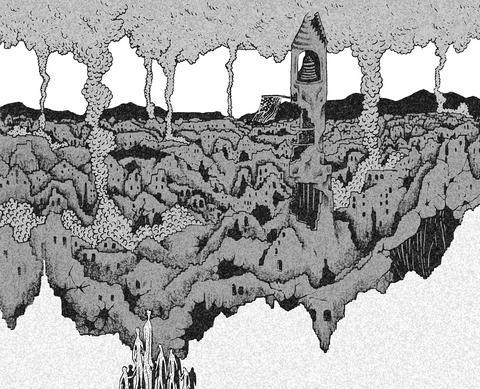
ILLUSTRATION: MOUNTAIN PEOPLE
With it has come the awful realities for civilians.
"Anyone who gets injured is likely to die, because there's no medicine and they can't get to doctors," said Abdul-Hameed Salim, a volunteer with the Iraqi Red Crescent. "There are snipers everywhere. Go outside and you're going to get shot."
Rasoul Ibrahim, who fled Fallujah on foot with his wife and three children last Thursday morning, said families left in the city were in desperate need. Doctors at Fallujah's hospital said there had been an increase in typhoid cases.
"There's no water. People are drinking dirty water. Children are dying," Ibrahim told aid workers in Habbaniya, a makeshift refugee camp 20km to the west of Fallujah where about 2,000 families are sheltering.
"People are eating flour because there's no proper food," he said.
The picture is at best patchy. In the battle for Fallujah the fate of those who have remained, perhaps between 30,000 and 50,000 in a city whose population is normally 250,000, remains largely unknown.
And for a reason. One of the first actions of US troops in the hours before the full-scale assault on the city from the north was to seize its general hospital to prevent what one US officer described as "insurgent propaganda" over casualty figures.
So the condition of those who have stayed has come out in dribs and drabs: a nine-year old boy who died of a wound caused by shrapnel to the stomach because he could not reach medical aid; the claim by Mohammed Amer, a doctor at a Fallujah clinic, that 12 people had died in the opening assault; and the statements of the aid agencies.
On Friday, an Iraqi journalist leaving the city gave one of the few insights into civilian conditions. Those who have not fled, he said, had stayed indoors for fear of constant explosions.
"If the fighters fire a mortar, US forces respond with huge force," said the journalist, who asked not to be named.
There was heavy damage to houses. US forces were destroying every car they saw for fear of car bombs, he said.
The city had been without power or water for days. Frozen food had spoiled and people could not charge their cellphones. The journalist said US forces controlled the northern half of the city, but insurgents were still fighting in the central Wahda and southerly Shuhada and Sinai districts.
"Some people hadn't prepared well. They didn't stock up on tinned food. They didn't think it would be this bad," he said.
On Saturday a four-truck Red Crescent convoy of relief supplies was finally given permission to enter the city. The trucks were carrying food, blankets, first-aid kits, medicine and a water purification unit.
There is another group whose names and histories remain obscured amid the statements by senior US officers and the Pentagon that they have killed hundreds of insurgents. They are the US soldiers who have been arriving in their plane-loads to the US military hospital at Landstuhl in Germany, the biggest in Europe. They are the wounded who cannot be treated in the Iraq theater -- suffering from spinal and neurological injuries
Already, confronted by the surge in combat casualties that have seen 24 US soldiers dead and more than 200 wounded, the hospital is expanding its capacity. Lieutenant-Colonel Richard Jordan, a physician at the hospital's deployed warrior center, which assesses incoming wounded after their six-hour plane trip, said: "We've had more cases of bullet wounds than usual, though some have also suffered blast wounds from rocket-propelled grenades."
These are the costs of war with consequences that go beyond the simple and oft-stated objective of reclaiming Fallujah from the insurgents. On the one side is an increasing allied death toll that threatens a lingering political impact in both the US and UK. On the other is the already escalating "blow-back" on the interim government of prime minister Ayad Allawi and his security forces and on his allies in the US-led multinational forces.
The assault on Fallujah has coincided with the insurgents' own offensive this month across the areas where they are strongest -- most obviously in Mosul, a city of a million people that in recent months has threatened to equal Fallujah as the main resistance center.
On Saturday the Iraqi government was rushing reinforcements to Mosul after coordinated attacks on police stations and Iraqi National Guard centers that had in effect driven security forces from the streets and left large areas under the control of the insurgents.
According to residents, insurgents were in charge of some areas of southern and western Mosul, holding two police stations and manning roadblocks, as Iraq's third-largest city appeared to be sliding out of US and Iraqi control. Residents in neighborhoods throughout the city on the Tigris, 385km north of Baghdad, said there was little visible presence of Iraqi security forces or US troops on Saturday.
They said armed gunmen held some areas.
"In the south and the west of the city, insurgents are doing patrols to protect banks and shops from looters. They are guarding hospitals, schools and fire stations," said one man, who would give only his first name, Thamer.
Another resident said there were Iraqi National Guards and some US troops positioned at the ends of some of the five bridges that span the Tigris, but other than that, security was light. Insurgents were keeping security elsewhere.
Mosul province deputy Khissrou Gouran said that on Friday gunmen had tried to storm a food distribution center in the city's Yarmouk area, but were forced back by National Guardsmen and security guards.
The gunmen were trying to destroy election registration cards held at the center, he said. Militants in Mosul have also assassinated the head of the city's anti-crime task force, Brigadier-General Mowaffaq Mohammed Dahham, and set fire to his home.
"With the start of operations in Fallujah a few days ago, we expected that there would be some reaction in Mosul," Brigadier-General Carter Ham, commander of US forces in the city, told CNN.
He doubted the Mosul attackers were insurgents who fled Fallujah and said most "were from the northern part of Iraq, in and around Mosul and the Tigris river valley south of the city."
It has not just been in Mosul. In Baghdad on Friday clashes erupted in at least four neighborhoods of the capital. Clashes also broke out from Hawija and Tal Afar in the north to Samarra -- where the police chief was also fired -- and Ramadi in central Iraq.
Such has been the violence in response to the assault on Fallujah that politicians and officials are already changing their briefing lines on what the battle for Fallujah was supposed to achieve.
Six weeks ago officials on both sides of the Atlantic were talking about how they hoped that giving the fighters in the city "a big slap" would be definitive in ending the insurgency and quickly pave the way for elections in January.
It is a promise that has been made before. The establishment of an Iraqi governing council was supposed to do the same, as was the capture of former Iraqi president Saddam Hussein and the handover of sovereignty. Yet all have seen the violence get worse.
Now senior military officers in the UK and the US have begun to express private doubts over whether the battle for Fallujah will make things better in the long run, or much worse. By Saturday even US President George W. Bush was rowing back on expectations that there would be any improvement in Iraq's security situation, instead warning that it could worsen in the run-up to the planned elections in January.
Fallujah, it now appears, may be a turning point, but of a kind that London and Washington had not anticipated. For while the US Marines may win the battle in the "city of mosques," the inevitable question will be: at what cost?
Already the fighting in the city, and the preparation for the battle, has overturned hard-held assumptions about the nature of the insurgents. For months, in briefings in Baghdad and elsewhere, the picture of the insurgency was of a chaotic and largely criminal affair, bolstered by ex-Baathists and foreign terrorists from the Zarqawi network.
In recent months, however, intelligence officials in Washington and the UK have drawn up a picture that is infinitely more troubling for the interim government and its sponsors in the West. From an estimate that the fighters number hundreds, latest figures put the numbers of insurgents at up to 20,000 fighters and allies. Even that appears to be a guess.
What is also clear is that, far from being loosely organized groups, the insurgency is well funded and led by up to 20 former regime members, including cousins of Saddam, and Mohammed Younis al-Ahmed, a former aide to Saddam and regional Baath party leader.
On the ground, too, the US military appears to have underestimated the sophistication and determination of the insurgents, particularly in Fallujah. As the battle has unfolded, US troops have been surprised by the ingenuity of the fighters who, aware that their communications can be listened to by the US soldiers, have used flags to concentrate their attacks.
The insurgents also appear to have fine-tuned their tactics against US helicopters, bringing down four by ground fire from rocket-propelled grenades and small arms in a few days.
In what appears to have been a major tactical error, it now appears that perhaps the majority of insurgents in Fallujah, including Abu Musab al-Zarqawi, whose alleged presence there was the pretext for the assault, may have been able to slip away to regroup elsewhere.
US military reports show that bands of up to 15 guerrillas at a time left Fallujah in the days before the US onslaught.
"That's probably why we've been able to move as fast as we have," one officer from the Army's 1st Cavalry Division, said. "We gave them so much fair warning that the only ones who stayed had a death wish."
There is another view -- that those who chose to stay and die did so as an overtly political act of immolation. Because they see their deaths in Fallujah not as a last stand, but as the beginning of a wider insurrection.

Is a new foreign partner for Taiwan emerging in the Middle East? Last week, Taiwanese media reported that Deputy Minister of Foreign Affairs Francois Wu (吳志中) secretly visited Israel, a country with whom Taiwan has long shared unofficial relations but which has approached those relations cautiously. In the wake of China’s implicit but clear support for Hamas and Iran in the wake of the October 2023 assault on Israel, Jerusalem’s calculus may be changing. Both small countries facing literal existential threats, Israel and Taiwan have much to gain from closer ties. In his recent op-ed for the Washington Post, President William
Taiwan-India relations appear to have been put on the back burner this year, including on Taiwan’s side. Geopolitical pressures have compelled both countries to recalibrate their priorities, even as their core security challenges remain unchanged. However, what is striking is the visible decline in the attention India once received from Taiwan. The absence of the annual Diwali celebrations for the Indian community and the lack of a commemoration marking the 30-year anniversary of the representative offices, the India Taipei Association and the Taipei Economic and Cultural Center, speak volumes and raise serious questions about whether Taiwan still has a coherent India
A stabbing attack inside and near two busy Taipei MRT stations on Friday evening shocked the nation and made headlines in many foreign and local news media, as such indiscriminate attacks are rare in Taiwan. Four people died, including the 27-year-old suspect, and 11 people sustained injuries. At Taipei Main Station, the suspect threw smoke grenades near two exits and fatally stabbed one person who tried to stop him. He later made his way to Eslite Spectrum Nanxi department store near Zhongshan MRT Station, where he threw more smoke grenades and fatally stabbed a person on a scooter by the roadside.
Recent media reports have again warned that traditional Chinese medicine pharmacies are disappearing and might vanish altogether within the next 15 years. Yet viewed through the broader lens of social and economic change, the rise and fall — or transformation — of industries is rarely the result of a single factor, nor is it inherently negative. Taiwan itself offers a clear parallel. Once renowned globally for manufacturing, it is now best known for its high-tech industries. Along the way, some businesses successfully transformed, while others disappeared. These shifts, painful as they might be for those directly affected, have not necessarily harmed society


 RSS
RSS