


The best book I've read about America after Sept. 11 isn't about either America or Sept. 11. It's War Is a Force That Gives Us Meaning, an essay on the psychology of war by Chris Hedges, a veteran war correspondent. Better than any poll analysis or focus group, it explains why US President George W. Bush, despite policy failures at home and abroad, is ahead in the polls.
War, Hedges says, plays to some fundamental urges.
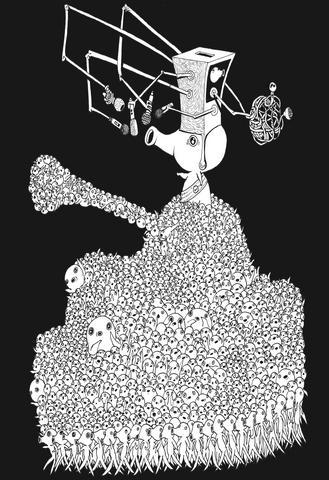
ILLUSTRATION: MOUNTAIN PEOPLE
"Lurking beneath the surface of every society, including ours," he says, "is the passionate yearning for a nationalist cause that exalts us, the kind that war alone is able to deliver."
When war psychology takes hold, the public believes, temporarily, in a "mythic reality" in which our nation is purely good, our enemies are purely evil, and anyone who isn't our ally is our enemy.
This state of mind works greatly to the benefit of those in power.
One striking part of the book describes Argentina's reaction to the 1982 Falklands war. General Leopoldo Galtieri, the leader of the country's military junta, cynically launched that war to distract the public from the failure of his economic policies. It worked: "The junta, which had been on the verge of collapse" just before the war, "instantly became the saviors of the country."
The point is that once war psychology takes hold, the public desperately wants to believe in its leadership, and ascribes heroic qualities to even the least deserving ruler. National adulation for the junta ended only after a humiliating military defeat.
Bush isn't Galtieri: America really was attacked on Sept. 11, and any president would have followed up with a counterstrike against the Taliban. Yet the Bush administration, like the Argentine junta, derived enormous political benefit from the impulse of a nation at war to rally around its leader.
Another president might have refrained from exploiting that surge of support for partisan gain; Bush didn't.
And his administration has sought to perpetuate the war psychology that makes such exploitation possible.
Step by step, the fight against al-Qaeda became a universal "war on terror," then a confrontation with the "axis of evil," then a war against all evil everywhere. Nobody knows where it all ends.
What is clear is that whenever political debate turns to Bush's actual record in office, his popularity sinks. Only by doing whatever it takes to change the subject to the war on terror -- not to what he's actually doing about terrorist threats, but to his "leadership," whatever that means -- can he get a bump in the polls.
The Republican convention made it clear that Bush intends to use what's left of his heroic image to win the election, and early polls suggest that the strategy may be working. What can Senator John Kerry do?
Campaigning exclusively on domestic issues won't work. Bush must be held to account for his dismal record on jobs, health care and the environment. But as Hedges writes, when war psychology makes a public yearn to believe in its leaders, "there is little that logic or fact or truth can do to alter the experience."
To win, the Kerry campaign has to convince a significant number of voters that the self-proclaimed "war president" isn't an effective war leader -- he only plays one on TV.
This charge has the virtue of being true. It's hard to find a nonpartisan national security analyst with a good word for the Bush administration's foreign policy. Iraq, in particular, is a slow-motion disaster brought on by wishful thinking, cronyism and epic incompetence.
If I were running the Kerry campaign, I'd remind people frequently about Bush's flight-suit photo-op, when he declared the end of major combat. In fact, the war goes on unabated. News coverage of Iraq dropped off sharply after the supposed transfer of sovereignty on June 28, but as many US soldiers have died since the transfer as in the original invasion.
And I'd point out that while Bush spared no effort preparing for his carrier landing -- he even received underwater survival training in the White House pool -- he didn't prepare for things that actually mattered, like securing and rebuilding Iraq after Baghdad fell.
Will it work? I don't know. But to win, Kerry must try to puncture the myth that Bush's handlers have so assiduously created.
Chinese Nationalist Party (KMT) Chairwoman Cheng Li-wun (鄭麗文) on Tuesday returned from her visit to the US, where she had met with several US senators and representatives, think tanks, and overseas Taiwanese and Chinese communities, espousing her vision of promoting cross-strait dialogue as a way to evade war. On Monday last week, she sat down with US academic Orville Schell and Asia Society Policy Institute distinguished fellow Daniel Russel. Russel is a seasoned diplomat who has served in positions related to East Asian and Indo-Pacific affairs. At the conclusion of the discussion, Russel employed his considerable diplomatic experience and knowledge
I arrived in Taiwan when I was 18, fresh out of high school and trying to navigate university life. Everything felt unfamiliar. My broken Mandarin quickly revealed what I already knew: I was not from here. When I told people I was from Indonesia, many told me that I did not look Indonesian. This caught me off guard, not because it was cruel, but because of how casually it was said. Sometimes it came with curiosity, sometimes surprise, occasionally admiration for my “fair skin.” More often than not, the people asking meant no harm. It is understandable. I look ethnically
Nearly three decades after the 1997 handover, Hong Kong has become a paradox: a place where financial dynamism coexists with political repression — a reality Taiwan cannot afford to ignore. Despite a sharp contraction of civic freedoms since 2020, Hong Kong remains a major global financial center. It has recently overtaken Switzerland as the world’s largest offshore wealth hub, supported by steady inflows of capital from China and across Asia. The territory continues to serve as a key intermediary linking Chinese firms, multinational investors and global markets. Institutional continuity has played a role. The Hong Kong dollar’s peg to the

Five weeks since US President Donald Trump met with Chinese President Xi Jinping (習近平) in Beijing, his administration now faces two important tests in the Indo-Pacific. The first test is one of the president’s own making. After meeting with Xi, Trump described arms sales to Taiwan as “a very good negotiating chip” and announced that a previously approved sale was now “in abeyance.” The Financial Times later reported that Beijing is holding approval for a visit by Elbridge Colby, the undersecretary of defense for policy, pending the president’s decision on the sale. During Trump’s first term in office, he regularized the arms


 RSS
RSS