


Looking at the growing bulk of the EU surrounding them -- and at the pressures it's exerting on their defiantly independent nation -- the Swiss are starting to think that joining the union may not be such a bad idea after all.
As the EU prepares to add members in Eastern Europe on May 1, a glance at the map of Europe underscores Switzerland's isolation as the holdout in a vast expanse covered by the blue and gold EU flag from the Atlantic Ocean to deep into former Soviet bloc territory.
The edginess in Switzerland was obvious last month when, without warning, Germany started intensive border checks on cars entering from the northern Swiss city of Basel, causing long traffic jams where most drivers were used to being waved through with scarcely a glance.
"Germany has abandoned Switzerland," lamented the weekly news magazine L'Hebdo, noting that the longtime advocate of Swiss interests in the EU was now leading the adversaries against the Alpine nation.
Swiss neutrality
The German move was read as growing impatience with the country's reluctance to join foreign alliances, based on Swiss neutrality first recognized by other European nations in 1648.
German officials maintain nothing anti-Swiss was intended by the checks and that they were only applying the rules to an external border as required by the EU's Schengen accord that allows freedom of movement inside the union.
But the Swiss are suspicious that Germany was retaliating for irritations, especially over demands that Switzerland stop foot-dragging on a potentially landmark EU deal to fight tax evasion.
The Swiss note that as the border checks were going into high gear, German Finance Minister Hans Eichel singled out Switzerland in declaring that "no country in Europe can be allowed to make a living in part by being a refuge for tax evaders."
Switzerland is willing to meet the EU demands by handing over to EU governments the 35 percent tax withheld from interest paid to their citizens on Swiss bank accounts, but they want more freedom for the 7.3 million Swiss to cross EU borders in exchange. The EU insists that there cannot be a link.
Other irritations include this year's addition of a fervent nationalist to the governing seven-member Swiss Cabinet -- billionaire industrialist Christoph Blocher, an outspoken opponent of the EU.
Three years ago an overwhelming 77 percent of Swiss voters sided with Blocher's campaign to reject a referendum proposal demanding the government immediately start negotiations to join the EU.
But the tide started to turn the following year. The country -- which had sat out World War I and World War II -- in 2002 voted for the first time to join the UN.
Blocher said in an April 11 interview with the weekly NZZ am Sonntag that the country's neutrality remains a protection against terrorism because it demonstrates that the small country is refraining from taking sides in a major power struggle.
Blocher, now justice minister, continues to rail against the EU. But a poll in the weekly SonntagsBlick this month said two-thirds of Swiss now favor moving toward EU membership. The random survey of 1,008 Swiss voters conducted on April 1 and April 2 had a margin of error of 3.16 percent, said the Swiss pollster, Isopublic of Gallup International.
Yvonne Ankele, who teaches German to foreign children in Zurich, said that she has always felt she was a European but that recently she has been feeling excluded.
"Now suddenly one has the feeling we aren't Europeans," Ankele said, adding that in the long term Switzerland will have to join the EU and will just have to face being one of the countries that pays more than it gets back because it is relatively better off.
"Naturally it will cost something," she said. "All rich countries have to pay."
Dominique Pattyn, manager of a book shop in Geneva, said she thought it would be better for Switzerland to be in the EU although she is a little concerned about non-Swiss overwhelming the job market.
"The unemployment rate in Switzerland isn't too high, but it's still there," Pattyn said. "We can't favor those who are coming from outside over those who are already here. That could be difficult to manage."
Swiss unemployment is 4.1 percent, compared with the latest EU average of 8 percent and rates among the 10 incoming members ranging from 5.3 percent in Cyprus to 20 percent in Poland.
Divided opinions
Opinions on joining the EU were divided in the central Swiss heartland, long the basis of Blocher's support and home of the legendary national hero William Tell, who championed Swiss independence by refusing to acknowledge an Austrian overlord around the time of Switzerland's founding in 1291.
Josephine Schwerzmann, a retired farmer in the central Swiss tax haven of Zug, said, "The rest of the world is changing but the Swiss still want to be William Tell."
Carine Masa, who works in an import-export firm in Brunnen on picturesque Lake Lucerne, said, "I am for and against. The advantages would come from the economy, one currency, travel, no customs, and certainly for the police pursuing criminals."
"But what I am against is this powerful, bureaucratic apparatus that the EU represents," Masa said. "That costs. We will have to adjust ourselves to it."
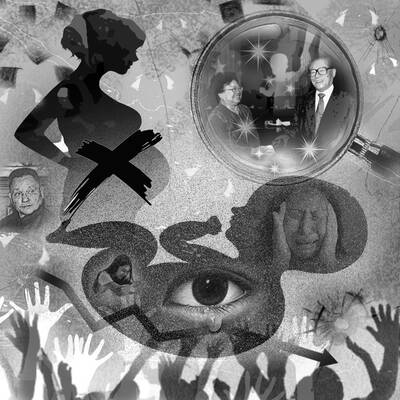
Jan. 1 marks a decade since China repealed its one-child policy. Just 10 days before, Peng Peiyun (彭珮雲), who long oversaw the often-brutal enforcement of China’s family-planning rules, died at the age of 96, having never been held accountable for her actions. Obituaries praised Peng for being “reform-minded,” even though, in practice, she only perpetuated an utterly inhumane policy, whose consequences have barely begun to materialize. It was Vice Premier Chen Muhua (陳慕華) who first proposed the one-child policy in 1979, with the endorsement of China’s then-top leaders, Chen Yun (陳雲) and Deng Xiaoping (鄧小平), as a means of avoiding the
The immediate response in Taiwan to the extraction of Venezuelan President Nicolas Maduro by the US over the weekend was to say that it was an example of violence by a major power against a smaller nation and that, as such, it gave Chinese President Xi Jinping (習近平) carte blanche to invade Taiwan. That assessment is vastly oversimplistic and, on more sober reflection, likely incorrect. Generally speaking, there are three basic interpretations from commentators in Taiwan. The first is that the US is no longer interested in what is happening beyond its own backyard, and no longer preoccupied with regions in other
A recent piece of international news has drawn surprisingly little attention, yet it deserves far closer scrutiny. German industrial heavyweight Siemens Mobility has reportedly outmaneuvered long-entrenched Chinese competitors in Southeast Asian infrastructure to secure a strategic partnership with Vietnam’s largest private conglomerate, Vingroup. The agreement positions Siemens to participate in the construction of a high-speed rail link between Hanoi and Ha Long Bay. German media were blunt in their assessment: This was not merely a commercial win, but has symbolic significance in “reshaping geopolitical influence.” At first glance, this might look like a routine outcome of corporate bidding. However, placed in

The last foreign delegation Nicolas Maduro met before he went to bed Friday night (January 2) was led by China’s top Latin America diplomat. “I had a pleasant meeting with Qiu Xiaoqi (邱小琪), Special Envoy of President Xi Jinping (習近平),” Venezuela’s soon-to-be ex-president tweeted on Telegram, “and we reaffirmed our commitment to the strategic relationship that is progressing and strengthening in various areas for building a multipolar world of development and peace.” Judging by how minutely the Central Intelligence Agency was monitoring Maduro’s every move on Friday, President Trump himself was certainly aware of Maduro’s felicitations to his Chinese guest. Just


 RSS
RSS