


If there is one word which sums up the modern Western mentality, it is "humanitarian." When political, religious or even moral motives for action are seen as less than wholly legitimate, the humanitarian claim is a kind of trump card. Who can be against helping people in danger? There should be no surprise that attempts to appropriate it for a particular policy, cause or campaign are so continuous. The point may have been reached where the humanitarian concept represents the principal counter in political rhetoric to the concept of "terror." We, the American administration might argue, are the sort of people who go halfway across the world to rescue others from tyranny or famine, whilst "they" -- the terrorists -- travel a similar distance just to kill and destroy.
The murky nature of such claims is evident to most people. Something in them seems true, but mixed up with something fraudulent. Judgments on the humanitarian successes and failures of recent years have pushed in on us in recent weeks. The 10th anniversary of the failure in Rwanda is a reminder of the terrible results of doing nothing in the face of genocide. The return of American and other troops to Haiti illustrated the consequences of interventions carried out without sufficient seriousness or perseverance. The attacks on Serbs in Kosovo demonstrated that people saved from ethnic cleansing will not necessarily refrain from it themselves, however long the period of international tutelage to which they are subject.
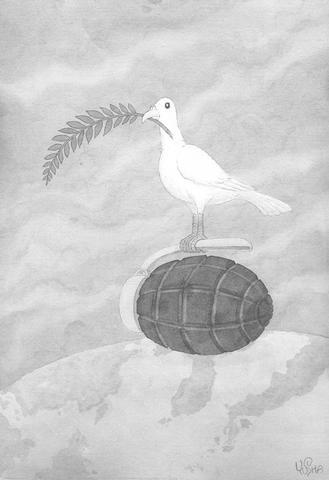
ILLUSTRATION: YU SHA
Even as these lessons are considered, new problems are apparent. The peace plan brokered by the French after their intervention in the Ivory Coast is in trouble. In Sudan, according to some alarming reports, including those by theNew York Times writer Nicholas Kristof, new ethnic cleansing is taking place in the west of the country, just as the war in the south seemed to be winding down. In Iraq, an intervention retrospectively justified on humanitarian grounds hangs halfway between some kind of success and some kind of failure -- nobody knows which, even if the former is still more likely -- and continues to cost lives every day.
Clarity on these matters is not easily achieved. But the light cast on them in a new collection of essays brought out by Medecins Sans Frontieres (MSF) is very welcome. By reasserting the distinction between the humanitarian idea proper and the humanitarian motives or pretensions of political leaders, the MSF writers are able to move the arguments back to where they ought to be taking place. In essence, they are saying that there are two quite different sets of arguments. One is about foreign policy, and this should take place in the knowledge that even worthy foreign policy is not in the first place humanitarian.
The other is about the humanitarian mission, and the emphasis must be on the need for humanitarian organizations to distance themselves from governments and limit, as far as they can, their role as instruments of policy. US Secretary of State Colin Powell's call for non-governmental organizations to act as "a force multiplier for us ... an important part of our combat team" in Iraq shows the dangers. According to Jean-Herv Bradol, chairman of MSF France, "humanitarian logic" does not endorse humanitarian military intervention, or other forms of involvement, or abstention from intervention or involvement. It has nothing to do with any of them except to estimate their impact on the victims which all policies create and "to range itself with those deemed expendable for whatever reason." As other contributors remind the reader, modern humanitarianism emerged in the 19th century by "asking who needs help because of this war?" and not "who is right in this war?"
Bradol, who laid out some of these ideas in a speech at the Royal Institute for International Affairs this week, argues that these principles should lead to a re-ordering of priorities. We are treating as urgent on supposedly humanitarian grounds situations which are politically important, but which would not be at the top of any humanitarian list.
Crude mortality rates, for instance, are the best simple indicator of humanitarian need, but they show that Iraq and the Israeli-Palestinian conflict are very far from being the worst situations. The resources devoted to them, however, dwarf those deployed to deal with that in, for instance, the Democratic Republic of Congo, where millions may have died.
In other instances, like North Korea, huge resources are being expended in humanitarian aid, but that aid has not reached many of those for whom it was intended because, MSF says, it has largely gone to the party and the army. The humanitarian label is attached to a policy aimed at calming and containing the North Korean regime -- a policy which may be rational but, says MSF, let's not pretend it has anything much to do with feeding ordinary people, who have continued to starve to death in large numbers.
On Iraq, MSF steered a brave course. It refused to condemn the war in advance, as some other relief agencies did, on the grounds that neither condemnation nor approval was appropriate. It refused to join other agencies in what turned out to be inflated predictions about the humanitarian consequences of combat, just as it had earlier refused to accept the huge figures which opponents of sanctions gave for infant deaths. It refused to join in the chorus of demands from voluntary organizations for the UN to play a leading role in organizing and assuring relief in Iraq, noting how far beyond UN capacities that role was.
And as Rony Brauman and Pierre Salignon write in their contribution, it grasped very early that there was no humanitarian crisis in Iraq. "No humanitarian organization could serenely countenance the frightening disproportion between the budgets allotted to humanitarian aid in Iraq, which has few urgent needs, and the paltriness of the sums available for critical situations, notably in West and Central Africa."
The phrase humanitarian crisis is "a curious term," the same authors note, which "in one context ... permits the response to be confined purely to relief, like during the genocide in Rwanda; in another it justifies military intervention as in Kosovo," or, as in Iraq now, the diversion, for political reasons, of resources to a country which is relatively well-off.
This book is an aid to clearer thinking in an era in which, as David Rieff argues in his essay, states have decided that "humanitarianism is too important to be left to humanitarians."
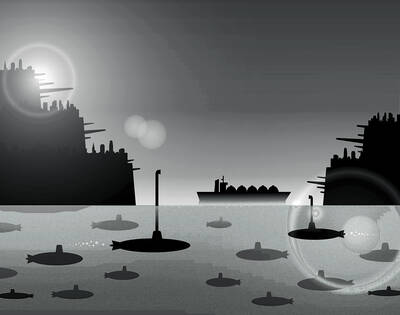
In the event of a war with China, Taiwan has some surprisingly tough defenses that could make it as difficult to tackle as a porcupine: A shoreline dotted with swamps, rocks and concrete barriers; conscription for all adult men; highways and airports that are built to double as hardened combat facilities. This porcupine has a soft underbelly, though, and the war in Iran is exposing it: energy. About 39,000 ships dock at Taiwan’s ports each year, more than the 30,000 that transit the Strait of Hormuz. About one-fifth of their inbound tonnage is coal, oil, refined fuels and liquefied natural gas (LNG),
On Monday, the day before Chinese Nationalist Party (KMT) Chairwoman Cheng Li-wun (鄭麗文) departed on her visit to China, the party released a promotional video titled “Only with peace can we ‘lie flat’” to highlight its desire to have peace across the Taiwan Strait. However, its use of the expression “lie flat” (tang ping, 躺平) drew sarcastic comments, with critics saying it sounded as if the party was “bowing down” to the Chinese Communist Party (CCP). Amid the controversy over the opposition parties blocking proposed defense budgets, Cheng departed for China after receiving an invitation from the CCP, with a meeting with
To counter the CCP’s escalating threats, Taiwan must build a national consensus and demonstrate the capability and the will to fight. The Chinese Communist Party (CCP) often leans on a seductive mantra to soften its threats, such as “Chinese do not kill Chinese.” The slogan is designed to frame territorial conquest (annexation) as a domestic family matter. A look at the historical ledger reveals a different truth. For the CCP, being labeled “family” has never been a guarantee of safety; it has been the primary prerequisite for state-sanctioned slaughter. From the forced starvation of 150,000 civilians at the Siege of Changchun
The two major opposition parties, the Chinese Nationalist Party (KMT) and the Taiwan People’s Party (TPP), jointly announced on Tuesday last week that former TPP lawmaker Chang Chi-kai (張啟楷) would be their joint candidate for Chiayi mayor, following polling conducted earlier this month. It is the first case of blue-white (KMT-TPP) cooperation in selecting a joint candidate under an agreement signed by their chairpersons last month. KMT and TPP supporters have blamed their 2024 presidential election loss on failing to decide on a joint candidate, which ended in a dramatic breakdown with participants pointing fingers, calling polls unfair, sobbing and walking


 RSS
RSS