


As Beijing is being pressured to allow its currency to rise against the US dollar, the arguments are generally proposed in terms of how it might benefit other countries. Such an argument is less compelling than one that points out how China might benefit from ending its peg.
In all events, China's fixed exchange rate policy is based upon a misperception about the best way for economies to grow. It turns out that Beijing is following a contradictory set of policies that paradoxically undermine its own economy but prop up the US economy by accommodating the pump-priming of America's central bank.
China, along with other countries, holds huge reserves of dollars. For their part, China and Hong Kong are the largest net purchasers of Treasury securities and have spent US$290 billion on them. US Treasury bond yields would be significantly higher were it not for these purchases and its ill-fated monetary expansion would have limited ostensible effects.
In an ironic historical twist, China's shift from a command economy has recreated the essential elements of mercantilism. Instead of measuring wealth in terms of gold stocks like the mercantilists, Beijing developed a dollar fetish. Similarly, there is an obsession with export-led growth.
More than two centuries ago, Adam Smith debunked both of these notions. First, the wealth of a country reflects it productive capacities. Second, this wealth can be enhanced by simply trading with other countries. In particular, he portrayed the greatest gains from trade arising from importing rather than exporting.
These growing foreign exchange reserves are creating domestic inflationary pressures and causing China's public-sector debt to balloon. Since capital controls oblige all exporters to deposit hard currencies in the central bank, they receive either freshly-printed yuan (usually in the form of bank deposits) or government debt.
Both arrangements will eventually become untenable by either generating an intolerable rate of inflation or an unacceptable burden of public-sector debt. These represent very high prices to pay to maintain current policies, including the pegged exchange rate.
At present, there is a great deal of volatility in foreign exchange markets. The largest force behind all this turmoil is a weakening US dollar because of a mix of considerations that have induced foreign-exchange brokers to sell Yankee dollars. In the case of the euro, interest arbitrage in the dollar-euro market means that dollars can be borrowed at low interest rates and traded for euros to buy euro-denominated assets with relatively higher yields. While the Federal Reserve has aggressively slashed interest rates, the European Central Bank has been reluctant to match the cuts.
The valuation of a currency is only one element to the competitive nature of an economy. The bad news is that leaders of countries with stronger currencies must develop the political will to carry out structural reforms or their economies will continue to underperform. Resistance to reforms for reduction of welfare and pension systems as well as halting rising labor costs mean that health and pension payments will keep labor costs high, especially in Europe. In the eurozone, insufficient competitive pressures and price rigidities push up domestic prices high while hindering output and job growth.
In all events, a currency can appreciate while the economy remains sluggish or it can depreciate despite robust growth. As it is, the valuation of a country's currency is not so much determined by the performance of its economy than by the forces of supply and demand on foreign currency markets. For a given supply of money, an increase in the production of goods will increase the exchange value of a currency since each unit will buy more goods. Likewise, increasing the supply of money relative to a fixed output of goods will lead to a decline in the purchasing power of money as each currency unit buys fewer goods.
So it is nonsense to declare before the fact that China's currency is undervalued. We can only know once all economic players can decide on where they wish to place their financial assets. Given the relatively high rate of growth in China's money supply, there could be considerable pressures for the yuan to depreciate.
This is because a rate of growth of the money supply that exceeds the growth rate of economic activity tends to cause the rate of exchange to fall. Even if exchange rates are fixed but capital can move freely, capital flight from the country tends to put pressures on to end loose monetary policies.
When exchange rates are determined by supply and demand, imbalances can continue for a long time only if most central banks coordinate their policy stances. Once they stop following similar monetary policies, an exchange value of a currency can drop sharply. In the worst case, the collapse of the exchange rate can trigger a severe shock to the real side of the domestic economy.
What is happening with respect to international valuations of the dollar at the moment is that America's central bankers are pumping in more money into the system than are most of its trading partners. So, the dollar will continue to weaken until the rate of increase in new money into the US economy no longer exceeds domestic economic growth. And it will have to come into line with the pace of monetary expansion followed by central banks in the rest of the world.
Christopher Lingle is Professor of Economics at Universidad Francisco Marroquon in Guatemala.
As red lanterns adorn street corners and social media feeds teem with zodiac divinations, the Year of the Horse has arrived. In our hyper-accelerated age, the horse is almost exclusively synonymous with the idiom ma dao cheng gong (馬到成功) — “instant success upon arrival.” It is a linguistic shot of adrenaline, fueling the thrilling illusion that once the bell tolls, our lives would screech off into a cloud of dust, leaving all troubles behind. Yet, when examining the millennia-long partnership between humans and this magnificent “biological machine,” a different truth emerges. The true essence of the horse is not merely speed;
Chinese Nationalist Party (KMT) Deputy Chairman Hsiao Hsu-tsen (蕭旭岑) earlier this month led a delegation to Beijing to attend a think tank forum between the KMT and Chinese Communist Party (CCP). After returning to Taiwan, Hsiao spoke at length about “accumulating mutual trust” and letting matters “fall into place,” portraying the forum as a series of discussions focused on cooperation in tourism, renewable energy, disaster prevention, emerging industries, health and medicine, and artificial intelligence (AI). However, when the entire dialogue presupposes the so-called “1992 consensus — the idea that there is only “one China,” with each side of the Taiwan
During the long Lunar New Year’s holiday, Taiwan has shown several positive developments in different aspects of society, hinting at a hopeful outlook for the Year of the Horse, but there are also significant challenges that the country must cautiously navigate with strength, wisdom and resilience. Before the holiday break, Taiwan’s stock market closed at a record 10,080.3 points and the TAIEX wrapped up at a record-high 33,605.71 points, while Taipei and Washington formally signed the Taiwan-US Agreement on Reciprocal Trade that caps US tariffs on Taiwanese goods at 15 percent and secures Taiwan preferential tariff treatment. President William Lai (賴清德) in
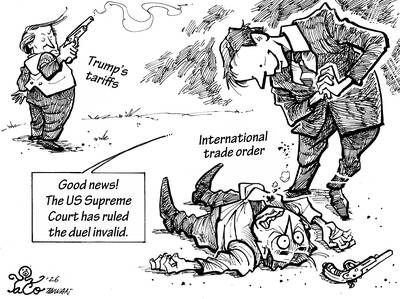
EDITORIAL CARTOON


 RSS
RSS