


The creation of the European Monetary Union (EMU) was an unprecedented achievement, promising deeper and larger markets. The stimulus to trade and investment is manifest. But will the euro last?
Two current developments will shape the answer. The first is the outcome of battles raging in France, Germany, and elsewhere over social security reform. The second is the debate over the inclusion of "social rights" in the EU's draft constitution.
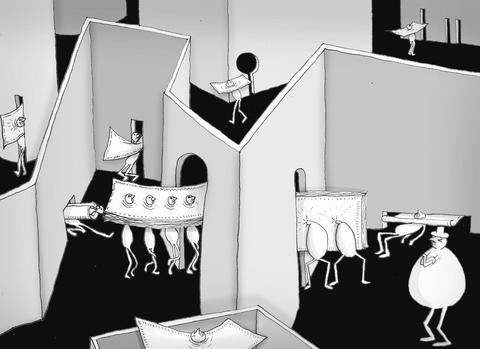
ILLUSTRATION: MOUNTAIN PEOPLE
Welfare state entitlements are vastly different from country to country in Europe. These differences portend intense conflicts within the EMU. France, Germany and Italy must scale back their social commitments, raise taxes, or borrow. But in the Eurozone's increasingly competitive environment, raising taxes would drive away business, while cutting benefits may be tantamount to political suicide. So the temptation to borrow is great.
The Stability and Growth Pact is designed to block that temptation by keeping budget deficits below 3 percent of GDP. But the pact is already straining, and today's serial violations may appear mild when the baby boom generation begins to retire and public pension and health liabilities become cash demands. Some national deficits may rise to twice the pact's limit.
If that happens, the affected countries can expect no help from the European Central Bank, which is prohibited from bailing out member states. Italy and Belgium, heavily indebted when the euro was launched, could become the classic victims of a vicious circle, in which high deficits trigger rising interest rates, higher borrowing costs, even higher deficits, and eventually default.
If an EMU country defaults, it will come under intense pressure to leave the euro in order to regain control of its currency and pay at least its domestic liabilities in devalued national paper. If that country is large, the shock waves could push other members over the edge with it.
Recent events in Argentina provide a warning as to how such a crisis can unfold. Ballooning provincial deficits, which Argentina's central government could not control -- but was obliged to finance -- pushed the country into default, forcing it to abandon a monetary pact (the currency's one-to-one peg to the dollar) to which the population was attached.
The euro faces a second basic challenge. The governments that launched the EMU anticipated that their workers and businesses would eventually be sufficiently mobile and flexible to adjust to economic changes affecting them differentially. At present, workers throughout the EU resist moving to change jobs, and social regulations hamper the mobility and adaptability of businesses. Legislatures are under pressure to relax these constraints.
But little noticed social provisions in the EU draft constitution, which Europe's leaders are expected to sign in less than a year, could compromise the liberalizing process.
In Part II of the draft constitution, a list of "social rights" is incorporated as "constitutional rights," enforced by the European Court of Justice. These include protection against "unjustified dismissal," the right to "working conditions that respect the worker's health, safety and dignity," and "entitlement to social security benefits [apparently regardless of cost] ... in cases such as illness, old age, and loss of employment."
Faced with these new statutes, the court might well change its basic approach. Since its inception, the court's thrust has been to enforce the economic freedoms mandated by successive agreements since the Treaty of Rome. A Bill of Social Rights will require the court to balance this liberalizing mission with attention to the new protections. In this new legal environment, national efforts to dismantle business restrictions could grind to a halt.
The consequences for the euro would be grave. Without further liberalization, the EMU will remain subject to potentially fatal strains arising from shocks that affect some countries more than others.
Imagine that the economic boom that Greece is experiencing in the run-up to next year's Olympics turns to bust after the games end. Because the drachma does not exist anymore, it cannot be devalued. If the European Central Bank considers a large reduction of interest rates, contrary to its inflation objectives, the bank won't be able to help by cutting interest rates to benefit Greece.
So the appropriate response for Greece would be an energetic restructuring program, involving closing some businesses, requiring changes in working conditions, and perhaps even cutting wages. But if regulations block Greek firms from laying off workers, and if militant Greek unions refuse any changes in working conditions, the result could be a wave of bankruptcies and a surge in unemployment.
The Greek government, already burdened by social security obligations, would have to increase unemployment payments, at a time when its revenues would be collapsing. Radical proposals to leave the euro, and restart the Greek economy with a program of devaluation and budgetary expansion, could become compelling.
In truth, many of the rigidities underlying this hypothetical crisis are not attributable to provisions in the draft constitution. Greece has not liberalized sufficiently to insure its economy against idiosyncratic shocks, despite impressive reforms to date. A new Bill of Social Rights would not create destructive rigidities, but it could slow down the liberalizing process that countries like Greece need to withstand the vicissitudes of a common currency.
A euro crisis can be avoided. But to do so the nations of Europe must lift the twin clouds of pension debt and regulatory protections. France and Germany are pursuing modest but nonetheless courageous reforms. If their liberalizing efforts, and those of others, are not to stall, their leaders should see to it that the draft Bill of Social Rights is not frozen in its present form in the EU's constitution. Instead, these rights should be left in the hands of national legislatures, which have the flexibility to change their minds.
Georges de Menil is professor of economics at the Ecole des Hautes Etudes en Sciences Sociales in Paris. COPYRIGHT: PROJECT SYNDICATE
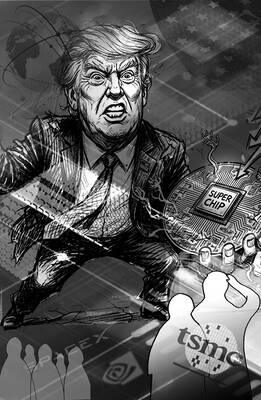
The White House’s decision to take a 9.9 percent stake in Intel Corp is looking like very shrewd business indeed. Since the government bought in at US$20.47 a share last August, the US chipmaker’s surging stock price has delivered the US a US$43 billion return. One of the reasons the investment has so far proved so sound is that the White House has made sure of it. According to The Wall Street Journal, Howard personally pushed deals on Intel’s behalf with some of the most lucrative clients imaginable. They include Nvidia Corp, the company at the heart of the AI
A single photograph can cut through a lot of noise, but it can also be used to misrepresent the truth. At the very least, it can concentrate the mind on something that requires further investigation. On Monday last week, Ma Ying-jeou Foundation CEO Tai Hsia-ling (戴遐齡) and former National Security Council secretary-general King Pu-tsung (金溥聰) held a news conference in which they showed a photograph of former foundation CEO Hsiao Hsu-tsen (蕭旭岑), now Chinese Nationalist Party (KMT) deputy chairman. In the image Hsiao is seated next to Xiamen Taiwan Businessmen Association chairman Han Ying-huan (韓螢煥). The two men were holding
I first met Professor Ray Jiing (井迎瑞) as a film and documentary student at Shih Hsin University’s (SHU) Department of Radio Television and Film in 1988. The following year, he went on to become the director of the Chinese Taipei Film Archive — forerunner of the Taiwan Film and Audiovisual Institute (TFAI). Over his eight-year tenure, Jiing rescued and restored over 200 classic Taiwanese films. In 1997, he established the Graduate Institute of Studies in Documentary and Film Archiving at Tainan National University of the Arts (TNNUA), and I joined the program in his third cohort of students. Beyond a
A recent report concerning a student who is suing his teacher posed the question in its headline: Does failing a student in two subjects constitute bullying? The college student in Chiayi County apparently sought NT$2 million (US$63,603) in state compensation, but a court dismissed the case. The first reaction of many might have been to ask: What has happened to students nowadays? Some say that teachers have lost their authority, while others say students are overindulged. Some even start reminiscing over the days when “whatever the teacher says goes.” However, the real issue might be overlooked if emotional reactions like that are the


 RSS
RSS