


Expert in internal repression but utterly incompetent in military strategy, Iraqi President Saddam Hussein thinks that he can fight and win. His strategy seems to be to defend Baghdad as another Stalingrad, street by street, house by house.
A war strategy that deliberately begins the way that most wars end, with a street-fighting defense of the capital city, is certainly original. It is also realistic in not even trying to defend Iraq's borders against American air power.
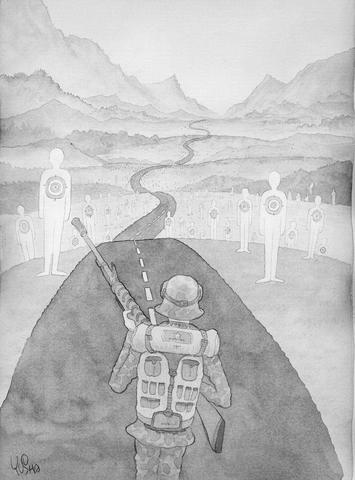
ILLUSTRATION: YU SHA
But it is fantasy to think that the people of Baghdad will defend Saddam's regime. A sullen passivity is the most that Saddam can expect from Iraqis. Street-fighting will need to be done by those targeted by air bombardment: Saddam's elite troops.
Whether they will fight after heavy bombing depends on the success of the air campaign. It is unlikely that Saddam's elite forces will be caught in well-identified barracks. They might be caught in encampments, however, even if frequently moved. Of course, the troops may be made invulnerable to bombing by being billeted among the civilian population, but armored vehicles and artillery cannot be hidden in apartment houses.
Saddam's security system for Baghdad includes the Special Republican Guard, whose 16,000 men are Iraq's most disciplined, best equipped troops. It is not clear how many street-fighters Saddam can obtain from his five competing security forces (the 5000-man Al Amn al-Khas Special Security Service, the 4,000-man, al-Mukhabarat al-Amma General Intelligence Directorate, the 5,000-man Al-Istikhbarat al-Askariyya Military Intelligence, the 5,000 man Al Amn al-Askariyya Military Security Service, and the 8,000-man Mudiriyat al-Amn al-Amma General Security Service) whose 25,000-30,000 men are distributed throughout Iraq. If it is numbers Saddam wants, he can get them from the "Fedayeen Saddam," which contains 15,000 men recruited from trusted tribes. For really big numbers, there is the Jaysh al-Sha'abi Popular Army, a party militia with 150,000 men and women in Baghdad alone.
But street-fighting requires even more training, cohesion and leadership than open-field combat. Even in "heroic" Stalingrad, the workers' militia collapsed at the battle's beginning. Saddam's numerous secret police contain many clerks, executioners, and torturers, but not many trained soldiers. As for the Fedayeen Saddam, they are village ruffians unfamiliar with Baghdad's urban landscape.
The men of the Special Republican Guard are supposed to be loyal because they are recruited largely from Saddam's own al-Bu Nasir tribe around Tikrit. But they are also a true praetorian guard, like their Roman predecessors. They have better uniforms and higher pay than ordinary soldiers - and officers too close to the intrigues of Iraq's palace politics to remain blindly devoted to Saddam. Quite a few have been executed over the years for plotting against Saddam. Not all of them were innocent.
Recently, Saddam moved the "non-special" Republican Guard into Baghdad. Its ten divisions, with at least 100,000 men, are better trained and armed than the regular army, which is now weaker than in the first Gulf War of 1991, when it scarcely resisted before surrendering. By contrast, the Guard's 1st Hammurabi, 2nd Al Medina, 3rd Tawakalna, and 6th Nebuchadnezzar divisions all fought back against US forces in 1991.
Despite their elite status, the Guard lacked the skill to hold their ground or inflict casualties. Of course, US forces had better equipment, but well-trained forces can sometimes offset technical disadvantages to score kills if not to win. Half of the Guard's divisions are lighter forces with more foot soldiers for street-fighting, but the rest are armored or mechanized and thus depend on tanks and combat carriers that can be easily targeted with precision weapons.
Baghdad's long suffering population, with its majority of alienated Shiites and a million disaffected Kurds, is unlikely to remain unmoved by the imminent arrival of US and British troops. An uprising that would give the allies the city without a fight, however, is too much to expect so long as they fear that Saddam might survive to punish them. But neighborhood manhunts for torturers and informers might create a hostile climate that discourages Saddam loyalists.
Even so, ousting Saddam will not be easy. The main offensive from Kuwait must advance for 500km to reach Baghdad. It is for this reason that the lighter forces centered on the 101st Airborne division and the British 16 Air Assault brigade will fly directly into the Baghdad area, linking up with armored columns racing up from Kuwait.
The offensive into and around Iraq's second city of Basra will be no easier. Its implicit mission is to discourage Iran from venturing across the Shatt river border, contested territory and scene of the most intense fighting of the eight-year Iran-Iraq war. For that, units will have to be thinly spread from the southern tip of Iraq at Faw up to Amara.
With US/UK ground forces outnumbered in most fights, and with many terrain obstacles to overcome, this dual offensives would be highly risky were it not for air power. Fighter bombers and attack helicopters would be employed to intercept any counter-attacks against the flanks of the advancing columns, and to break up blocking forces.
It will take that and more to reach Baghdad quickly. Before that, the initial "strategic" bombing will be of unprecedented dimensions, but not because there will be more strike aircraft than in the Gulf War. On the contrary, there will be less than half as many, not more than 700 in total. But in 1991, less than 150 aircraft were equipped to launch the precision weapons that did 90 percent of the useful bombing. Now all US and British strike aircraft use precision weapons. The number of separate targets that can be attacked in the first 48 hours should be five times as great as in 1991. More than 900 ship-launched cruise missiles -- triple the number in 1991 -- will double the impact of the initial air strikes.
In addition to air defenses, command centers and communications, key targets will be the offices, barracks, depots, bunkers, and any known evacuation lodgings and tented camps of Saddam's Special and regular Republican Guards, and of his five different security organizations. Whatever else happens, the war will bring an all-out attack against the executioners and torturers of Iraq's peoples.
Edward Luttwak is one of America's leading military strategists. He is a senior fellow at the Center for Strategic and International Studies, Washington.
Copyright: Project Syndicate

KMT Chairwoman Cheng Li-wun’s (鄭麗文) recent visit to Beijing and her upcoming visit to Washington will serve as a high-level test of her diplomatic mettle. In Beijing, Cheng was received with symbolic gestures, a warm reception, and high-level access. In Washington, she will receive far less pomp and far sharper questions about the KMT’s vision for the future of Taiwan. Her challenge will be to persuade Washington that the KMT’s engagement with China can coexist with strong deterrence. Cheng’s April 7-12 visit to mainland China coincided with an intense period of conflict in Iran. Despite the strategic significance of Cheng’s trip,

The closure of the Strait of Hormuz has sent the vast Asian chemicals industry into a tailspin. Deprived of the likes of Qatari natural gas and Saudi Arabian oil, the region’s fertilizer and plastics plants are slowing production or even shutting down. Everywhere except China, that is. In petrochemicals, China is unique. As well as a traditional industry that uses oil and gas as feedstock, it has parallel output that relies on its abundant domestic coal. Unsurprisingly, India and other regional powers want to copy and paste the Chinese method. This would not be easy — or climate friendly. The
US President Donald Trump recently repeated his claim that “Taiwan stole America’s chip industry,” reigniting public debate on the issue. As a former Taiwanese minister of economic affairs and an entrepreneur deeply involved in semiconductor supply chain development, I feel a responsibility to clarify this misunderstanding. From the perspective of global industrial evolution and the economic principle of comparative advantage, such a statement appears overly simplistic and risks obscuring the essence of the issue. The rise of Taiwan’s semiconductor industry was not built on “replacing America,” but rather emerged as a result of countries pursuing different development paths within the
Indonesian President Prabowo Subianto says he knows how to fix the problems facing Indonesia. Yet his economic mismanagement and authoritarian tendencies are steering the nation toward a familiar mix of currency instability and political chaos. The world’s fourth-most populous nation risks reversing the hard-won democratic and business reforms that came after the Asian Financial Crisis in 1997. At that time, the rupiah collapsed and the political upheaval that followed forced former president Haji Mohamed Suharto from power. Prabowo’s administration is ignoring similar warning signs. That disconnect was apparent in a national address on Wednesday, when Prabowo projected the swagger that has


 RSS
RSS