


BookExpo America, the publishing industry’s annual convention, was like a three-day seminar in how to fight and how to get along.
Authors, publishers, booksellers and agents at the Jacob K. Javits Convention Center battled and bartered over e-books and other usual suspects, while they united in their passion for the well-told story and a common wish for success, even as they compete for the privilege of success.
“I think we all understand that a best-selling book helps everyone because it brings people into the stores, and then those people buy more books,” Simon & Schuster CEO Carolyn Reidy said.
The tone of the convention, which ended on Thursday, brightened or darkened depending on whether the subject was the business or the book.
An opening day forum that featured author Scott Turow, publishing executives David Shanks of Penguin Group (USA) and Robert Miller of Workman, and literary agent Esther Newberg was all business, as the panelists argued with and around each other about author royalties, e-book prices and whether the good old days were good.
“I’m scared to death,” declared Newberg, an industry veteran of more than 30 years whose clients include Caroline Kennedy and Carl Hiassen. “One of the only good things about being old is that I’m not going to have to deal with this for long.”
But among books, and those who write them, it was good to be young or old, liberal or conservative, literary or commercial. You could look forward to novels by Jonathan Franzen and Nicole Krauss, James Patterson and Stephen King, to a new one by children’s favorite Suzanne Collins or to Justin Cronin’s much-anticipated The Passage. You could learn about the latest Noam Chomsky book at the booth for leftist Haymarket Books or check out a roll call of anti-Obama works by conservative Regnery Publishing.
Not all wishes were granted: Defying rumors, Keith Richards did not turn up at the convention. But booksellers still talked constantly about him, especially the lucky ones invited to a downtown party where they found the Rolling Stone drinking orange juice and double vodka, wearing a blue shirt equally buttoned and unbuttoned, and chatting about his memoir, Life, coming this fall.
“He was very charming and smart and coherent,” said Bob Wietrak, vice president for merchandising at Barnes & Noble Inc.
At least one superstar, although rarely confused with Richards, did appear at the convention. On opening night, Barbra Streisand discussed her upcoming My Passion for Design and unveiled slides of her latest epic productions, the houses she has spent the last few years designing and renovating. The Javits Center itself suggested a bookstore as Streisand might have commissioned — a spectacular bookstore, a super-duper store featuring sound stages, clowns, candy jars and room not just for the obvious books, but for the surprising and for the forbidden, like Sex in a Tent, courtesy of the Wilderness Press and sub-billed as A Wild Couple’s Guide to Getting Naughty in Nature.
Long lines of women — perhaps naughty — awaited the chance to meet and be photographed with Rick Springfield, the stringy-haired actor-singer who chewed gum and grinned as if knowing that each flash of the camera was a guaranteed purchase of his memoir, Late, Late at Night. During a lunch event, Christopher Hitchens quoted Shakespeare and recited dirty limericks, while at breakfast the day before, author-Duchess-Scandal Queen Sarah Ferguson could only agree that “real life is too extreme for fiction.”
Around town, Stephen Sondheim, Pat Conroy and Nora Ephron were among those attending a cocktail gathering hosted by Knopf Doubleday at a penthouse in the West Village. Sondheim spoke happily about his two-volume Finishing the Hat, while Ephron exchanged compliments with Hiassen and praised the iPad inside her handbag. At a Hyperion gathering in Times Square, Whoopi Goldberg showed off her iPad and an eclectic library that included vampire fiction and a new biography of Somerset Maugham.
Shanks, interviewed at the Penguin booth, proudly opened his iPad case and revealed he was reading Michael Lewis’ best-selling The Big Short, released not by Penguin, but by rival W.W. Norton and Company. More cross-company praise came from Random House Inc CEO Markus Dohle, who dropped in on Hachette Book Group head David Young and said: “Your booth is more crowded than mine.”
Good feelings seemed to overtake Daily Show host Jon Stewart like an alien force. Stewart, who promised to finish a book scheduled for the fall, presided over a Thursday breakfast gathering that included former US secretary of state Condoleezza Rice, a key member of a favorite Comedy Central target, the George W. Bush administration.
“I’m not familiar with her work, but I hear good things,” Stewart said, mildly, in welcoming her. Rice smiled and thanked him for his “stirring introduction.” She then inspired smiles, and tears, as she summarized her memoir Extraordinary, Ordinary People, a tribute to her parents and to her “implausible” rise from a segregated community in Birmingham, Alabama.
The audience of booksellers, many of whom likely would have rather shut down their stores than vote for former US president Bush, applauded and cheered. Stewart returned to the podium, a defeated man, and begged Rice: “Don’t-make-me-like-you.”

CREDIT-GRABBER: China said its coast guard rescued the crew of a fishing vessel that caught fire, who were actually rescued by a nearby Taiwanese boat and the CGA Maritime search and rescue operations do not have borders, and China should not use a shipwreck to infringe upon Taiwanese sovereignty, the Coast Guard Administration (CGA) said yesterday. The coast guard made the statement in response to the China Coast Guard (CCG) saying it saved a Taiwanese fishing boat. The Chuan Yu No. 6 (全漁6號), a fishing vessel registered in Keelung, on Thursday caught fire and sank in waters northeast of Diaoyutai Islands (釣魚台). The vessel left Keelung’s Badouzih Fishing Harbor (八斗子漁港) at 3:35pm on Sunday last week, with seven people on board — a 62-year-old Taiwanese captain surnamed Chang (張) and six
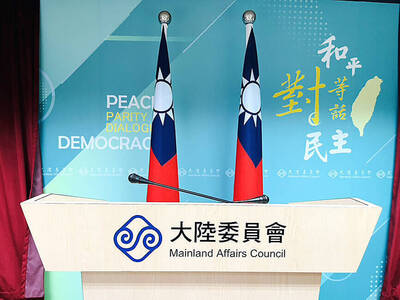
RISKY BUSINESS: The ‘incentives’ include initiatives that get suspended for no reason, creating uncertainty and resulting in considerable losses for Taiwanese, the MAC said China’s “incentives” failed to sway sentiment in Taiwan, as willingness to work in China hit a record low of 1.6 percent, a Ministry of Labor survey showed. The Directorate-General of Budget, Accounting and Statistics (DGBAS) also reported that the number of Taiwanese workers in China has nearly halved from a peak of 430,000 in 2012 to an estimated 231,000 in 2024. That marked a new low in the proportion of Taiwanese going abroad to work. The ministry’s annual survey on “Labor Life and Employment Status” includes questions respondents’ willingness to seek employment overseas. Willingness to work in China has steadily declined from

The Legislative Yuan’s Finance Committee yesterday approved proposed amendments to the Amusement Tax Act (娛樂稅法) that would abolish taxes on films, cultural activities and competitive sporting events, retaining the fee only for dance halls and golf courses. The proposed changes would set the maximum tax rate for dance halls and golf courses at 50 and 20 percent respectively, with local governments authorized to suspend the levies. Article 2 of the act says that “amusement tax shall be levied on tickets sold or fees charged by amusement places, facilities or activities” in six categories: “Cinema; professional singing, story-telling, dancing, circus, magic show, acrobatics

INFLATION UP? The IMF said CPI would increase to 1.5 percent this year, while the DGBAS projected it would rise to 1.68 percent, with GDP per capita of US$44,181 The IMF projected Taiwan’s real GDP would grow 5.2 percent this year, up from its 2.1 percent outlook in January, despite fears of global economic disruptions sparked by the US-Iran conflict. Taiwan’s consumer price index (CPI) is projected to increase to 1.5 percent, while unemployment would be 3.4 percent, roughly in line with estimates for Asia as a whole, the international body wrote in its Global Economic Outlook Report published in the US on Monday. The figures are comparatively better than the IMF outlook for the rest of the world, which pegged real GDP growth at 3.1 percent, down from 3.3 percent


 RSS
RSS