


With many people worried about getting sick -- whether from the common cold or exotic new strains of antibiotic-resistant bacteria -- Paul and Jeffrey Metzger had reason to hope that the germ-fighting key fob they invented would be a hit.
Their device, known as the Handler, began selling last year. It features a pop-out hook so germophobes can avoid touching surfaces where undesirable microbes may lurk. As added protection, the Handler's surfaces are impregnated with tiny particles of silver to kill germs that land on the device itself.
But the particles have run Maker Enterprises, the Metzger brothers' partnership, into trouble. The Metzgers realized that the Environmental Protection Agency (EPA) might decide that a law that regulates pesticides would apply to antimicrobial products like theirs.
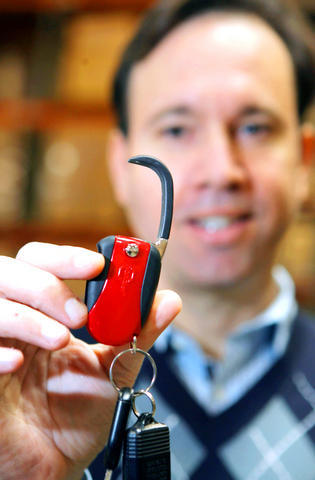
PHOTO: NY TIMES NEWS SERVICE
The agency ruled last fall that the law covered Samsung's Silvercare washing machine. Samsung was told it would have to register the machine as a pesticide, a costly, time-consuming process, because it claims the silver ions generated by the washer kill bacteria.
The Metzgers halted production of their key fob while they sought legal guidance on how to avoid a similar fate.
Their quandary highlights a challenge facing entrepreneurs who have ventured into nanotechnology, a field that relies on materials so small their dimensions are measured in billionths of a meter.
The Handler is one of many products marketing the antimicrobial potency of tiny quantities of silver.
The EPA has so far rejected calls from environmental groups to automatically classify nanoscale forms of materials as new chemicals under the broad toxic chemical control regulations. Nor does the agency consider size when determining what needs to be registered under its pesticide regulations. The effort to squeeze nanomaterials into existing regulations has left firms worried about how to market products without falling foul of regulators.
The law at issue -- the Federal Insecticide, Fungicide and Rodenticide Act, better known as FIFRA -- was conceived in 1947 to protect humans from agri-chemicals. In the case of the Handler, the question is how the law applies to barely measurable amounts of silver that are intended to be strictly confined instead of spread into the environment.
Silver's sterilizing powers are well-known, but no one can be certain that long experience with the metal is a complete guide to its hazards in its newly engineered forms. Nanoscale particles are often very potent. They may also have other unexpected properties that will become apparent only if many people are exposed to significant quantities over long periods of time.
One of the biggest concerns with such particles is that they may penetrate the brain and other organs that larger particles cannot reach.
Moreover, some critics worry that the technology may contribute to the evolution of microbes resistant to silver poisoning. And some health experts say that constantly reducing exposure to troublesome microbes may eventually weaken the human immune system.
Environmental groups point out that pesticide regulators may simply ignore an antimicrobial product if its manufacturer and distributors avoid making health claims. As the EPA interprets the regulation, a product is not "designed" to be a health-protecting antimicrobial if it is not advertised as such.
The agency said its handling of earlier antimicrobial products, especially the synthetic disinfectant triclosan, provided a model for nanosilver. Companies that had rushed to market with products impregnated with triclosan ended up paying fines and changing their labels. Many triclosan products have since been registered under the pesticide law.

PROVOCATIVE: Chinese Deputy Ambassador to the UN Sun Lei accused Japan of sending military vessels to deliberately provoke tensions in the Taiwan Strait China denounced remarks by Japan and the EU about the South China Sea at a UN Security Council meeting on Monday, and accused Tokyo of provocative behavior in the Taiwan Strait and planning military expansion. Ayano Kunimitsu, a Japanese vice foreign minister, told the Council meeting on maritime security that Tokyo was seriously concerned about the situation in the East China and South China seas, and reiterated Japan’s opposition to any attempt to change the “status quo” by force, and obstruction of freedom of navigation and overflight. Stavros Lambrinidis, head of the EU delegation to the UN, also highlighted South China Sea

The final batch of 28 M1A2T Abrams tanks purchased from the US arrived at Taipei Port last night and were transported to the Armor Training Command in Hsinchu County’s Hukou Township (湖口), completing the military’s multi-year procurement of 108 of the tanks. Starting at 12:10am today, reporters observed more than a dozen civilian flatbed trailers departing from Taipei Port, each carrying an M1A2T tank covered with black waterproof tarps. Escorted by military vehicles, the convoy traveled via the West Coast Expressway to the Armor Training Command, with police implementing traffic control. The army operates about 1,000 tanks, including CM-11 Brave Tiger
Taiwan Semiconductor Manufacturing Co (TSMC, 台積電), the world’s largest contract chipmaker, said it expects its 2-nanometer (2nm) chip capacity to grow at a compound annual rate of 70 percent from this year to 2028. The projection comes as five fabs begin volume production of 2-nanometer chips this year — two in Hsinchu and three in Kaohsiung — TSMC senior vice president and deputy cochief operating officer Cliff Hou (侯永清) said at the company’s annual technology symposium in Silicon Valley, California, last week. Output in the first year of 2-nanometer production, which began in the fourth quarter of last year, is expected to
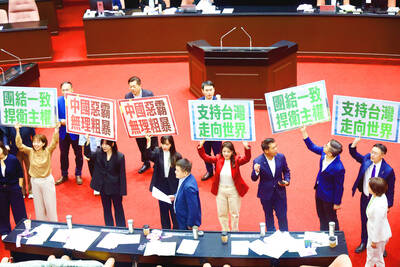
ESWATINI TRIP: The ‘irresponsible actions’ of three African nations set a dangerous precedent and they should be held accountable, a US representative said The US Senate Foreign Relations Committee on Thursday urged Washington not to normalize Chinese pressure, while a US lawmaker called on the US government to hold countries accountable for yielding to Beijing’s pressure to block President William Lai’s (賴清德) planned trip to Eswatini. Lai had been scheduled to visit Eswatini to attend birthday events for King Mswati III of Eswatini this week, but on Tuesday, the eve of his planned departure on Wednesday, the Presidential Office said the trip was “suspended” after the Seychelles, Mauritius and Madagascar unexpectedly withdrew overflight permission. “China reportedly pressured Mauritius, Seychelles, and Madagascar to deny airspace access


 RSS
RSS