


On a scrap of windswept prairie 11,000km from the Persian Gulf, in a small office where two stag trophies gaze down from the walls, Ronnie Roles is preparing for an American invasion of Iraq.
Roles is president of operations for Cudd Pressure Control, one of the three American companies that extinguished hundreds of oil well fires in Kuwait after the Persian Gulf War and lately have been in touch with the Pentagon about similar service in a possible war in Iraq.
Like his counterparts at the other companies, Boots & Coots International Well Control and Wild Well Control, Roles is making sure that men and equipment in the US and around the world could be sent to Iraq at a moment's notice. Administration officials and oil industry executives now worry that Saddam Hussein could similarly torch Iraq's oil fields if the US attacks, just as retreating Iraqi troops blew up 700 of Kuwait's 1,000 oil wells, sinking the country into a months-long night of roiling fire and black skies.
For all their experience amid such danger, the firefighting companies say that Iraq could pose some extraordinary new challenges. No one in the industry, for example, has worked on oil wells tainted by chemical or biological weapons. No one wants to enter booby-trapped fields. And no one is quite sure who will pay for salvaging Iraq's vast oil reserves, the second largest in the world after Saudi Arabia's.
"Initially, the problems would probably be the same as in Kuwait: whether there are working airports or water nearby to fight the fires," Roles said. "But with the fields there in Saddam's back yard, will he cause more problems, with things like mines at the wells?"
A Pentagon spokesman declined to comment on any contact with oil firefighting companies, saying that the Defense Department does not discuss contingency plans or talks with private companies unless a contract is signed. "But it is part of our job to be ready for different situations," said the spokesman, Lieutenant Dan Heplage. "That's just prudent."
The Bush administration says that restoring Iraq's oil production is paramount to the US' long-term interests in the country and the Middle East as a whole. Revenues from oil exports would be crucial to reviving the economy if Saddam is ousted, and a healthy economy, in turn, would shore up political stability. So if Iraq's oil industry were damaged -- which is not a certainty but a possibility very much on the minds of American war planners -- companies that battle fires would need to get to the fields fast to limit the destruction.
Two fronts
"It's not unimaginable that the war effort would still be going on while we're in there," said Jerry L. Winchester, president and chief operating officer of Boots & Coots, which is based in Houston.
In the corridor around the corner from Winchester, some far-sighted employee has recently pinned up maps of Iraq's topography, oil fields and pipelines. The corporate art that fills the hallways of well-control companies like Boots & Coots is almost exclusively photos of pillars of flame over oil wells and the occasional offshore oil platform, shorn in half by an explosion and sinking into the sea.
Oilfield firefighters make no secret of the rush they get from walking into danger. Though the legendary Red Adair is no longer in business, the men who run this generation of companies are all his proteges. They are the rock stars in an industry that has become increasingly tame, high-tech and climate controlled. Yet even for them, there are fewer fires and blowouts than there used to be. Of the 40 to 60 well-control emergencies that Wild Well Control handles every year, for example, only about six of them rage into fires, said the chief executive, Pat Campbell.
Kuwait turned out to be like nothing the companies had ever seen, and Iraq could be worse, executives said. When Iraq invaded Kuwait, Kuwaiti oil executives who had fled into exile and Western well-control companies were able to work together in anticipation of the sabotage of Kuwaiti fields.
Fiery hell
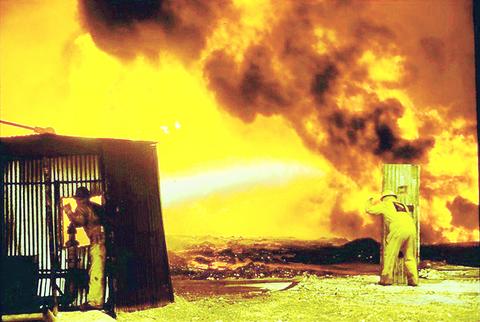
In March 1991, when the first teams of firefighters arrived, they thought they had walked into hell, Winchester recalled. "You're used to pulling up to a location and seeing one well on fire, not 80," he said, "and you know there's another 80 out there and a few hundred behind those."
The fires roared louder than jet engines. Smoke blotted out the sky. Oil pooled in lakes in the desert.
Allied forces had bombed the Iraqi troops in the Kuwaiti fields, leaving behind thousands of unexploded cluster bombs that were quickly camouflaged by the shifting sands. Iraqi corpses littered the fields. Escaping troops stole the earth-moving equipment the firefighters would need to control the wells. And there was little water to use in fighting the fires.
Experts initially estimated that it would take four or five years to extinguish the fires. Instead, the job was completed in nine months. The firefighting companies, executives said, had some good luck and a great deal of help -- both of which could be hard to find in Iraq.
As prolific as some of Kuwait's wells are, there are Iraqi wells that produce even more oil. If they were blown up, they might be harder to control, and the oil spills from them more difficult to contain. "That's a big environmental nightmare," said Bill Mahler, marketing manager at Wild Well Control. "You wouldn't wish that on anyone."
The cooperation of the Kuwaitis eased the firefighting considerably. The national oil company handed over technical information about the wells that helped the firefighters understand things like what kind of equipment they should use in Kuwait. The firefighters do not expect such help from Iraqi oil officials. The Kuwaitis piped in water from the sea that the firefighters used to put down the flames. But many Iraqi fields are far from rivers and lakes, and it is still unclear where water would come from.
Money to be made
The Kuwaiti mission was very lucrative for well-control, Winchester said. But the industry is still unsure who would pay to rescue the Iraqi oil industry. Would it be the American government or the UN or the Iraqis themselves, once their fields were operational once more?
"I don't know, and I don't know if anyone else knows yet," Roles said. "The government hasn't volunteered and said, `We'll pick up the bill.'"
Executives hope that just as Kuwait did not turn out to be as awful as feared, Iraq may not either. The Kuwaiti wells were inexpertly blown up, which limited the damage, and the same might occur in Iraq.
The Kuwaiti wells were also all the same type, and the well-control companies suspect that the Iraqi wells might be similar enough to one another that firefighters could master them in a short period of time.
And there remains the tiny hope that perhaps Iraqi troops, while ready to destroy their neighbor's riches, would balk at destroying their own. "Saddam might blow up his own wells if he felt he had nothing left to lose, but the Iraqis themselves might not do that if they feel he is on his way out," Campbell said.
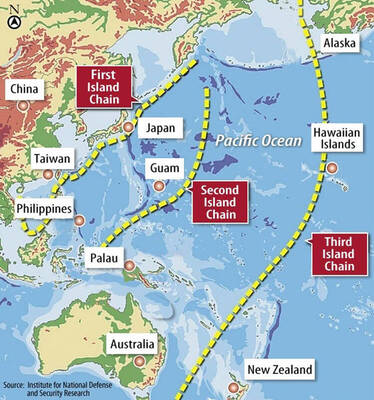
The US government has signed defense cooperation agreements with Japan and the Philippines to boost the deterrence capabilities of countries in the first island chain, a report by the National Security Bureau (NSB) showed. The main countries on the first island chain include the two nations and Taiwan. The bureau is to present the report at a meeting of the legislature’s Foreign Affairs and National Defense Committee tomorrow. The US military has deployed Typhon missile systems to Japan’s Yamaguchi Prefecture and Zambales province in the Philippines during their joint military exercises. It has also installed NMESIS anti-ship systems in Japan’s Okinawa

‘WIN-WIN’: The Philippines, and central and eastern European countries are important potential drone cooperation partners, Minister of Foreign Affairs Lin Chia-lung said Minister of Foreign Affairs Lin Chia-lung (林佳龍) in an interview published yesterday confirmed that there are joint ventures between Taiwan and Poland in the drone industry. Lin made the remark in an exclusive interview with the Chinese-language Liberty Times (the Taipei Times’ sister paper). The government-backed Taiwan Excellence Drone International Business Opportunities Alliance and the Polish Chamber of Unmanned Systems on Wednesday last week signed a memorandum of understanding in Poland to develop a “non-China” supply chain for drones and work together on key technologies. Asked if Taiwan prioritized Poland among central and eastern European countries in drone collaboration, Lin
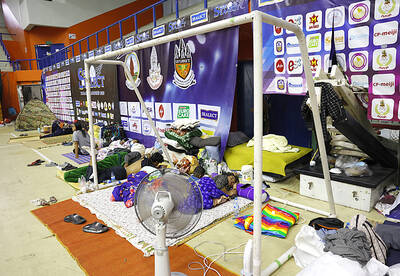
Renewed border fighting between Thailand and Cambodia showed no signs of abating yesterday, leaving hundreds of thousands of displaced people in both countries living in strained conditions as more flooded into temporary shelters. Reporters on the Thai side of the border heard sounds of outgoing, indirect fire yesterday. About 400,000 people have been evacuated from affected areas in Thailand and about 700 schools closed while fighting was ongoing in four border provinces, said Thai Rear Admiral Surasant Kongsiri, a spokesman for the military. Cambodia evacuated more than 127,000 villagers and closed hundreds of schools, the Thai Ministry of Defense said. Thailand’s military announced that

NO CONFIDENCE MOTION? The premier said that being toppled by the legislature for defending the Constitution would be a democratic badge of honor for him Premier Cho Jung-tai (卓榮泰) yesterday announced that the Cabinet would not countersign the amendments to the local revenue-sharing law passed by the Legislative Yuan last month. Cho said the decision not to countersign the amendments to the Act Governing the Allocation of Government Revenues and Expenditures (財政收支劃分法) was made in accordance with the Constitution. “The decision aims to safeguard our Constitution,” he said. The Constitution stipulates the president shall, in accordance with law, promulgate laws and issue mandates with the countersignature of the head of the Executive Yuan, or with the countersignatures of both the head of the Executive Yuan and ministers or


 RSS
RSS