


The Cyprus government took a bold step on Wednesday towards liberalizing the lucrative telecommunications market by nominating the Permanent Secretary of the Ministry of Communications as the new regulator of the sector.
So far, all basic telecoms services and infrastructure have been the sole responsibility of the Cyprus Telecommunications Authority semi-state monopoly.
Parliament is discussing the corporatization of CyTA, backed by more than 90 per cent of the staff, according to Communications Minister Averof Neophytou.
Announcing the Cabinet decision for the regulator, government spokesman Michalis Papapetrou said the nominee, Vassos Pyrgos, will be employed under a five-year contract.
Cyprus, which opened accession negotiations with the EU in 1998, is liberalizing sectors such as telecommunications to harmonize itself with EU norms and regulations.
Fixed and mobile telephony are handled by the CyTA monopoly. Fixed telephony, with 437,000 subscribers, has a market penetration of 64 percent. Mobile telephony has a market penetration of 44 percent with 301,000 subscribers.
Basic communications services (satellite links, undersea cables) are also a CyTA monopoly, while all other commercial services (Internet, retailing) are also offered by private companies.
Testifying during a house communications committee briefing Tuesday, Neophytou said the CyTA corporatization plan is the only to deal with the challenges of liberalization and deregulation.
A limited liability company will be set up to hold the assets and liabilities of CyTA after the land and other assets have been valued.
Employees can move to the new company, retire or serve as employees of the old CyTA. Of the share capital, 6 percent will be offered to staff and those with CyTA pensions.
Staff will appoint one member to the 11-member board, but their shares are non-transferable and non-negotiable. The rest of the share capital will be held by the state. The Council of Ministers will not have the right to transfer, sell or negotiate the shares to a third party.
"We hope that the state will provide us with the necessary autonomy and flexibility to transform CyTA into a public limited company and the limitation of the relationship between the major- owner, the state, and CYTA Ltd into a strictly financial one," Chairman Stathis Papadakis said recently.
Despite reductions to the CYTAGSM mobile service and the introduction of two new charge packages, as well as cuts of up to 55 percent on international call rates, total revenue in 2000 rose 29.7 million Cyprus pounds (US$45 million), or 16.6 percent, to C?208.7 million. Expenses reached C?118 million, up 1.7 percent.
CyTA is a shareholder in the satellite operator, Intelsat, other international telecom cables and the undersea Black Sea Fibre Optic Cable System, for which it was recently appointed as commercial operator.
The BSFOCS' 1300km long cable will connect Varna in Bulgaria with Odessa in the Ukraine and Novorossyisk in Russia.
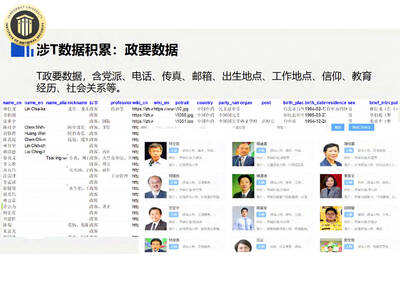
NETWORK-MAPPING PROJECT: The database contains 170 detailed files of Taiwanese politicians and about 23 million records of household registration data in Taiwan China has developed a network-mapping project targeting political figures and parties in Taiwan to monitor public opinion during elections and to craft tailored influence campaigns aimed at dividing Taiwanese society, according to documents leaked by Chinese technology firm GoLaxy (中科天璣). The documents, collected by Taipei-based Doublethink Lab, showed a database was specifically created to gather detailed information on Taiwanese political figures, including their political affiliations, job histories, birthplaces, residences, education, religion and a brief biography about them. Several notable Taiwanese politicians are in the database, including President William Lai (賴清德), former president Tsai Ing-wen (蔡英文), Minister of Foreign Affairs Lin Chia-lung (林佳龍),

KEY INDUSTRY: The vice premier discussed a plan to create a non-red drone supply chain by next year, which has been allocated a budget of more than NT$7.2 billion The government has budgeted NT$44.2 billion (US$1.38 billion) to cultivate Taiwan’s uncrewed aerial vehicle (UAV) industry over the next five years, which would make the nation a major player in the industry’s democratic supply chain in the Asia-Pacific region, Premier Cho Jung-tai (卓榮泰) said yesterday. Cho made the remarks during a visit to the facilities of Cub Elecparts Inc (為升電裝). Democratic Progressive Party (DPP) Legislator Chen Su-yueh (陳素月) and Chinese Nationalist Party (KMT) Legislator Hsieh Yi-fong (謝依鳳) also participated in the trip. Cub Elecparts has transitioned from the automotive industry to the defense industry, which is the top priority among the nation’s
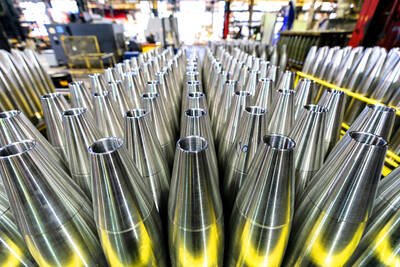
UPGRADED MISSILE: The Chungshan Institute of Science and Technology is reportedly to conduct a live-fire test of the Hsiung Feng III anti-ship missile on Thursday next week The US Army is planning to build new facilities to boost explosives production and strengthen its supply chain, a move aimed at addressing munitions shortages and supporting obligations to partners including Taiwan, Ukraine and Israel, Defense News reported. The army has issued a sources sought notice for a proposed Center of Excellence at the Blue Grass Army Depot in Kentucky, the report said. The facility would serve as a hub within the US industrial base for the production of key military explosives, including research department explosives (RDX) and high melting explosives (HMX), while also supporting research and development of next-generation materials. The proposed
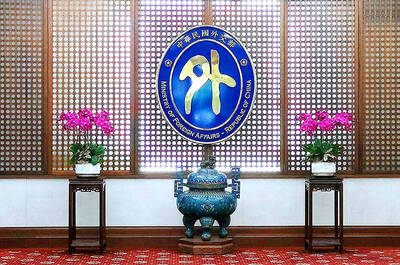
SOUTH KOREA DISPUTE: If Seoul continues to ignore its request, Taiwan would change South Korea’s designation on its arrival cards, the foreign ministry said If South Korea does not reply appropriately to a request to correct Taiwan’s name on its e-Arrival card system before March 31, the government would take corresponding measures to change how South Korea is labeled on the online Taiwan Arrival Card system, the Ministry of Foreign Affairs said yesterday. South Korea’s e-Arrival card system lists Taiwan as “China (Taiwan)” in the “point of departure” and “next destination” fields. Taipei has asked Seoul to change the wording. Since March 1, South Koreans who hold government-issued Alien Resident Certificates (ARC) have been identified as from “South Korea” rather than the “Republic of Korea,” the


 RSS
RSS