


The COVID-19 outbreak in China has hit both foreign and domestic tourist arrivals in Kaohsiung, leading major hotels in the city to suspend or downsize operations to reduce costs as they wait for a rebound.
Lees Boutique Hotel (麗景飯店) and the Taroko Park outlet of Holiday Garden Hotel (華園飯店) have suspended operations for one to two months.
Poor occupancy rates prompted Holiday Garden to temporarily close the Taroko Park property and send customers to its outlet near Liuhe Night Market (六合夜市), hotel officials said.
That property has proven relatively resilient, with occupancy rates of 50 percent, thanks to business guests and discount offers that reduced room rates by 15 percent to NT$1,999 (US$66.36) per night, the officials said.
The hotel has also attracted guests from foreign baseball teams that are holding player training in Kaohsiung.
However, the family-focused Taroko Park outlet, next to Taroko park and Suzuka Circuit Park, has suffered from its less convenient location, even with the government extending schools’ winter break through this week as part of efforts to curb the spread of the virus.
Taiwanese are avoiding going out and traveling domestically, because of concerns over the outbreak.
Lees Boutique has moved its customers to the nearby Lees Hotel (麗尊酒店) as a way of trimming costs.
The hotel group said it has no intention of shutting down the boutique property permanently, but is adopting makeshift measures to cope with the drastic decline in the market.
Staff layoffs or unpaid leave are not an issue. and there is no timetable for resuming full operations at the boutique, it said.
Grand Hi-Lai Hotel (漢來大飯店), one of the biggest hotels in the city, has closed off half of its 20 floors and encouraged employees to take unused leave after occupancy plummeted to 30 percent this month.
The hotel is offering special room rates of NT$2,800 per day and room upgrades for guests who stay at the hotel by the end of next month.
Silks Club (晶英國際行館), the city’s most expensive hotel, yesterday launched a special program to encourage long stays at its executive suites, priced at NT$22,000 per night for an entire month.
TAIPEI OFFERS
The promotion follows its affiliate Regent Taipei’s announcement that it would provide gift coupons worth NT$8,000 for all guests who stay at the five-star hotel for NT$6,000 per night.
The Palais de Chine (君品酒店), near Taipei Railway Station, has introduced monthly room rates of NT$45,000 for guests from now on until June 30, which is about 80 percent off its regular monthly rate.
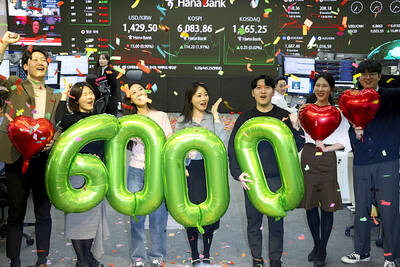
South Korea’s equity benchmark yesterday crossed a new milestone just a month after surpassing the once-unthinkable 5,000 mark as surging global memory demand powers the country’s biggest chipmakers. The KOSPI advanced as much as 2.6 percent to a record 6,123, with Samsung Electronics Co and SK Hynix Inc each gaining more than 2 percent. With the benchmark now up 45 percent this year, South Korea’s stock market capitalization has also moved past France’s, following last month’s overtaking of Germany’s. Long overlooked by foreign funds, despite being undervalued, South Korean stocks have now emerged as clear winners in the global market. The so-called “artificial intelligence
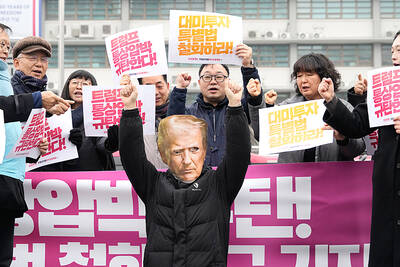
CONFUSION: Taiwan, Japan and other big exporters are cautiously monitoring the situation, while analysts said more Trump responses ate likely after his loss in court US trading partners in Asia started weighing fresh uncertainties yesterday after President Donald Trump vowed to impose a new tariff on imports, hours after the Supreme Court struck down many of the sweeping levies he used to launch a global trade war. The court’s ruling invalidated a number of tariffs that the Trump administration had imposed on Asian export powerhouses from China and South Korea to Japan and Taiwan, the world’s largest chip maker and a key player in tech supply chains. Within hours, Trump said he would impose a new 10 percent duty on US imports from all countries starting on
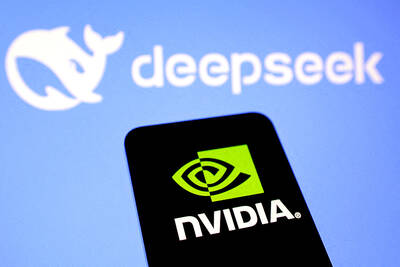
Chinese artificial intelligence (AI) start-up DeepSeek’s (深度求索) latest AI model, set to be released as soon as next week, was trained on Nvidia Corp’s most advanced AI chip, the Blackwell, a senior official of US President Donald Trump’s administration said on Monday, in what could represent a violation of US export controls. The US believes DeepSeek will remove the technical indicators that might reveal its use of American AI chips, the official said, adding that the Blackwells are likely clustered at its data center in Inner Mongolia, an autonomous region of China. The person declined to say how the US government received

Like many of us who are mindful of our plastic consumption, Beth Gardiner would take her own bags to the supermarket and be annoyed whenever she forgot to do so. Out without her refillable bottle, she would avoid buying bottled water. “Here I am, in my own little life, worrying about that and trying to use less plastic,” she says. Then she read an article in this newspaper, just over eight years ago, and discovered that fossil fuel companies had plowed more than US$180 billion into plastic plants in the US since 2010. “It was a kick in the teeth,” Gardiner


 RSS
RSS