


The US dollar vaulted to a four-month peak against of basket of major currencies on Friday, propelled by a strong US non-farm payrolls report that followed a spate of upbeat economic data this week, a scenario expected to keep US interest rates steady.
The US dollar index posted its largest weekly percentage gain in more than two years with a 1.3 percent jump.
The US currency also hit a two-month high against sterling and the Canadian dollar, a six-week peak versus the Swiss franc and a four-month high against the euro.
However, it fell against the safe-haven yen amid persistent fears about the 2019 novel coronavirus outbreak in China, although investors were focused a little more on US payrolls data for much of the New York session.
Data showed that US non-farm payrolls increased by 225,000 jobs last month, with employment at construction sites increasing by the most in a year given milder-than-normal temperatures.
Economists polled by Reuters had forecast payrolls would rise by 160,000 jobs.
“Today’s positive prints confirmed that the US job market is firing on all cylinders, the US economy is expanding,” said Olivier Konzeoue, foreign-exchange Sales Trader at Saxo Markets in London. “The [US] Federal Reserve looks set to stay put for the time being.”
The US dollar index rose 0.2 percent to 98.687 on Friday.
The US dollar also rose 0.3 percent against the Swiss franc at SF0.9772, gained 0.1 percent versus the Canadian dollar to C$1.3301 and climbed 0.3 percent versus sterling, which fell to US$1.2887.
However, the greenback fell 0.2 percent against the yen to ¥109.76 on what analysts said was more a safe-haven play for the Japanese currency in the wake of the outbreak.
In Taipei, the New Taiwan dollar fell against the US dollar, dropping NT$0.044 to close at NT$30.126, but it was up 0.4 percent for the week.
The Fed, in its latest monetary policy report to the US Congress released on Friday, cited the fallout from the spreading virus as one of the risks to the US economic outlook.
“This is the first major hint that the Fed is concerned that the virus could possibly derail global growth,” said Edward Moya, senior market analyst at Oanda Corp in New York.
The outbreak has killed at least 700 people in China.
The virus has spread globally, with 320 cases in 27 countries and regions outside China, a tally of official statements showed.
The euro on Friday fell to its lowest since October last year after German industrial output recorded its biggest decline in a decade in December.
The European single currency on Friday fell 0.3 percent to US$1.0943. It is down 1.4 for the week, its worst weekly loss since November.
The offshore yuan was down 0.4 percent at 7.005 yuan per US dollar.
Additional reporting by staff writer

The EU and US are nearing an agreement to coordinate on producing and securing critical minerals, part of a push to break reliance on Chinese supplies. The potential deal would create incentives, such as minimum prices, that could advantage non-Chinese suppliers, according to a draft of an “action plan” seen by Bloomberg. The EU and US would also cooperate on standards, investments and joint projects, as well as coordinate on any supply disruptions by countries like China. The two sides are additionally seeking other “like-minded partners” to join a multicountry accord to help create these new critical mineral supply chains, which feed into

For weeks now, the global tech industry has been waiting for a major artificial intelligence (AI) launch from DeepSeek (深度求索), seen as a benchmark for China’s progress in the fast-moving field. More than a year has passed since the start-up put Chinese AI on the map in early last year with a low-cost chatbot that performed at a similar level to US rivals. However, despite reports and rumors about its imminent release, DeepSeek’s next-generation “V4” model is nowhere in sight. Speculation is also swirling over the geopolitical implications of which computer chips were chosen to train and power the new
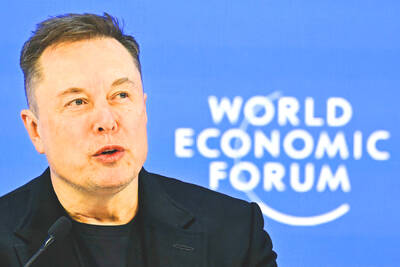
Elon Musk’s lieutenants have reached out to chip industry suppliers, including Applied Materials Inc, Tokyo Electron Ltd and Lam Research Corp, for his envisioned Terafab, early steps in an audacious and likely arduous attempt to break into the production of cutting-edge chips. Staff working for the joint venture between Tesla Inc and Space Exploration Technologies Corp (SpaceX) have sought price quotes and delivery times for an array of chipmaking gear, people familiar with the matter said. In past weeks, they’ve contacted makers of photomasks, substrates, etchers, depositors, cleaning devices, testers and other tools, according to the people, who asked not to

Japan approved ¥631.5 billion (US$3.97 billion) in additional subsidies to hasten Rapidus Corp’s entry into the high-stakes artificial intelligence (AI) chipmaking arena, ramping up support for a project widely regarded as a long shot. The capital is intended to bankroll Rapidus’ work for information technology firm Fujitsu Ltd, one of the initial customers that Tokyo hopes would get the signature endeavor off the ground. The new money raises the fees and investments that the government is injecting into the start-up to ¥2.6 trillion by the end of the current fiscal year to March next year, the Japanese Ministry of Economy, Trade and


 RSS
RSS