


The merger and acquisition (M&A) train powered through instability this year, keeping a pace dealmakers worry will not be maintained next year.
Global mergers and acquisitions weathered geopolitical tensions and roiling markets to post US$2.99 trillion in volume this year, a 1.5 percent dip from last year, although still the fifth-best year ever.
The number of deals this year through Friday last week dropped 4.2 percent to 29,015, according to data compiled by Bloomberg. The biggest was United Technologies Corp’s agreement in June to buy Raytheon Co, creating an aerospace and defense player worth more than US$100 billion.
“The current M&A market has proven to be unstoppable,” Goldman Sachs Group Inc cohead of global mergers and acquisitions Dusty Philip said. “Despite spikes in market volatility and macro concerns regarding trade and political uncertainty, we’ve seen a flurry of large-scale M&A transactions in recent weeks.”
The bank’s “backlog is clearly up from the beginning of the year,” he said.
Goldman Sachs remained the top-ranked dealmaker this year, advising on 281 transactions worth US$1 trillion, according to data compiled by Bloomberg.
JPMorgan Chase & Co, neck and neck with Morgan Stanley for the second slot, followed with 258 deals worth US$874 billion. Morgan Stanley advised on 234 deals worth US$821 billion.
While last year they were buoyed by a flush of private equity deals and transactions in the middle-market, this year was propped up by a rush of mega-mergers. The top three investment banks were also helped as turmoil in Europe stung the region’s dealmakers.
Board rooms have plenty to worry about next year: the tumultuous US presidential campaign, the UK’s Brexit deadlines, tariff-fueled trade tensions and regulatory regimes targeting the world’s largest companies.
There are likely to be fewer large deals next year, partly because of regulatory issues, Morgan Stanley’s global head of mergers and acquisitions Robert Kindler said. He expects the number of transactions to be comparable to this year, even as volumes shrink.
“I don’t expect that in anticipation of the election there will be a rush to do deals out of concern with the possibility of a change in administration,” he said. “I don’t think there’s that much of a difference between the current administration and what some of the Democratic candidates are saying.”
Some deal drivers have not let up, such as shareholders pushing for buyout paydays over stock buybacks. As global economic activity grows more subdued, companies seeking growth are fighting over fewer desirable assets.
Private equity firms, flush with an estimated US$1.4 trillion in dry powder, are benefiting from cheap financing and finding partners to buy bigger targets.
The largest this year was the US$14.3 billion buyout of fiber network company Zayo Group Holdings Inc announced in May, in which Stockholm-based private equity firm EQT AB joined Digital Colony Partners.
Several private equity firms have been circling Germany’s Thyssenkrupp AG, which could fetch more than 15 billion euros (US$16.6 billion), people familiar with the matter have said.
Buyout firms have also been eyeing even larger targets such as Walgreens Boots Alliance Inc, the US$52 billion drugstore operator.
While buyout firms are expected to remain very active next year, some of their ambitions could be hampered by tightening credit markets.
“People are going to be hard pressed to add a lot of leverage,” JPMorgan global cohead of mergers and acquisitions Chris Ventresca said.
Alison Harding-Jones, head of M&A for Europe, the Middle East and Africa at Citigroup Inc, expects a busy first half of the year.
“There’s support for strategic deals that are fairly priced — demand for high quality companies is strong across strategics and private equity,” she said.
Healthcare M&A volumes hit an all-time high this year, reaching US$461 billion. Mega deals included Bristol-Myers Squibb Co buying Celgene Corp and AbbVie Inc acquiring Allergan PLC.
Bank of America Corp’s head of healthcare banking for Europe, the Middle East and Africa Christina Dix said pharmaceutical companies would focus on optimizing their portfolios amid drug pricing pressure and US healthcare reform.
Jonathan Davis, an M&A partner at Kirkland & Ellis who advised AbbVie on the Allergan deal, said the deals pipeline is strong, but he is watching whether companies show increased caution next year.
“There are a lot of positive conversations going on, but that is balanced by a few pronounced headwinds, including an upcoming election cycle and associated political and regulatory uncertainty, high valuations and recent choppiness in the credit markets,” he added.
To combat future market swings, companies are using stock to fund deals at the highest level in almost 20 years.
Acquisitions by US companies in which part of the payment is stock have surged 41 percent to US$753 billion, higher than any previous full year since 2000.
Paying in stock, which ties a deal’s risk to the market, would remain a popular option to hard cash, JPMorgan’s head of M&A for North America Anu Aiyengar said.
“When you have a large amount of uncertainty in the world, one way to address that is to do stock-for-stock deals,” she said.

Cairo’s new monorail slices across the city skyline, running above the familiar chaos of blaring horns and aging buses’ exhaust fumes that mark rush hour below. The US$4.5 billion monorail, opened this month, is among Egypt’s most prominent new transport projects, part of a debt-funded infrastructure drive criticized for sapping state finances while bringing limited benefits to most of the country’s 109 million people. “It feels like you’re in a different country,” said Ramy Sayed, a restaurant manager, aboard a driverless Innovia 300 train. “No noise, no traffic, we’re not used to this.” The eastern line runs 56km from the bustling middle-class

Starlux Airlines Co (星宇航空) today unveiled a long-haul network expansion plan at a shareholders’ meeting in Taipei, including direct flights to Barcelona, Spain, and Zurich, Switzerland, as well as a service connecting Taipei, Sydney and New Zealand. Starlux is to become the first Taiwanese carrier to offer non-stop services to the two European cities, while the inaugural oceanic route is expected to expand transit opportunities within the Australia-New Zealand market, Starlux said. Flight services to Chicago, Dallas, Washington and New York are under evaluation, the airline added. Prior to the shareholders’ meeting, the airline earlier this year announced that it would be

Taiwanese prosecutors suspect that three people successfully smuggled at least one shipment of Nvidia Corp artificial intelligence (AI) chips to China after first exporting them to Japan, people familiar with the matter said. The trio was detained last week by the Keelung District Prosecutors’ Office for allegedly falsifying documents related to exports of Super Micro Computer Inc servers containing advanced Nvidia chips, which the US has barred from sale to China without a license from Washington. The move marked Taiwan’s first public crackdown on AI chip diversion after years of pressure from the US to take a more active role in curtailing
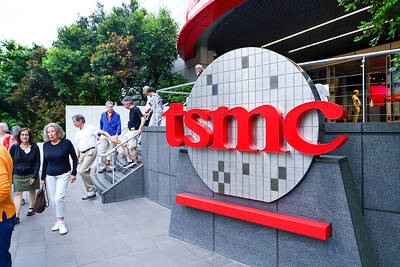
Taiwan Semiconductor Manufacturing Co (TSMC, 台積電) employee bonuses are likely to grow more than 30 percent this year, in line with the past few years as the company’s profits continue to set new records, an anonymous source cited TSMC chairman C.C. Wei (魏哲家) as saying yesterday. TSMC, the world’s largest contract chipmaker, is committed to taking care of its workers, the source said, citing Wei’s meeting with employees yesterday morning. Wei also expressed gratitude to employees for their contribution to the company’s improving bottom line, the source added. Since 2023, TSMC’s employee bonuses have grown at an annual rate of


 RSS
RSS