


AngloGold Ashanti Ltd’s last South African mine is luring potential buyers as the rally in gold boosts profitability. That interest does not mean AngloGold chief executive officer Kelvin Dushnisky will achieve his target price.
AngloGold wants about US$500 million for Mponeng and a number of smaller South African assets, according to people familiar with the matter, who asked not to be identified as the issue is private.
Harmony Gold Mining Co and Sibanye Gold Ltd have submitted formal proposals, the people said.
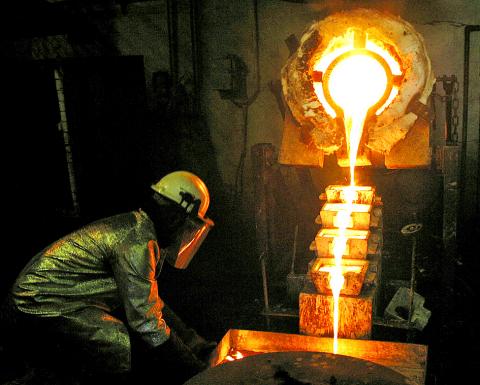
Photo: Reuters
The discussions are at an early stage and it is uncertain whether they will lead to a deal, they said.
Any acquirer faces additional costs as they bankroll a stake in the mine for employees and nearby communities to comply with a law seeking to address inequities stemming from apartheid. Mponeng’s valuation is also being squeezed by geological challenges: It is the world’s deepest mine and requires investment of US$1 billion to extend its life beyond eight years, JPMorgan Chase & Co has said.
“You have to ask yourself, why would you buy a mine 4km deep?” said Peter Major, an analyst at Mergence Corporate Solutions in Cape Town. “It’s a huge risk. Those that are interested will want to get a discount.”
“We remain committed to streamlining our portfolio — guided by our capital allocation priorities — but we don’t comment on deals in process,” said Stewart Bailey, executive vice president of corporate affairs at AngloGold.
Harmony chief executive Peter Steenkamp said that Mponeng could help his company replace depleting reserves, but added that recent changes to South Africa’s mining laws have raised the cost of doing deals.
In particular, an acquirer would have to fund a 10 percent stake in the mine for employees and communities to promote black economic empowerment, he said.
“You have to build all this into your price,” Steenkamp said on Aug. 20. “That option makes South African projects difficult.”
Sibanye is also interested, not least because Mponeng lies adjacent to its Driefontein mine, said chief executive Neal Froneman.
While the company is subject to a non-disclosure agreement, he said that Sibanye is part of the process.
“Sibanye is well positioned to deliver shareholder value and consider this opportunity,” Froneman said.
There is also interest from Chinese buyers, including Heaven-Sent Capital Management Group (天堂矽谷資產管理集團), in some of the smaller AngloGold assets, people familiar with the matter said.
Heaven-Sent acquired another mine from AngloGold two years ago and holds mining assets in South Africa through Village Main Reef Ltd.
“We assess possible new acquisitions as opportunities arise; for obvious reasons we don’t go into the specifics of this process,” Village Main Reef spokesman James Duncan said in an e-mail.
For the world’s No. 3 gold producer, there could be far-reaching implications. The sale would complete AngloGold’s withdrawal from South Africa, allowing it to focus on more profitable operations and potentially shifting its primary listing away from Johannesburg to London or Toronto.
A South African exit would also remove the discount that AngloGold trades at to global peers such as Barrick Gold Corp, according to RBC Capital Markets.
A weaker rand, which lowers costs for South African miners, and a higher gold price are burnishing Mponeng’s appeal. In the second quarter, a key measure of costs at the mine fell to US$1,174 an ounce, compared with an average gold price of almost US$1,309.
While Mponeng would complement their existing operations, neither Harmony, nor Sibanye is flush with cash.
Sibanye reported a first-half loss and is burdened by debt piled up during a string of acquisitions in the platinum industry.
Harmony reported a loss for the 12 months through June.
AngloGold could be open to receiving part payment in future cash flows from Mponeng — similar to the deal Sibanye concluded when it bought mines from Anglo American Platinum Ltd, said James Bell, an analyst at RBC Capital Markets.
“I think they are willing to be more flexible potentially on valuation but the key message is this is no fire sale,” he said. “If they are getting low-ball offers, I don’t expect them to sell just to get the assets off the books.”
Commodity prices:
‧ On Friday, gold fell US$9.20 to US$1,506.20 per ounce, silver fell US0.69 to US$17.97 per ounce and copper was unchanged at US$2.62 per pound.

The domestic unit of the Chinese-owned, Dutch-headquartered chipmaker Nexperia BV will soon be able to produce semiconductors locally within China, according to two company sources. Nexperia is at the center of a global tug-of-war over critical semiconductor technology, with a Dutch court in February ordering a probe into alleged mismanagement at the company. The geopolitical tussle has disrupted supply chains, with some carmakers reportedly forced to cut production due to chip shortages. Local production would allow Nexperia’s domestic arm, Nexperia Semiconductors (China) Ltd (安世半導體中國), to bypass restrictions in place since October on the supply of silicon wafers — etched with tiny components to

Singapore-based ride-hailing and delivery giant Grab Holdings Ltd has applied for regulatory approval to acquire the Taiwan operations of Germany-based Delivery Hero SE's Foodpanda in a deal valued at about US$600 million. Grab submitted the filing to the Fair Trade Commission on Friday last week, with the transaction subject to regulatory review and approval, the company said in a statement yesterday. Its independent governance structure would help foster a healthy and competitive market in Taiwan if the deal is approved, Grab said. Grab, which is listed on the NASDAQ, said in the filing that US-based Uber Technologies Inc holds about 13 percent of

Taiwan is open to joining a global liquefied natural gas (LNG) program if one is created, but on the condition that countries provide delivery even in a scenario where there is a conflict with China, an energy department official said yesterday. While Taiwan’s priority is to have enough LNG at home, the nation is open to exploring potential strategic reserves in other countries such as Japan or South Korea, Energy Administration Deputy Director-General Chen Chung-hsien (陳崇憲) said. While the LNG market does not have a global reserve for emergencies like that of oil, the concept has been raised a few times —

Taiwan Semiconductor Manufacturing Co (TSMC, 台積電) yesterday received government approval to deploy its advanced 3-nanometer (3nm) process at its second fab currently under construction in Japan, the Ministry of Economic Affairs said in a news release. The ministry green-lit the plan for the facility in Kumamoto, which is scheduled to start installing equipment and come online in 2028 with a monthly production capacity of 15,000 12-inch wafers, the ministry said. The Department of Investment Review in June 2024 authorized a US$5.26 billion investment for the facility, slated to manufacture 6- to 12nm chips, significantly less advanced than 3nm process. At a meeting with


 RSS
RSS