


Asia Pacific Telecom Co (APT, 亞太電信) is planning a rights issue to raise NT$15 billion (US$478.27 million) via a private placement to improve its financial structure and join the 5G spectrum auction in December.
Its board of directors has approved the plan to issue a maximum of 1.5 billion new common shares for subscription by existing shareholders, the company said in a filing with the Taiwan Stock Exchange on Thursday.
“We have included them [the company’s major shareholders] as potential subscribers,” Asia Pacific Telecom president Huang Nan-ren (黃南仁) told reporters at the Taiwan Stock Exchange, when asked whether the company’s major shareholders have agreed to subscribe to the new shares.
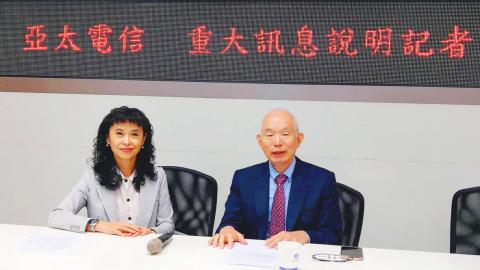
Photo: Wang Yi-hung, Taipei Times
“They will have make their own assessments and decide after the issue price is fixed,” he said.
Hon Hai Precision Industry Co (鴻海精密), which holds 19.63 percent of APT’s stock, is its biggest shareholder, the company’s annual report said.
Taiwan Mobile Co (台灣大哥大) holds 3.45 percent, making it APT’s third-largest shareholder.
All eyes are on Taiwan Mobile, amid speculation that the nation’s No. 2 telecom operator could boost its holdings in APT via the share offer and pave the way for 5G spectrum sharing.
APT has been leasing Taiwan Mobile’s 4G network to make up for a shortage of base stations when it launched its 4G services in 2014, raising regulatory concerns.
The company is currently only allowed to use Taiwan Mobile’s 4G network in remote areas.
The National Communications Commission has said it would allow 5G spectrum sharing — which it restricted for 3G and 4G — because of limited 5G bandwidth.
The commission plans to auction 2,790 megahertz (MHz) of bandwidth for 5G services, including 270MHz in the 3.5 gigahertz (GHz) band, 2,500MHz in the 28GHz band and 20MHz in the 1,800MHz band.
Each bidder will be capped at 100MHz in the 3.5GHz frequency band and at 800MHz in the 28GHz frequency band, according to the regulator.
APT’s board has approved management’s proposal to bid for all three frequency bands.
The board also passed a proposal to reduce APT’s capital by 34.46 percent to improve its financial structure.
The company is required to cut its capital as stipulated by the Company Act (公司法) after posting cumulative losses of NT$22.15 billion as of June 30, more than half of its capital of NT$42.98 billion.
After the reduction, APT would see its book value return to NT$10 per share, from NT$6.55 at the end of June, the company said.
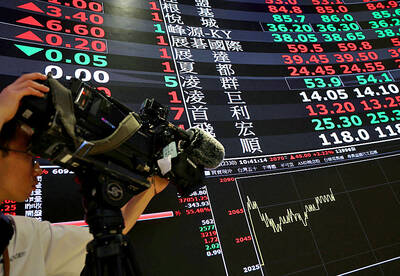
After several years flying high as Asia’s best Nvidia Corp proxy, Taiwan Semiconductor Manufacturing Co (TSMC, 台積電) is increasingly vying with other artificial intelligence (AI) stocks for investor attention. Stock traders are chasing a wider array of beneficiaries as mainstream usage of AI creates demand for hardware beyond the most-advanced chips TSMC makes for Nvidia. Subthemes from the deepening memory crunch to advances in robotics are also luring bids. At the same time, investment caps on single stocks are pushing funds to diversify, while retail investors long familiar with TSMC through its US depositary receipts are being offered a broader set of
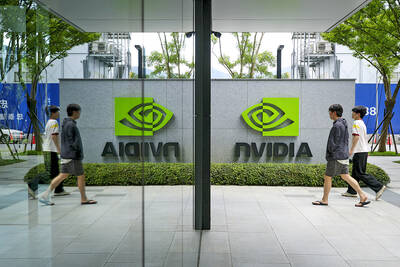
UNDER MICROSCOPE: Taiwan detained three people who allegedly conspired to buy servers in Taiwan and export them using fraudulent documentation, prosecutors said Nvidia Corp chief executive officer Jensen Huang (黃仁勳) on Saturday urged Super Micro Computer Inc to tighten up on compliance after Taiwan detained three people this week for allegedly making fraudulent declarations about artificial intelligence (AI) servers made by its US partner. The development marked the nation’s first crackdown on semiconductor smuggling, which grew after the US slapped restrictions on exports of high-end chips such as Nvidia AI accelerators to China. Nvidia is “rigorous” in explaining regulations to all of its partners, Huang told reporters after arriving in Taipei. “Ultimately Super Micro has to run their own company,” he said in response to
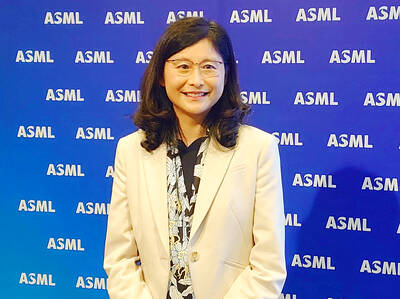
Netherlands-based semiconductor equipment supplier ASML Holding NV yesterday said that it is planning to hire an additional 1,000 people in Taiwan this year in response to growing demand from clients. ASML had previously planned to recruit 600 people this year, but that the plan has been adjusted upward, ASML vice president and ASML Taiwan general manager Grace Wang (汪佳慧) told reporters. ASML has a workforce of more than 4,500 in Taiwan, accounting for about 10 percent of its global total, Wang said. This year’s recruitment campaign would focus on adding people in the customer support, manufacturing and supply chain domains to assist ASML

TECH RELIANCE: Growth is increasingly reflecting an unequal K-shaped distribution, where technology sectors outperform and other industries struggle, an expert said Standard Chartered Bank has significantly raised its forecast for Taiwan’s economic growth to 9.5 percent this year, up from 7.6 percent previously, citing surging artificial intelligence (AI) demand driving exports, semiconductor production and investment. The upgrade reflects a sustained AI supercycle that continues to fuel demand for advanced chips and technology infrastructure, which form the backbone of Taiwan’s exports, the bank said in a report this week. “We raise our 2026 growth forecast to reflect a much stronger-than-expected first-quarter GDP figure,” Standard Chartered senior economist for greater China and Asia Tommy Wu (胡東安) said in the report. Driven largely by a 35.3 percent


 RSS
RSS