


Renaissance Taipei Shihlin Hotel (台北士林萬麗酒店) aims to become the best five-star hotel in the nation with steady growth in revenue and profit, newly installed manager Daniel Meier said yesterday.
Meier made known the plan ahead of the lifestyle hotel brand’s first anniversary next month.
“While increasing the property’s revenue and profit is my No. 1 mission, I believe the best way to achieve the end is to deliver impeccable service so guests will return,” Meier told reporters.
The facility of 104 guest rooms is seeking a top ranking by TripAdvisor, the largest social travel Web site in the world, by the end of this year from its current third spot, Meier said.
Meier, who assumed the helm at Renaissance last month, said he is a firm believer that a 1 percent higher score on heavyweight social travel media can generate a 1.5 percent gain in revenue.
Occupancy rates average 80 percent with daily room rates of NT$6,000 (US$193.29), suggesting room for improvement to achieve full occupancy, director of sales Jake Wang (王鷹傑) said.
That goal is possible due to the property’s modest size, Wang said, adding that the hotel was fully occupied last week.
A focus on service quality makes sense, as the hotel has elegant hardware built by Huang Hsiang (皇翔建設) on a plot of land across from Shilin Residence with a contemporary design, Meier said.
It is also within walking distance of Shilin MRT Station and Shilin Night Market, and a few bus stops from the National Palace Museum and Yangmingshan National Park, he added.
Positioned as a city resort, Renaissance Shihlin attracts both leisure tourists and business travelers who want to explore Taipei after work, he said.
Domestic tourists, and visitors from China and the US constitute the biggest source of customers, Meier said.
Meier, who previously worked for Kempinski Seychelles Resort, the Royal Begonia, Luxury Collection Resort, Sanya, and other famed properties, said he is to give top priority to motivating his coworkers so they would do their best to take care of guests.


ENERGY ISSUES: The TSIA urged the government to increase natural gas and helium reserves to reduce the impact of the Middle East war on semiconductor supply stability Chip testing and packaging service provider ASE Technology Holding Co (日月光投控) yesterday said it planned to invest more than NT$100 billion (US$3.15 billion) in building a new advanced chip testing facility in Kaohsiung to keep up with customer demand driven by the artificial intelligence (AI) boom. That would be included in the company’s capital expenditure budget next year, ASE said. There is also room to raise this year’s capital spending budget from a record-high US$7 billion estimated three months ago, it added. ASE would have six factories under construction this year, another record-breaking number, ASE chief operating officer Tien Wu

The EU and US are nearing an agreement to coordinate on producing and securing critical minerals, part of a push to break reliance on Chinese supplies. The potential deal would create incentives, such as minimum prices, that could advantage non-Chinese suppliers, according to a draft of an “action plan” seen by Bloomberg. The EU and US would also cooperate on standards, investments and joint projects, as well as coordinate on any supply disruptions by countries like China. The two sides are additionally seeking other “like-minded partners” to join a multicountry accord to help create these new critical mineral supply chains, which feed into

For weeks now, the global tech industry has been waiting for a major artificial intelligence (AI) launch from DeepSeek (深度求索), seen as a benchmark for China’s progress in the fast-moving field. More than a year has passed since the start-up put Chinese AI on the map in early last year with a low-cost chatbot that performed at a similar level to US rivals. However, despite reports and rumors about its imminent release, DeepSeek’s next-generation “V4” model is nowhere in sight. Speculation is also swirling over the geopolitical implications of which computer chips were chosen to train and power the new
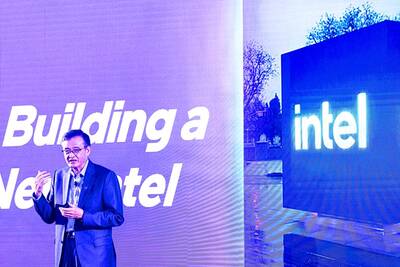
Intel Corp is joining Elon Musk’s long-shot effort to develop semiconductors for Tesla Inc, Space Exploration Technologies Corp and xAI, marking a surprising twist in the chipmaker’s comeback bid. Intel would help the Terafab project “refactor” the technology in a chip factory, the company said on Tuesday in a post on X, Musk’s social media platform. That is a stage in the development process that typically helps make chips more powerful or reliable. The chipmaker’s shares jumped 4.2 percent to US$52.91 in New York trading on Tuesday. The Terafab project is a grand plan by Musk to eventually manufacture his own chips for


 RSS
RSS