


Taiwan Paiho Ltd (台灣百和) yesterday said its new factory in Vietnam would start mass production next month, which is expected to raise its Vietnamese output by 20 percent later this year.
“Production lines at our factory in the Le Minh Xuan 3 Industrial Park recently started pilot runs and are to begin mass production next month to meet growing demand in the region,” a Paiho public relations official, who declined to be named, said by telephone.
“We expect the second half of the year to outpace the first half as the Tokyo Olympics draw near, and orders for shoelaces are likely to grow as our clients release new shoe designs,” she said.
In the first half of the year, net profit attributable to the parent company, which makes shoelaces, touch fasteners and elastics for shoes and clothes, climbed 16.81 percent year-on-year to NT$798.26 million (US$25.72 million), Paiho reported last week.
Earnings per share increased from NT$2.29 a year earlier to NT$2.68, but gross margin decreased 2.13 percentage points to 35.1 percent due to low utilization rates for four-way elastics products, it said.
Revenue rose 34.27 percent to NT$7.91 billion, but would have only increased 12.7 percent if real-estate sales were omitted, it said.
“The increase in sales and profits are due to contribution from our top 10 clients, which climbed 5 percentage points to 63 percent in the first half of the year,” the official said.
The company’s major customers include Adidas AG, Nike Inc, Under Armour Inc, New Balance Athletic Shoe Inc, Reebok International Ltd and Puma AG, analysts said.
Paiho has factories in Taiwan, Vietnam, Indonesia and Dongguan, Wuxi and Jiading in China.
The Indonesian operations turned profitable in January, the company said.
Shoelaces accounted for 54 percent of total sales in the first six months, touch fasteners made up 15.9 percent, elastics contributed 13 percent and molded hooks came in at 9 percent, it said.
The official said new four-way stretchable elastic and woven jacquard fabric products have higher average selling prices and a good margin outlook, although they only accounted for 2 percent of total sales in the first half of the year.
Paiho has been expanding its customer base by reaching out to the aviation and virtual reality sectors, she said.
The company also expects several real-estate development projects and the sale of some parking lots to contribute to sales later this year or in the second quarter of next year, she added.
Paiho shares yesterday closed up 4.11 percent at NT$96.3 in Taipei trading. They have skyrocketed 95.33 percent so far this year.
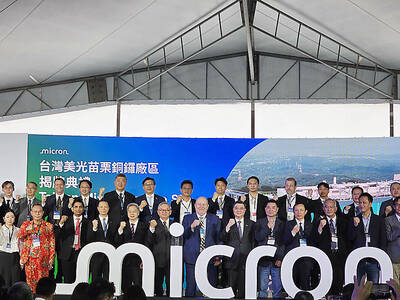
UNPRECEDENTED PACE: Micron Technology has announced plans to expand manufacturing capabilities with the acquisition of a new chip plant in Miaoli Micron Technology Inc unveiled a newly acquired chip plant in Miaoli County yesterday, as the company expands capacity to meet growing demand for advanced DRAM chips, including high-bandwidth memory chips amid the artificial intelligence boom. The plant in Miaoli County’s Tongluo Township (銅鑼), which Micron acquired from Powerchip Semiconductor Manufacturing Corp (力積電) for US$1.8 billion, is expected to make a sizeable capacity contribution to the company from fiscal 2028, the company said in a statement. It would be an extended production site of Micron’s large-scale manufacturing hub in Taichung, the company said. As the global semiconductor industry is racing to reach US$1 trillion

Singapore-based ride-hailing and delivery giant Grab Holdings Ltd has applied for regulatory approval to acquire the Taiwan operations of Germany-based Delivery Hero SE's Foodpanda in a deal valued at about US$600 million. Grab submitted the filing to the Fair Trade Commission on Friday last week, with the transaction subject to regulatory review and approval, the company said in a statement yesterday. Its independent governance structure would help foster a healthy and competitive market in Taiwan if the deal is approved, Grab said. Grab, which is listed on the NASDAQ, said in the filing that US-based Uber Technologies Inc holds about 13 percent of

Taiwan’s food delivery market could undergo a major shift if Singapore-based Grab Holdings Ltd completes its planned acquisition of Delivery Hero SE’s Foodpanda business in Taiwan, industry experts said. Grab on Monday last week announced it would acquire Foodpanda’s Taiwan operations for US$600 million. The deal is expected to be finalized in the second half of this year, with Grab aiming to complete user migration to its platform by the first half of next year. A duopoly between Uber Eats and Foodpanda dominates Taiwan’s delivery market, a structure that has remained intact since the Fair Trade Commission (FTC) blocked Uber Technologies Inc’s

Memory chip stocks extended their losses yesterday after Alphabet Inc’s Google publicized research that could allow more efficient use of the storage needed for artificial intelligence (AI) development. SK Hynix Inc and Samsung Electronics Co, South Korean leaders in the market, fell more than 6 percent and about 5 percent respectively in Seoul. In the US, Micron Technology Inc, Western Digital Corp and Sandisk Corp slid more than 2 percent in pre-market trading, after they all closed lower on Wednesday. Memory companies have been on a tear in recent months as the rapid development of AI infrastructure triggered a spike in chip


 RSS
RSS