


The nation’s exports last month rose 0.5 percent to US$28.39 billion, a record for June, as demand for electronics gained momentum ahead of the launches of next-generation devices, the Ministry of Finance said yesterday.
The surprising pickup reversed seven consecutive months of decline, but the ministry hesitated to speculate on a recovery, saying that uncertainty lingers and most firms remain conservative in their outlook.
“It is premature to say, due to poor visibility, whether the pickup is an isolated occurrence or the sign of a stable uptrend,” Department of Statistics Director-General Beatrice Tsai (蔡美娜) said in a report.
Outbound shipments could go either way this month, as well as beyond that, depending on how the global economy unfolds, Tsai said.
Export data showed that outbound shipments of semiconductors rose 8 percent to US$8.05 billion, outperforming the 3.3 percent increase for electronics shipments.
Inventory demand from international technology brands likely underpinned the showing, Tsai said, alluding to Apple Inc.
Chip supplier Taiwan Semiconductor Manufacturing Co (台積電) is to offer guidance during its quarterly investors’ conference next week.
Exports of information and communications products increased 20.2 percent from a year earlier, as makers of computer components moved facilities home from China, Tsai said.
The relocations enabled shipments to the US to increase 18.5 percent, but shipments to all other destinations — China, Europe, Japan and ASEAN markets — fell, the report said.
China made up 38.7 percent of exports, its second-lowest total ever, while the US made up 13.9 percent, its highest in 13 years, Tsai said.
Exports of chemical and plastic products continued to shrink at a double-digit percentage pace, as languid demand weighed on raw material prices, she said.
Last month’s imports recovered faster with a 6.6 percent increase to US$24.51 billion, thanks to the aggressive purchasing of capital equipment by local firms, leaving a trade surplus of US$3.87 billion for the month, a 26.1 percent retreat from a year earlier, it said.
Imports of semiconductor capital equipment nearly doubled as firms sought to stay out in front of the global market, Tsai said, adding that facility relocations and foreign investment in Taiwan also lent support.
Second-quarter exports fell 2.6 percent to US$81.91 billion, while imports rose 0.9 percent to US$70.89 billion, both beating a May forecast by the Directorate-General of Budget, Accounting and Statistics, Tsai said.
“Again, I cannot say that trade tensions have turned out less severe, as things have not yet settled,” she said.
In the first half of this year, exports contracted 3.4 percent, while imports squeezed out a 0.1 percent increase, the report said.
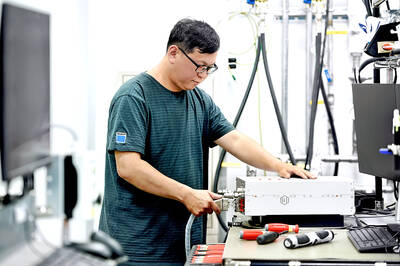
SEMICONDUCTORS: The German laser and plasma generator company will expand its local services as its specialized offerings support Taiwan’s semiconductor industries Trumpf SE + Co KG, a global leader in supplying laser technology and plasma generators used in chip production, is expanding its investments in Taiwan in an effort to deeply integrate into the global semiconductor supply chain in the pursuit of growth. The company, headquartered in Ditzingen, Germany, has invested significantly in a newly inaugurated regional technical center for plasma generators in Taoyuan, its latest expansion in Taiwan after being engaged in various industries for more than 25 years. The center, the first of its kind Trumpf built outside Germany, aims to serve customers from Taiwan, Japan, Southeast Asia and South Korea,

Gasoline and diesel prices at domestic fuel stations are to fall NT$0.2 per liter this week, down for a second consecutive week, CPC Corp, Taiwan (台灣中油) and Formosa Petrochemical Corp (台塑石化) announced yesterday. Effective today, gasoline prices at CPC and Formosa stations are to drop to NT$26.4, NT$27.9 and NT$29.9 per liter for 92, 95 and 98-octane unleaded gasoline respectively, the companies said in separate statements. The price of premium diesel is to fall to NT$24.8 per liter at CPC stations and NT$24.6 at Formosa pumps, they said. The price adjustments came even as international crude oil prices rose last week, as traders
Taiwan Semiconductor Manufacturing Co (TSMC, 台積電), which supplies advanced chips to Nvidia Corp and Apple Inc, yesterday reported NT$1.046 trillion (US$33.1 billion) in revenue for last quarter, driven by constantly strong demand for artificial intelligence (AI) chips, falling in the upper end of its forecast. Based on TSMC’s financial guidance, revenue would expand about 22 percent sequentially to the range from US$32.2 billion to US$33.4 billion during the final quarter of 2024, it told investors in October last year. Last year in total, revenue jumped 31.61 percent to NT$3.81 trillion, compared with NT$2.89 trillion generated in the year before, according to
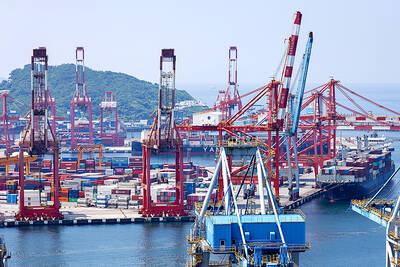
PRECEDENTED TIMES: In news that surely does not shock, AI and tech exports drove a banner for exports last year as Taiwan’s economic growth experienced a flood tide Taiwan’s exports delivered a blockbuster finish to last year with last month’s shipments rising at the second-highest pace on record as demand for artificial intelligence (AI) hardware and advanced computing remained strong, the Ministry of Finance said yesterday. Exports surged 43.4 percent from a year earlier to US$62.48 billion last month, extending growth to 26 consecutive months. Imports climbed 14.9 percent to US$43.04 billion, the second-highest monthly level historically, resulting in a trade surplus of US$19.43 billion — more than double that of the year before. Department of Statistics Director-General Beatrice Tsai (蔡美娜) described the performance as “surprisingly outstanding,” forecasting export growth


 RSS
RSS